
You are currently browsing the tag archive for the ‘PLA’ tag.
Event:
A Chinese jet carried out a highly aggressive maneuver near a U.S. military plane over international waters in the South China Sea yesterday (Reuters report; CNN report; Al-Jazeera report)
Insight:
Following Xi Jinping’s era-defining dictum to “Dare to Fight” (敢于斗争) on March 9th of this year, the Peoples Liberation Army has been recently putting those words into practice, as seen with yesterday’s highly-aggressive fly-by. Also yesterday, China’s Defense Minister Li Shangfu bluntly and publicly rejected U.S. Defense Secretary Lloyd Austin’s proposal to meet while both attend the Shangri La Dialogue meeting in Singapore this weekend to discuss improving military-to-military lines of communication for the purpose of keeping miscalculations from spiraling into crises. The takeaway: Xi Jinping is choosing to jettison the hard lessons learned from the 2001 Hainan Island incident in order to strike a Dare to Fight posture for both domestic and international audiences in 2023.
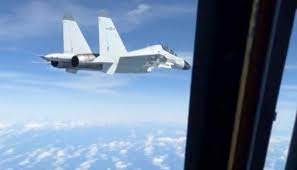
.
Context:
The Hainan Island incident, which occurred on April 1, 2001, was a potential military flashpoint event involving a collision between a United States Navy EP-3E ARIES II signals intelligence aircraft and a Chinese J-8II interceptor jet.
During the incident, the EP-3E ARIES II aircraft was conducting a routine surveillance mission in international airspace near Hainan Island when it collided with the Chinese interceptor jet. The Chinese J-8II jet pilot, Wang Wei, tragically lost his life, while the EP-3E plane made an emergency landing on Hainan Island. The 24 crew members were detained and interrogated by Chinese authorities over an 11 day period until the crisis was defused by diplomats with an artfully worded statement crafted to allow both sides to save face.
Following the incident, both the United States and China conducted investigations and diplomatic negotiations to address the aftermath. Some of the general lessons learned from the Hainan Island incident include:
• Importance of Communication and Crisis Management: The incident highlighted the necessity for effective communication and crisis management between military forces of different nations. Improved communication channels and crisis response mechanisms can help prevent misunderstandings, manage tensions, and avoid accidents.
• Need for Clear Rules of Engagement: Clarity in rules of engagement is crucial to avoid misunderstandings and prevent accidental collisions. Developing and maintaining clear guidelines for military aircraft operations in close proximity can help reduce the risk of accidents and promote safety.
• Enhanced Airspace Management and International Cooperation: The incident underscored the importance of effective airspace management and international cooperation to ensure the safe and peaceful use of airspace. Better coordination mechanisms, sharing of flight information, and adherence to established international norms and protocols can help prevent incidents in shared airspace.
• Diplomatic Engagement and Conflict Resolution: The Hainan Island incident emphasized the importance of diplomatic engagement and conflict resolution to de-escalate tensions and find mutually agreeable solutions. Diplomatic efforts can help facilitate the resolution of disputes and prevent further escalation of conflicts.
• Airborne Collision Avoidance Systems (ACAS): The incident also highlighted the need for improved collision avoidance systems and technologies to enhance situational awareness and prevent mid-air collisions. The development and implementation of advanced ACAS can help aircraft detect and avoid potential collisions, thereby increasing overall flight safety.
Technical analysis of the collision by U.S. experts concluded that the collision was caused by unintended contact between the two aircraft as a direct result of Chinese pilot Wang Wei’s overly aggressive fly-by. While Chinese authorities claimed that the U.S. EP3E aircraft had dipped its wing to initiate the contact, computer modeling showed conclusively that the relatively slow-moving EP3E could not have maneuvered in such a way as to affect the fast-moving Chinese interceptor jet.
Perspective:
I was stationed as the chief of the U.S. Commercial Section in the American Institute in Taiwan (the de facto “U.S. Embassy”) at the time of this incident. My A.I.T. colleagues were directly involved in the reporting and post-incident analysis of this tense encounter.



 ______Assessing China / The TEA Collaborative______