
You are currently browsing the tag archive for the ‘trends’ tag.
Less than twenty-four hours ago, Xi Jinping was officially confirmed for his third term as President of the People’s Republic of China at the Two Sessions meetings in Beijing. This ribbon-tying exercise completes a package of norm-shattering consolidation of power put in place last fall at the 22nd National People’s Congress. At each iteration, the NPC shuffles and updates the power structure within the China Communist Party and, a half-year later, the Two Sessions then translates those positions of power into the State Council and other organs of national administration. The CCP controls the “goods” of authority and power, the State Council just “delivers” them.
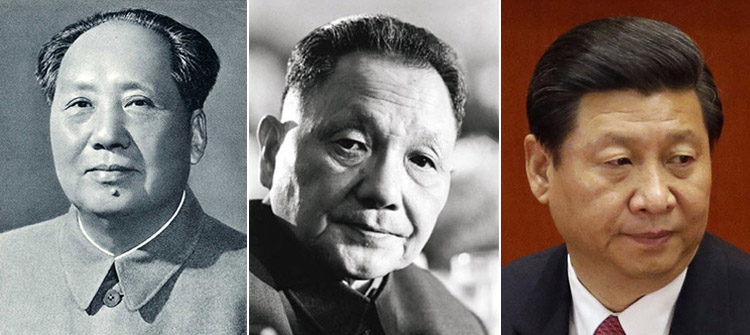
In the week leading up to Xi’s securing a historic third term as President at this year’s Two Sessions, there was a war of words between China and the U.S. about the future of the U.S.-China relationship and, by extension, the world. Over the next week, I will peel back a couple of layers of that particular onion including my thoughts on the role being played by Qin Gang, Xi’s newly-appointed Foreign Minister fresh from his most recent assignment as Ambassador to the United States.
As for today, the focus is on highly-encoded pronouncements…
Politically, the Chinese Communist Party has a well-established practice of formulating, and telegraphing, its most-determined policy directions in Five Year Plans and in periodic, quite abstruse revisions to the pantheon of CCP ideology (such as the replacement of Deng Xiaoping’s “great international circulation” theory by Xi’s “dual circulation” theory in 2020). Although highly-revealing of PRC political intentions, this is head-spinning stuff and requires both facility with the Chinese language and a questing spirit to enter the labyrinth of PRC ideological discourse.
There is a simpler, pithier way to read the tea-leaves, however. Culturally, the Chinese language has a genius for encoding highly complex thinking in short bursts of characters, as illustrated most commonly by the pervasive use of 成语 four-character expressions. This predisposition to distill complexity into concise character sets shows itself in occasional 24-character sets of instruction delivered by China’s top leaders. Very occasional, highly formulaic, deeply revealing.
Until this year’s Two Sessions, the last of these had been delivered by Deng Xiaoping in 1990, following the convulsion of Tiananmen and in the lead-up to his recommitment to capitalism with Chinese characteristics during his Southern Tour. That 24 character edit read:
冷静观察 Observe calmly
稳住阵脚 secure our position
沉着应付 cope with affairs calmly
韬 光养晦 hide our capacities and bide our time
善于守拙 be good at maintaining a low profile
决不当头 never claim leadership
During the past week’s Two Sessions, Xi Jinping provided his oracular update to Deng Xiaoping’s pronouncement (and, in so doing, continued his program of positioning himself center-stage with Mao and relegating Deng to the wings). Xi’s version reads:
沉着冷静 Be calm
保持定力 keep determined
稳中求进 seek progress & stability
积极作为 be proactive & achieve things
团结一致 unite (under the banner of the party)
敢于斗争 dare to fight
As with Chinese four character expressions, a few words can speak volumes. Xi’s words — and his insertions of change within a decades-old formula of continuity — speak for themselves.

P.S. I am indebted to Moritz Rudolf for his translation of these two 24-character auguries. His translation is better than mine would have been.
The SARS-COV-19 outbreak was first detected almost exactly three years ago in Wuhan. In large part because of PRC Government obfuscation and delay, the world was caught off-balance in ensuing months. We all know the toll in human lives and suffering that has followed.
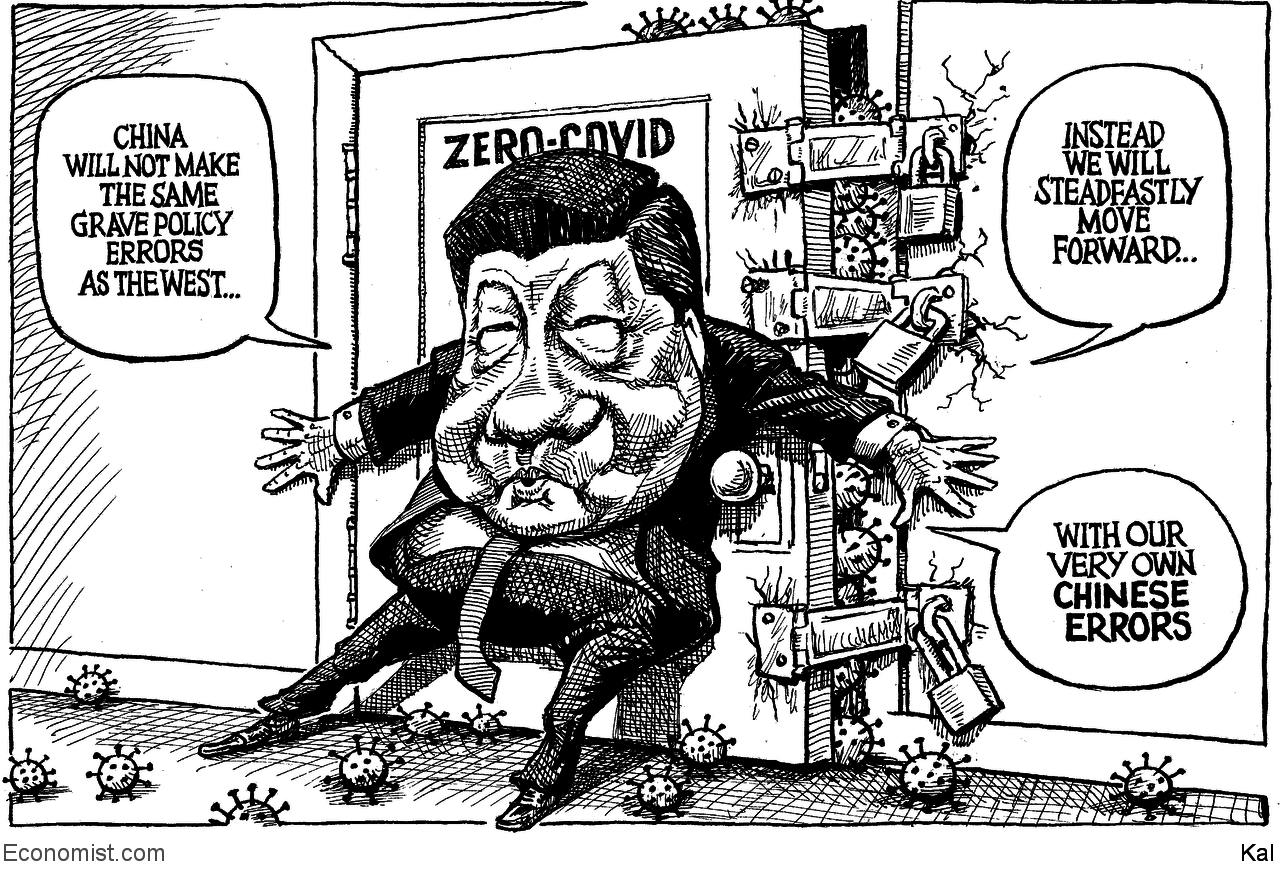
For democratic-leaning, economically-advanced societies, the road back to a semblance of “normalcy” has been long and difficult but citizens in these countries are now embracing their return to “the new normal.” For less developed countries in the Global South, the journey has been even more arduous and painful due to constrained resources (though, interestingly, the genetic stock of African nations seems to have insulated many of their populations from the worst of Covid-19’s virulence). It is only in China — and perhaps also in North Korea but who knows what has been happening there — that the experience has been dramatically different. Xi Jinping’s “steadfast” policy of Zero Covid — and, subsequently, Dynamic Zero Covid — has resulted in coercive lockdowns of as much as 20% of the country’s population at a given time and in an ineffective vaccination program weakened by hostility to foreign-made mRNA vaccines and propaganda-induced vaccine-hesitancy among its elderly. Today, only 40% of the most vulnerable segment of Chinese seniors — those over 80 — have received two doses and a booster of the Chinese-made vaccine, a combination which has been shown to be no more effective than two doses (without booster) of the Moderna, Pfizer and comparable Western-developed vaccines.
The crippling effects of Xi’s Zero Covid and Dynamic Zero Covid policies on China’s economic performance, coupled with the unprecedented nation-wide protests against the lockdowns flaring up in late November prompted the PRC Government to suddenly drop the policies — and, in fact, any mention of these policies — in early December. As well documented in front-page reporting in today’s New York Times (After Scuttling ‘Zero Covid,’ Xi Offers No Plan), this about-face is potentially catastrophic in its suddeness: the PRC government has not readied any robust vaccination or even public education program to fill the vacuum left in the wake of Zero Covid, reliable data about infections is no longer available since government-mandated mass-testing has been dropped and people are being told to self-test at home, and Xi Jinping is nowhere to be seen, having snuck out the back door of the monument to his infallibility and PRC governmental superiority he built around his Zero Covid policy.

Xi’s Zero Covid policy has clearly boomeranged on him — and, more tragically, on the Chinese people:
- Projections of more than a million infections in coming weeks
- ICUs and hospitals already overwhelmed
- Morgues and crematoria backlogged and corpses stacked in plain view (despite PRC Govt acknowledging zero deaths)
But does the boomerang effect end there? Despite today’s excellent reporting by the Times and recent reporting by other news outlets, the scope of what is happening in China is only dimly understood outside of China. In large part, this is due to the fact that the scope is not well understood in China — except anecdotally and in felt individual experience — due to the heavy curtain of state-media censorship. The scope may be vast …
There are many reasons we should be attending closely to these developments. Humanity and empathy are high among those reasons. But perhaps the most important reason is that this could all come back and boomerang on us again, too. Unchecked spread among a vast, poorly-protected population can easily give rise to a new strain in China that could once again spread throughout the world.
What goes around, comes around. Wuhan Redux? If so, the finger of blame is to be pointed directly at Xi Jinping.
Experts predicting COVID cases in China to explode after the country ends strict zero-COVID policy (USA Today, 6 hours ago)
Scientists predict COVID surge in China this winter, with hundreds of millions of people infected (NPR, 1 day ago)
Strain on China’s hospitals may now be resulting in doctors and nurses infecting patients (BBC, 2 days ago)
There are a lot of things people don’t realize about Taiwan. I’ll mention three. First, it is the United States’ 11th largest trading partner worldwide, despite the island’s small population of just under 24 million. Second (and surprisingly given that China maintains iron-fisted control over its strategic industries), Taiwan “owned’ (both figuratively and in the sense of being the equity owner) most of the factories producing semiconductors, advanced information technologies and even some of the key communications equipment in China throughout the 1990s and, diminishingly but still decidedly, into the new millenium. (These Information and Communications Technologies make up the so-called ICT industry. Just think of Apple, Microsoft, Hewlett-Packard, AT&T and Verizon and all of their various competitors as comprising one vast and strategically vital sector). Third and still somewhat under-appreciated in the U.S. is the story of the growth of Taiwan’s vibrant democracy, which started taking root with reforms under Generalissimo Chiang Kai-shek’s son, Chiang Ching-kuo, in the mid-1980s and flowered under President Lee Teng-hui who was in power from 1988-2000 (and who passed away last month, on July 30th). The significance of this last point is that Taiwan’s experience has repudiated, with underlining, bolding and an exclamation mark, the self-serving claim voiced by generations of authoritarian-leaning leaders in Greater China and Asia – namely, that the Chinese (ethnic Han) people, heirs to a long tradition of imperial rule, are simply not suited to Western-style democracy.
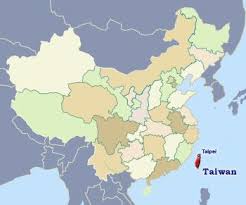
Today’s post is a scene-setter for the “Global TECHtonics: U.S./China Faultline” series of technology-related posts which will be forthcoming on a weekly basis, usually on Mondays, starting next week. This scene-setter will draw mostly on my personal experience. It will also tug mostly on the economic and technological threads mentioned above and will only touch lightly on the political one. (In two weeks’ time, we’ll pick up the political thread more directly and weave it more visibly as the background to an examination of the current, very acute semiconductor supply chain tensions involving Taiwan, China and the United States in the run-up to the U.S. elections as well as what China’s recent imposition of a new security law in Hong Kong portends for Taiwan.)
Personally, I’ve had the good fortune to live in Taiwan for three separate periods in my life: for six months in early 1977 (trying to consolidate, in an entirely ad hoc and ultimately ineffective way, the Mandarin language I had studied for three years in college), for a full year in 1979-80 (finally succeeding at consolidating my Mandarin through the rigorous Stanford Inter-University Program for Chinese Language Studies at Taiwan National University in Taipei, the springboard I did succeed in identifying in 1977 as a way of achieving, on a deferred basis, my goal of nailing down the language ) and finally for three years 1999-2002 when I served as head of the Commercial Section of the American Institute in Taiwan (AIT operates as the de facto U.S. Embassy in Taiwan. Along with the AIT Washington Headquarters – the de facto counterpart to the U.S. Department of State for all things Taiwan – AIT was created in 1979 as part of the Taiwan Relations Act, whereby the U.S Congress spelled out the terms of continued U.S. involvement with Taiwan (the Republic of China) following President Carter’s decision earlier that year to de-recognize the Republic of China as “China” and to our recognize the Peoples Republic of China as “China” instead.
It was my three years of experience as the Senior Commercial Officer at A.I.T. which gave me a front-row seat – and sometimes got me inside the ring – of the complicated, three-way tag-team match involving the U.S., Taiwan and China in the global ICT arena. I’m going to give a few glimpses of what that entailed. Not that any of this reveals anything particular about me (except for revealing my questionable golfing skills). The experiences were all simply part and parcel of the position I was lucky enough to fill. My point in sharing these experiences is to set-up to the main point which this post is aiming for – a glimpse into how timing matters, particularly in Washington.
So, what did that three years at AIT make possible for me? For starters, I was able to forge close relationships with the trail-blazers of Taiwan’s global IT preeminence – Morris Chang, the founder and then Chairman of Taiwan Semiconductor Manufacturing Corporation (TSMC); Stan Shih, the founder and then Chairman of Acer Computer and later of the Acer Group (Stan and I were equally erratic on the golf course which made for a strong bonding experience); and, to a lesser extent with the more aloof Terry Gou, founder and Chairman of Hon Hai Precision Industries (better known by its tradename Foxconn, the electronics contract manufacturer which assembles iPhones throughout China). This level of diplomatic access is somewhat rarefied even for Ambassadors around the world but in Taiwan – like in Berlin, the post I served in prior to Taiwan – the U.S. was viewed as the guarantor of the country’s existence (for Taiwan as a current and on-going reality and for Berlin as a Cold War period reality) and important doors, even in the Presidential Office Building, were open for me.

Along the way, I was called on by American companies to help prepare for Y2K and then to clear up the debris of their local operations following the ‘Tech Wreck,’ the fallout of the sudden collapse of the dot.com bubble following its a valuation peak in March 2000. Months later, I was involved in the delicate minuet whereby China was welcomed into the World Trade Organization in December 2001, followed by Taiwan’s accession minutes later.
Along the way, I was honored to be the local host in Taiwan when then-Taipei Mayor (and later President of Taiwan) Ma Ying-jeou invited Bill Gates, Carly Fiorina and Michael Dell, along with scores of other U.S. IT industry leaders, to the World Congress on Information Technology (WCIT) in June 2000. And, again in 2006, I was asked to be the “WCIT Ambassador” responsible for organizing and bringing to Austin, TX for WCIT XV the official delegation from Taiwan, the second largest international delegation among the more than 2,000 official delegates at that event.
So, as China’s economy continued to grow by double-digits over these years and as China began to close the technology gap between Taiwan-owned ICT manufacturers operating in China and its own home-boosted technology companies, the stakes started rising for the developed economies and particularly for the U.S. The crux of the high-stakes gambit involved the global supply-chains linking U.S. brands and Taiwan OEMs (Original Equipment Manufacturers) producing the hardware for top U.S. brand-name companies, such as Foxconn’s manufacturing of Apple iPhones, previously mentioned here, or TSMC’s backstopping of production and supply of Intel’s chips. The questions in the early 2000s were many: did relocation of so many Taiwan-owned production facilities to the mainland, where labor costs were cheaper, pose risk to the integrity and sustainability of these vital supply chains? Would the increasing economic integration taking place between Taiwan and China tend to stabilize the political situation in East Asia or would it add a new dimension of instability? In the simplest formulation, could – and would — economics trump politics? Could global supply chains function as the cords to tie together the Asian region – historically fragmented and politically divided – into a more integrated polity more closely resembling stable Europe or could they get ripped out on the whim of a political leader?
With these questions in the headlines – at least in the business sections – of major newspapers and business periodicals, I was invited on three occasions to give expert testimony about these global ICT supply chain issues to a Congressional Commission, then called the China Economic Security Review Commission, during the 107th ,108th, and 109th Sessions of the U.S. Congress.

On a parallel track over this same period, I was able to get peer-reviewed articles giving my answers to these questions in several academic journals and books. In 2006, my article The Politics of Greater China’s Integration into the Global Info Tech Supply Chain was published in The Journal of Contemporary China (Vol. 13, No. 40) and in 2007 my paper Taiwan’s FTA Prospects from the Global IT Supply Chain Perspective was published in the book Economic Integration, Democratization and National Security in East Asia, edited by Peter C.Y. Chow (Edward Elgar Publishing).
If you’re reading this sentence, it means you’ve stayed patiently with me through a lengthy set-up for an ending tag-line which holds irony and hopefully some insight into how things work (sic) in Washington and what pot is close to boiling over at the moment on the world’s front burner. I’ll be able to wrap this up now. Just keep in mind the title of that last article – “Taiwan’s FTA Prospects …” which refers to the Taiwan’s prospects for finalizing a Free Trade Agreement (FTA) with the U.S. (The knot identified in that article was that a U.S.-Taiwan FTA would shore up for U.S. firms the strength and resilience of supply chains to the most advanced ICT products from Taiwan’s top tech firms but come at the risk of provoking a rageful reaction from China for throwing shade on its “One China” shibboleth.)
So what’s the finale to this set piece? In 2005, Ambassador Jim Lilley took it upon himself to introduce me to the American Enterprise Institute for a possible appointment as a fellow or scholar there. AEI trends a little to the right of my own political perspective but Jim Lilley was already established there as a Senior Fellow and, having gone through Tiananmen with him at the helm of the U.S. Mission, I had utmost respect for him and was flattered by his effort to get me on board. Also, my boarding school classmate, Nick Eberstadt, was well-established there as a demographic diviner of the harsh realities underlying North Korea’s inscrutable surface as was Arthur Waldron, another China expert I knew well from UPenn. Jim arranged for me to have a series of conversations with various experts during the course of the day and, in each conversation, we grappled with the various questions outlined above. At the end of the day, I was invited into the President’s office and was informed by senior management that, although they found the day-long discussion intellectually invigorating, they didn’t see my expertise as particularly relevant to government policy or to AEI’s mission. The essence of the message was that the free market would take care of all these questions and that government policymakers didn’t need to, and actually shouldn’t try, to think about them too much.
So that was 2005. Now in 2020, the jury is in and those questions are not only recognized as highly relevant to policy makers, they are at the incandescent center of U.S.-China relations. The global supply chain question is now at the beating heart of the Trump Administration’s moves to “decouple” the U.S. and Chinese technology universes. Just Tuesday, Apple was on the line with the White House along with a dozen other top U.S multinational companies, explaining the massive hit they project their iPhone sales in China will take if the President’s banning of WeChat takes effect.
Another example: Throughout the year, Taiwan Semiconductor Manufacturing Corporation (TSMC) has found itself ever-closer to a “impossible choice,” one forcing it to abandon its long-established strategy of serving both the U.S. (including Intel) and PRC (including Huawei) markets and instead to choose one at the expense of the other. Some military strategists fret that Xi Jinping, after having brought Hong Kong to heel with imposition of a new security law, will be tempted to take advantage of the pandemic and make its next move in the near-term on Taiwan. The rationale? Fulfillment of a “Chinese Dream” ambition for reunifying an imagined China from the past, of course, but for much more practical aims as well. Ninety-miles across the Strait of Taiwan, in the Hsinchu Science-based Technology Park (and other locations nearby) lies perhaps the world’s greatest single concentration of advanced microelectronic engineering talent and production facilities. This prowess has eluded China’s attempts, over decades, to home-grow. A quick power grab by China — while the world is distracted with COVID and the U.S. is internally riven by partisanship – may be highly unlikely but it is not at all inconceivable. We need to be anticipating, and guarding against, worst-case scenarios if we hope to effectively forestall them.
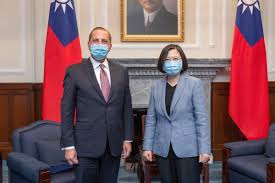
For me, the most satisfying single example of how my set of questions and provisional answers from fifteen years ago is finally getting serious traction in DC happened on Wednesday. Earlier in the week, President Tsai Ing-wen had hosted Health & Human Services Secretary Alex Azar on an official, multi-day visit to Taiwan for discussions about Taiwan’s exemplary response to the COVID-19 pandemic and the need for Taiwan to be allowed full participation, over Beijing’s objections, in the World Health Organization. The visit by Azar was the highest-level visit to Taiwan by a U.S. official, and the only Cabinet-level visit, since Taiwan’s de-recognition in 1979. Immediately after the “wheels-up” departure of Secretary Azar, President Tsai held a news conference in which she set out a single priority for U.S.-Taiwan relations in the upcoming year: to begin negotiations with the U.S. Government for a U.S.-Taiwan Free Trade Agreement (FTA) to strengthen trade flows and to safeguard supply chains.
Sweet.


 ______Assessing China / The TEA Collaborative______