
You are currently browsing the category archive for the ‘Policy’ category.
Over 10 years, Xi Jinping has methodically amassed power. Beginning with an unprecedented consolidation of military support, Xi then launched his ‘Tigers and Flies’ campaign, sidelining his political rivals along with officials accused of corruption. Over many years he patiently laid the groundwork to elevate Xi Jinping Thought to match the official stature of Mao Zedong Thought, and edge out Deng Xiaoping Thought, in the CCP’s ideological pantheon. He then overturned international commitments regarding Hong Kong, and brought that free-wheeling and Westernized city to heel with the introduction of a new security law. At the last 19th Party Congress in 2017, Xi tossed aside Deng’s “hide-and-abide” (韜光養晦、有所作為) approach to international relations and gave a triumphalist speech, announcing that China had not only arrived on the world stage but that it deserved central position on that stage. With the outbreak of the Covid-19 epidemic, Xi used sharp-elbow tactics to block scientific investigation into its origins in China and ordered sweeping zero-Covid lockdowns to highlight his government’s ability to take more effective action than was possible for democratic governments in the US and the West. The Winter Olympics were meant to be Xi’s star-turn to demonstrate — more to the Chinese people than to international audiences (many of whom undertook diplomatic boycotts of the Games because of oppression of Uyghurs in Xinjiang and other issues) — that he was a flawless and unrivalled champion. He even went so far as to claim that the authoritarian system he presided over represented a superior form of democracy to Western liberal democracy.

Along this path to unrivalled power in China, Xi first jettisoned the system of collective rule by the Standing Committee of the Politburo which Deng had put in place to guard against recurrence of unbridled rule by any one individual, epitomized by the last years of Mao’s rule. Longer term, Xi’s aim in amassing power has been to discard the limit of a president to two five-year terms, another safeguard Deng put in place and which he himself observed.
The announcement of leadership for the next five-year term will happen at the CCP’s 20th Party Congress in Beijing this autumn. At that meeting, Xi is widely expected to be named for a precedent-shattering third term. This will mark a historic high-point for Xi. His systematic consolidation of power has been designed, in part, to create an air of inevitability about this outcome. While his selection is still overwhelmingly likely, a number of significant fissures have appeared in recent weeks which crack this façade of total control.
ZERO-COVID
While undoubtedly successful in limiting the number of infections, hospitalizations, and deaths in the first two years of the pandemic, Xi’s Zero-Covid policy has created a raft of problems for China more recently, most notably during the highly-transmissible omicron phase. While incidences of infection, hospitalization and death have been dropping worldwide, they have been surging in China, with the number of confirmed cases more than quadrupling from mid-February to mid-March of this year. Elderly citizens are especially at risk due to their low rates of vaccination and hospitals have already become overwhelmed, due in part to the low number of hospital beds on a per capita basis in China. While it can be argued that the Zero-Covid policy ‘bought time’ for the development of vaccines, Xi’s championing of the locally developed Sinovac vaccine and his refusal to permit the use of more clinically-effective vaccines developed in the West, has blunted that advantage somewhat since the Sinovac vaccine is notably less effective against the omicron variant. The Zero-Covid policy has also meant that there is practically zero immunity in the Chinese population as a result of exposure to the virus as it becomes endemic worldwide. If SARS-COV-2 can be compared to a flame, China’s population is like a vast field of tinder. Finally, the economic and social costs have become glaringly apparent with the lockdown of an entire province, Jilin, in the northeast and the of Shenzhen and Dongguan – China’s two largest manufacturing hubs for information and communications technology (ICT) — in the south.
While Xi will, with considerable justification, continue to claim credit for his “triumph” over the coronavirus, China is by no means out of the pandemic woods and the setbacks of the last month make his strident claims ring more hollow, both internationally and domestically.
REAL ESTATE
In September last year, Chinese real-estate development firms began to feel the severe discomfort of a massive hang-over following years of real-estate speculation partying. The problems were most evident in real-estate giant Evergrande but soon spread to a host of other significant players in the field such as Fantasia, Modern Land, China Property Group and Xinyuan Real Estate Group. At the institutional level, the problems hitting the $5 trillion sector were the result of a unique PRC nexus of aggressive real estate development, lax banking, and local government incentive structures. More simply, the problems resulted from “unrestrained borrowing, expansion as an end-in-itself, and corruption.”
While the PRC Government claimed this week that the real-estate free-fall has been “stabilized,” pricing data from real estate developers across the country continue to show sharp deterioration. Also this week, Evergrande announced a further delay in sharing its plan for restructuring and for paying back bonds and other financial obligations. The government has strong reason to put on a brave face while throwing up a curtain of opacity around the problem. Property-related industries account for more than 30% of China’s economic output. Continued problems in the sector could drag China’s growth below the optimistic, post-pandemic official target of 5% growth, a minimum level which must be maintained in the years ahead for China to escape the ‘middle income trap.’ More immediately, it risks alienating an important swath of the urban public, 80% of whose household wealth is tied up in real estate and who see their property values plummeting. (A particularly aggrieved segment of this population are buyers who have paid up front to the developers, as is common in China, for a property not yet built and for which construction has halted indefinitely while values continue to slide).
While Xi has voiced loud promises to not let the bottom fall out of this sector and to support homeowners currently caught in the fallout, there is little evidence on the ground of these promises translating into reality. Meanwhile, the situation risks alienating the public and sowing dissent among officials.
‘COMMON PROSPERITY’
As measured by the Gini coefficient, China ranked fourth in the world in 2022 for greatest wealth disparity and inequality (after South Africa, Namibia and Sri Lanka). While Deng Xiaoping had announced famously in the late 1980s that “to get rich is glorious” and to “let some get rich first,” the extreme degree of inequality persisting in China four decades later is a source of growing social and political concern. The heady days of 10% growth have long ago disappeared and Chinese who thought they would be boarding on a later rail-car in the national train of prosperity now worry that the train may have departed, stranding them on the platform.
To counter this source of social unease, Xi unveiled with great fanfare in 2021 a policy of ‘Common Prosperity.” Writ large, this policy was meant to cement Xi’s place — side-by-side with Mao and with Deng slightly in the background – in China’s pantheon of modern heroes. In this telling, Mao was the one who roused China to throw off its ‘Sick Man of Asia’ bondage to foreign imperialists and to stand up. Deng contrived a transitional stage of capitalist-style wealth-creation for enough Chinese that China could attain wealth and power (富权). It was left to Xi to complete this project of national rejuvenation, by reinstituting a Marxist “Common Prosperity’ for all Chinese and returning China to the center of the world stage.
Without getting into either the ideological weeds (such as Xi’s ‘Dual Circulation’ strategy) or deep into the tangle of economic measures (e.g., restrictions on overseas listings by Chinese companies, user-data and other controls put on Chinese Big Tech firms, clampdown on student test-prep and video game commercial sectors, etc) which Xi embraced in 2021 to advance his Common Prosperity agenda, the general effect was felt quickly and keenly in the form of abrupt economic slowdown. In the first quarter of this year, the Common Prosperity program has been ‘walked back’ by numerous party officials who have emphasized that it represents a historic project more than an immediate project. Premier Li Keqiang, in his lengthy speech to 3,000 deputies at the opening of the National People’s Congress earlier in the month, mentioned Common Prosperity only one time. For educated Chinese — who have been skillfully parsing official pronouncements closely ever since the Cultural Revolution for clues about where the country is headed — this lack of visibility and endorsement for Xi Jinping’s signature program represents a remarkable degree of push-back for Xi by top-level leaders.
UKRAINE
Chris Buckley’s report in last Friday’s New York Times traces the contours of what is potentially the most damaging crack to appear in Xi’s carefully-crafted, monolithic façade of power and control. The article details the war of words that has erupted on the Chinese internet following the warning delivered by a respected scholar and politically-connected insider, Hu Wei, to the effect that China “risked becoming a pariah if it didn’t denounce Russia’s invasion of Ukraine.” As was covered in last week’s post and as continues to play out this week, Chinese officials have contorted themselves by claiming to be neutral and wanting peace while following Putin’s lead in not calling the ‘special military operation’ either a war or an invasion, in not objecting to Russia’s violation of Ukraine’s sovereignty and territorial integrity, and in amplifying Kremlin disinformation about U.S. bio-military labs in Ukraine.
As argued last week, this has the potential to grow into a strategic blunder for China with significant geopolitical fall-out. It may affect not only Xi’s ambitions to retake Taiwan – the last territorial piece in his China Rejuvenation plan – but to bear long term costs for China as a rising power in the Indo-Pacific region and for its standing in the world at large.
None of this is to suggest that Xi will not get his third term as President this fall. It is only to say that the carefully-cultivated blooms of infallibility and inevitability are now off the XJP rose.
Xi has been in power for less than half of Putin’s tenure (18 years as President and 4 years as the power behind the throne for Medvedev) but there are doubtless people in Zhongnanhai wondering to themselves, post-Putin’s invasion, whether Deng didn’t get it right with his moves to limit the untrammeled exercise of power by an individual leader.

On February 4th, at the conclusion of their day-long summit in Beijing, Vladimir Putin and Xi Jinping declared that the friendship between Russia and China “has no limits.” That same day, the Beijing Winter Olympics officially began, ending a little more than two weeks later on February 20th. On February 24th, Russia’s full-scale invasion of Ukraine began.

There has been extensive analysis of the three major miscalculations Putin has made up to this point: (1) his overestimation of the readiness and effectiveness of his military machine; (2) his underestimation of the resilience and fighting spirit of the Ukrainian people; and (3) the speed and scale with which NATO and EU countries, along with many others, have come together to sanction Russia and to support Ukraine (in all ways short of direct military involvement on, or in the air above, Ukrainian territory). It is too early to tell whether a fourth major miscalculation may have to do with Putin’s misplaced faith in the degree of economic, financial and trade support which China would provide Russia to backfill against these sanctions).
But what about Xi Jinping? What is his calculus for advancing (his interpretation of) China’s interests through this crisis? And what miscalculations has he appeared to have made so far?
Xi’s first miscalculation was immediate and damaging. He is known to have had some discussion with Putin on Feb. 4th about the imminent “special operation” in Ukraine. It is not clear whether Putin lied to him or Xi simply failed to ask the right questions to take Putin’s measure. In either case, Xi Jinping is known to have been caught by surprise and ‘perturbed’ by the scale, duration and ruthlessness of Putin’s “special operation.” As described in my February 4th post “Four Seismic U.S.-China-Russia Shifts,” Putin’s move forced Xi, unexpectedly and very publicly, to choose between his new-found friendship without limits and adherence to China’s mantra-like stated policy of non-interference in the affairs of sovereign nations, as enunciated in 1954 in Zhou Enlai’s Five Principles of Peaceful Co-existence (and championed explicitly with regard to Ukraine’s territorial integrity following Russia’s annexation of Crimea in 2014)
Evidence of Xi’s miscalculation of Putin’s intentions in Ukraine became apparent in the initially hesitant and fence-sitting response by the PRC officials during the first two weeks of the crisis. On the one hand, Chinese officials refused to refer to the invasion publicly with any term other than Putin’s Orwellian “special operation” terminology; pivoted reliably to blaming the crisis on NATO rather than Russia aggression; blocked a series of actions from being taken against Russia in the U.N. Security Council; amplified Russian disinformation about the U.S. operating bio-military labs in Ukraine (a play out of the FSK, formerly KGB, playbook which suggests that Putin is contemplating the use of bio- or chemical weapons and is ready to throw sand in the world’s eyes by blaming the U.S. and/or NATO for their eventual use); and has even embedded Chinese journalists with Russian military units on the ground in Ukraine. On the other, China says its the friend of both Ukraine and Russia; talks about the need for the cessation of violence; offers publicly to mediate between the two sides while not actually taking any steps toward a mediation effort); and repeats the mantra of its Five Principles of Peaceful Coexistence as if Putin’s actions in Ukraine were taking place in some parallel universe.
There have been other related miscalculatiions. For instance, the PRC Government has been repeatedly caught off balance by the Biden Administration’s aggressive use of classified U.S. intelligence findings, with his Administration quickly de-classifying key reports and pushing the information out into the public sphere, both domestically and internationally. This began with President Biden’s sharing in real-time with the world the U.S. intelligence community’s pre-invasion assessments that Putin had made the decision to invade. This very public use of previously hush-hush intelligence findings marks a clear break from past White House precedent and has also been aimed at China in recent weeks: first, in divulging the fact that Xi Jinping had prior knowledge of the invasion from his Feb. 4th meeting with Putin and that Xi had, in fact, asked Putin to hold off on initiating that military operation until after the conclusion of the Beijing Winter Olympics; and, second, in disclosing publicly on the eve of Secretary of State Anthony Blinken’s March 14th meeting with China’s top diplomat Yang Jiechi the fact that Beijing had received requests from Moscow for military and economic assistance to aid its war effort. These and other revelations have punctured China’s contrived public posture and shown that, behind the peaceful resolution rhetoric and thin veil of neutrality in the conflict, the reality is that China is not sitting on the fence but has indeed been coming down on Russia’s side.
The initial confusion in China’s response and now the growing evidence of China’s support, up to a point, for Russia were probably to be expected : under-the-table support for Putin was inevitable given the top-down nature of Chinese government decision-making and the personal investment which Xi had made in Putin and Russia just weeks earlier. Just as powerfully through, China wants to keep some fig-leaf semblance of its Five Principles of Peaceful Coexistence policy because its repudiation would roil China’s international relations, among others, with its Belt & Road Initiative partner countries. Equally, it does not want to run afoul of the trip wire of U.S.-led financial and economic sanctions by aiding Russia overtly with military aid, financial relief or with trade in sanctioned commodities like microchips, especially following the stern warning delivered by Secretary Blinken earlier this week.
Over the last week, there are signs that the Beijing leadership is trying to “elevate” its initial indecision and aloofness into what it believes can be a long-term winning strategy for coming out ahead of the West when flames die out and the dust settles from the Ukraine conflagration. The Zhongnanhai thesis is that it is not worldwide supporters of post-WWII liberal democracy that are rallying to support Ukraine as much as it is a “civilizational” struggle between a Russian identity promulgated by Putin and a Western identity and set of values represented primarily by the U.S. and Europe. The thinking goes that, if China stands back from this clash, it can pick up the pieces and emerge stronger than either of the two depleted civilizational antagonists. This accords with Xi Jinping’s decade-long championing of the rejuvenation, and even superiority, of Han identity and the Chinese model. In Xi’s thinking, this policy of studious and disciplined aloofness — limited to cheering on Russia with “dog-whistle” encouragement and forms of back-channel support it can get away with while seizing opportunities to denigrate the West to his domestic audience and to countries in Central Asia, the Pacific, and Africa — has two clear advantages: (1) it avoids any risk for Xi in decisively backing ‘a loser’ in Putin, an outcome already sealed in his international pariah status and increasingly likely on the battlefield even if Kiev is taken and the war shifts to an insurgency; and (2) it gives Xi space to attend to the many immediate challenges facing him in the run-up to the critical Party Congress this fall where he is bidding for a third, controversial term as President. Those challenges include: a sharp fall-off in economic performance (brought on in part by excesses of his own Common Prosperity policy introduced over the past year; rapidly rising Covid case-counts and lock-downs in Shenzhen and Donguan in the south, in Shanghai and in Jilin to the northeast; and the recent hardening of attitudes toward China throughout much of the world as ably analyzed by Elizabeth Economy in The World According to China and in her Jan/Feb 2022 article in Foreign Affairs.
The jury is out but I submit that this policy of official aloofness may well prove to be Xi Jinping’s biggest and longest-lasting miscalculation with regard to Ukraine. Xi may think in ethno-nationalist terms, but much of the world’s response is underpinned by non-Western allies such as Japan, South Korea and Singapore who have benefitted from, and are committed to upholding, the post-WWII order based on national sovereignity and the rule of law. In fact, it is Taiwan which represents and symbolizes the fullest repudiation of Xi’s thesis. Absent some mis-adventure by North Korea (which is a disturbing possibility) or a premature move by Xi to extinguish the symbol Taiwan represents (which I consider very unlikely in the near-term), Xi’s official ‘aloofness’ and sub-rosa support for Putin will be remembered by the world in the wake of the Ukraine conflict. There are times when a person, or a nation, must choose sides. Not choosing sides in such situations is, in fact, a choice that is noticed and remembered. Pretending not to choose sides while actually backing the ‘wrong side’ is morally repugnant. There is not a middle way.

After a puzzling on-again, off-again trade action against China’s information and communications technology (ICT) giant ZTE in 2018, the Trump Administration began sanctioning China’s number #1 ICT player Huawei in May 2019. The sanctioning action involved putting Huawei on a Commerce Department “entity list” and thereby restricting U.S. suppliers from selling their goods and technology to Huawei.
As with all of Trump’s trade actions against China, impulse outweighed well thought-out execution in the Huawei crackdown. Initially, some sales were allowed and others denied without clear criteria being communicated to U.S. industry. Later, without preparatory signaling, the Huawei campaign was intensified by expanding U.S. government authority to require licenses for sales of semiconductors made abroad with American technology.
The fitfulness of this policy can be measured by (1) the number of licenses (and dollar value of affected goods and technology) pending but held up in the inter-agency process and (2) the number of licenses (and dollar value of affected goods and technology) which had been applied for by U.S. companies but not processed towards the end of the Trump Administration. (As things stood at the time of the November 3rd election, the expectation was that products in both categories which had clear 5G application would likely be rejected while non-5G products would likely be processed on case-by-case basis.)
Meanwhile, in the international sphere, the Trump Administration pursued a parallel campaign to try to persuade traditional allies to disallow Huawei technology from 5G infrastructural build-out in their respective markets on the grounds that – despite price and performance competitiveness — Huawei’s products represent a national security threat. The results of this international campaign were mixed at best, not least because many of these traditional allies had themselves been targets of different tariff sanctions under Trump’s America First trade policy. Without delving into the changing fortunes of this campaign at different times in different parts of the world, a summary headline on November 3rd might have read “Trump’s 5G Campaign Against Huawei: Embraced in India, Accommodated in the UK, Begrudged in Germany and Repudiated in Thailand and Elsewhere.”
The Biden Administration, while making a quick and clean break from Trump Administration trade policy in the area of climate change mitigation and clean energy technology, has largely kept the Trump Administration domestic policy of restrictive licensing for sales of advanced ICT goods in place. At least, it has made clear that no substantive change should be expected until after the completion of a whole-of-government review of China trade policy and a parallel review of strategic global supply chains which includes semiconductors. In the international arena, it has relaxed the narrowly-focused pressure campaign against Huawei adoption in favor of a more broadly-conceived alliance strategy to rally traditional allies and other democracies to rise to the 21st century challenge posed by China’s autocratic model.
So where do things stand today? The restriction of supplies of U.S. advanced semiconductors to Huawei under both the Trump and Biden Administrations has taken the biggest toll on Huawei. Less impactful but still a headwind for Huawei has been the doubt sown internationally as the U.S. and China edge closer towards global confrontation and supply chain de-coupling. The result? Huawei reported last Friday its third straight quarterly decline in revenues, falling a significant 38% against 2021Q1 results.
Huawei is likely to remain at the center of a highly-fraught tug-of-war between the U.S. and China over 5G. On one side, China has ability to leverage the world’s largest installed base of advanced mobile phone users in the world. On the other, the U.S. dominates the global market for the advanced microchip designs on which advanced telecom markets depend. And the U.S. maintains close partnerships with the world’s leading microchip fabricators in Taiwan and the makers of the world’s leading fabrication equipment in the Netherlands and elsewhere.
Expect more tremors and seismic activity on this fault-line for the foreseeable future. Just last week, the PRC government issued retaliatory actions against Huawei’s main Western rivals – Sweden’s Ericsson AB and Finland’s Nokia, among others. And, as fall-out from the recent spread of the SARS-COV-2 Delta-variant in China, it was announced over the weekend that the World 5G Conference – scheduled for August 6-8 in Beijing – would be postponed indefinitely. Pressure continues to mount while chances to release that pent-up pressure close off.

On January 13th of this year, President Trump abruptly ordered the termination of the U.S.-China EcoPartnership Program. Seven days before leaving office and without notice, Trump turned the lights off on this 10-year old program, pulling the rug out from under 36 committed and on-going bi-national projects to lower carbon-emissions at global scale.
The Biden Administration is assessing its options for re-vitalizing, in some shape or form, this model of innovative and impactful public-private collaboration to put a dent in global greenhouse gas emissions. This might involve replication of the program to India. ReGen250 is already in the starting gate with a U.S. Mid-Atlantic/State of Maharashtra candidate program should that take shape, as is described on pages 8-9 of our article published last month in the peer-reviewed science journal Environmental Progress and Sustainable Energy.
In the meanwhile, we are pressing forward with unofficial support from the two U.S. Government agencies which ran the EcoPartnership program for ten years — the U.S. Department of State and the U.S. Department of Energy — on a purely private and sub-national basis. Our goal in China looking forward is to explore the possibility of expanding from a regional effort (low-carbon collaboration between the U.S.-Mid-Atlantic and the Jing-Jin-Ji (京津冀) region of Beijing, Tianjin and Hebei Province to national scale.
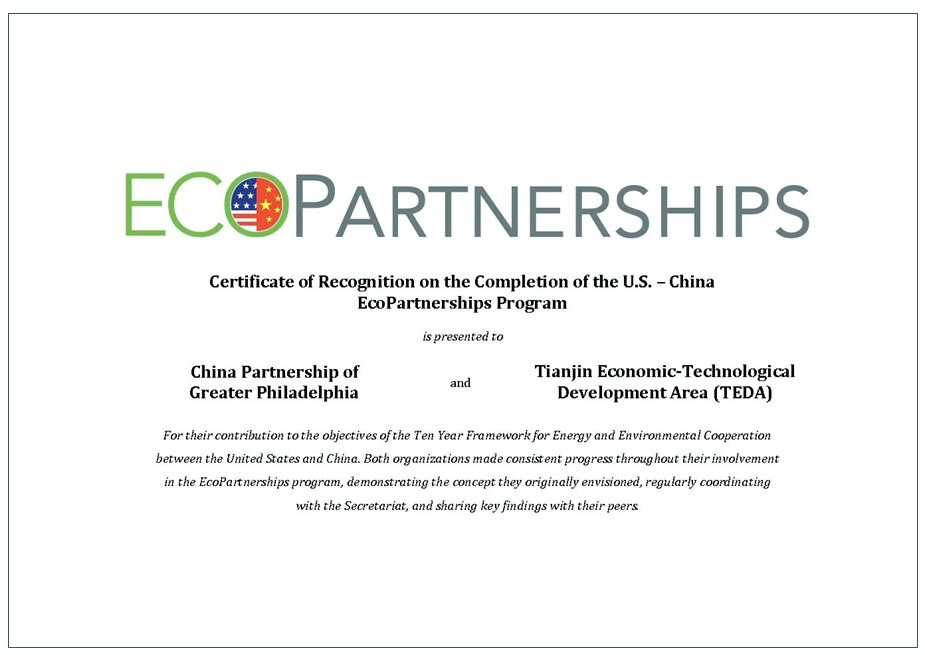
How will we accomplish this without the direct support of the U.S. Government? The first step was to confirm the Biden Administration’s encouragement of trade with China in support of Paris Accord goals and then to renew our region-to-region BE Better program partnership with our primary partner in China, the TEDA EcoCenter. These steps were taken last quarter.
The next steps involve exploring prospects for the resumption of the Sino-U.S. Eco Park national-level opportunity with the Green Development League as outlined at the 2020 U.S.-China EcoPartnership Summit. (As described in detail in a prior post, the Green Development League comprises the 36 top-ranked NETDZs throughout China and the GDL Secretary-General is our original EcoPartnership partner (the TEDA EcoCenter and its Director Madame Yuyan Song).
As the exclusive U.S.-based working group member for the proposed Sino-U.S. Eco Park, China Partnership would leverage expertise and input from (1) our region-to-region BE Better program partners (experts in “energy-efficient, smart and healthy built environments” for industrial park users) as well as (2) our U.S.-China BEST Cities partners (with additional constituencies of support to include the U.S.-China Business Council, the U.S. Industry Advisory Board of the U.S.-China Clean Energy Research Center for Building Energy Efficiency (CERC-BEE), the National Governors Association, and the National League of Cities) in order to identify a comprehensive range of U.S. clean energy technologies and infrastructures from across eastern, central and western regions of the United States to be incorporated into the Sino-U.S. BE Better Eco Park model.

The primary impact of this milestone — CPGP’s formally joining the Green Development League’s working group for design of a Sino-U.S. Eco Park with scalability and replicability to multiple locations throughout China — is literally “to put the U.S. on the map” alongside eight other similar International Eco Parks already functioning in China under PRC Ministry of Commerce auspices. These eight other Eco Park projects represent mostly Sino-European collaborations (e.g., Sino-German Eco Park, Sino-Swiss Zhenjiang Eco Park, Sino-Austrian Eco Park, Sino-Finland Beijing Eco Park) and, to date, none represents a Sino-U.S. collaboration. The CPGP/U.S.-China BEST Cities model was selected, following the March 27, 2018 deadline for application, due to its unique structure of open collaboration designed to introduce U.S. urban clean energy infrastructures and technologies to TEDA and the 35 other top National Economic-technological Development Zones (NETDZ) in the Green Development League.
Using comparables drawn from the realized, real-world experience of the Sino-German Eco Park in Dalian but adjusted to account for the relatively greater GDP of the U.S., a Sino-U.S. BE Better Eco Park leveraging our EcoPartnership’s platform of energy-efficient, smart, healthy built environment and clean manufacturing for industrial park application should reasonably be expected to realize within its initial 5 years:
• As many as 300 signed project agreements (with nearly 60% of those either in production or under construction during that timeframe) representing total investment of 100 billion RMB (approx. USD 15 billion at today’s exchange rate)
• As many as 90 of these projects would be expected to fall in the high-end manufacturing and new energy field with total investment of 67.5 billion RMB (approx. USD 10 billion at today’s exchange rate)
• As many as 80 of these projects would be expected to fall in the advanced services sector with total investment of 35 billion RMB (approx. USD 5 billion at today’s exchange rate)
We are now actively exploring the most practical route for realizing this goal which would involve resumption, post-Trump Administration, of our primary partnership model with (a) TEDA, (b) the 36 GDLs and (c) the 219 NETDZs. Additionally, we have recourse to a secondary partnership model focused on the Jing-Jin-Ji/Xiongan New Area mega-development project.
With respect to the 35-year macroeconomic development effort ushered in by Deng Xiaoping and the Shenzhen and Pudong macro-development projects, Xiongan has both continuities and distinctive differences. One similarity is the size envisioned for the Xiongan New Area -– roughly 50% bigger than Pudong (east of Shanghai) and slightly larger than Shenzhen (to the north of Hong Kong). While Xiongan can be thought of as culminating the coastal progression of these macro-projects–- starting in the south with Shenzhen in the 1980s and moving to the central coast with Pudong in the 1990s -– the final, northern leg of this triad was wobbly at first. President Hu Jintao and Premier Wen Jiabao initially envisioned the third macro-project leg as being Binhai to the northeast of Tianjin. Post-2012, however, plans for Binhai lost most of their momentum and it was only with President Xi Jinping’s emergence in power that priority was shifted from Binhai to Xiongan. It is more in the discontinuities between Xiongan and the earlier Shenzhen and Pudong macro-projects that Xiongan’s significance can best be understood. The first 30 years of the PRC’s post-Cultural Revolution industrial development was based on a high-carbon model. (This is frequently referred to in China by the phrase 先污染后治理 meaning “pollute first, clean up (or remediate) later”). In contrast, the Xiongan industrial model championed by Xi Jinping focuses on a different set of values for the next 30-year-or-so phase of China’s development in the 21st century: the goals of (1) promoting and putting into practice low-carbon industrialization and sustainability innovations and (2) lessening social inequality and narrowing the gap between rich and poor in shared benefits of industrialization and economic development.
Last week, ReGen 250 — the 501c3 non-profit with which the TEA Collaborative is associated — celebrated its 10th Anniversary. To mark the occasion, it’s timely to cast an eye back and quickly survey the road traveled to fix where the TEA Collaborative stands today.
We’ll cover the tech perspective, the energy & environment perspective and the PRC planning ambitions perspective in separate T-series, E-series and A-series posts this week.

My focus on technology issues, especially supply chain issues for advanced ICT (information and communications technology) products involving the U.S.-China-Taiwan triangle, was most intense prior to the founding of ReGen250 in 2011. Some highlights include:
- Three-time Invited Congressional Commission Expert Witness at the U.S.-China Economic and Security Review Commission’s Public Hearings on Global Supply Chains and Cross-Straits Security Issues (109th, 108th, and 107th Sessions of the U.S. Congress)
- Director and Head of Partnership Development, Asia at the World Economic Forum (with strategic focus on ICT, Energy, Transportation, Finance industries)
- Author of The Politics of Greater China’s Integration into the Global Info Tech Supply Chain in The Journal of Contemporary China, Vol. 13, No. 40; and of Taiwan’s FTA Prospects from the Global IT Supply Chain Perspective in Economic Integration, Democratization and National Security in East Asia, edited by Peter C.Y. Chow
- Green Team Leader on Cross-Straits Economics, U.S. Dept. of Defense/Defense Intelligence Agency Strategic Coercion Wargame convened by Science Applications International Corporation (SAIC)
- Invited Non-Governmental Expert Participant, Asian Scenario Seminar Game at the Army War College, Carlisle, PA
- Co-organizer of The Role of Taiwan in the Post-WTO Global Supply Chain Workshop at the 19th Modern Engineering & Technology Seminar
- Official Host (“Ambassador”) for the Taiwan Delegation at World Congress on Information Technology XV in Austin TX
- Featured Speaker & Seminar Consultant – RAND Corporation, MITRE Corporation
- Keynote/Plenary Speaker at large scale media (Forbes, BusinessWeek, Reuters, The Economist Conference Group) and investor (Berkshire-Hathaway-themed 3rd Annual Global Investment Conference, China’s Financial Markets Conference, New York Cleantech Investors Forum, National Association of Business Economists/NABE) conferences
- Moderator at Fabless Semiconductor Association and Wharton China Business Forum annual conference events
- Advisor on Global Business Outreach, The Lauder Institute, University of Pennsylvania
- Invited Think-tank Speaker: CSIS, AEI, Heritage, Brookings, etc
For the TEA Collaborative, this perspective has been brought to bear in a number of recent posts:
- Timing Matters — situates Taiwan’s role in the global supply chain for microchips and other advanced ICT products
- U.S./China Tech De-Coupling: 4 Levels of Risk — assesses the Trump Administration’s fitful tech policy toward China
- Fiddling Around with U.S.-China Tech – brings perspectives from the boardroom, the cultural sidelines and from history in reviewing Trump Administration tech policy toward China
- TikTok Endgame Against the Timeclock – surveys tensions between the U.S. and China as relates to social media companies in general and TikTok in particular
- Taiwan Straddles U.S.-China Microchip Supply Chain Fault-line – takes a sounding of Taiwan’s position as supplier of 40% of the world’s chips and 80% of the world’s most advanced chips
- 21st C. Tech Tug-of-War between China and the U.S. – takes a look at what it will take for the U.S. to compete more effectively against China to retain tech preeminence in the 21st century
This are representative of the most consequential questions and challenges underlying U.S.-China relations at the present moment. They are at the core of the whole-of-government policy review towards China now being coordinated by Kurt Campbell and the National Security Council. Ironically, these issues were dismissed by the American Enterprise Institute when Ambassador Jim Lilley introduced me to AEI for a day-long series of interviews preparatory to a possible appointment back in 2002. AEI’s conclusion at the end of the day as their senior leadership explained their decision not to make an offer? These were all questions which the free market would sort out and there’s no role for AEI or policy makers to play. Ideologically consistent perhaps but hardly prescient.
Volume 2, Number 3 in Global TECHtonics: U.S./China Fault-line series

A U.S.-led initiative to reach out to China and to welcome it into the community of Western nations began with President Nixon trip to Beijing in February 1972. Orchestrated by Henry Kissinger, Nixon’s National Security Advisor at the time, the trip was a brilliant Cold War gambit to exploit the growing rift between Moscow and Beijing. The trip kicked off a seven-year process of “normalizing” relations between the West and “the sleeping dragon” of Asia and, in so doing, divided the Soviet bloc. Through almost half-a-century and a bipartisan succession of Presidents, the effort to engage with China continued as that country woke from its Cultural Revolution nightmare and began to rise up, shaking the world as it did so.
February 1972 was the Year of the Rat (Water Element) in the Chinese zodiac. Forty-eight years later we are again in the Year of the Rat under the Metal Element. In Chinese traditional thinking, we have gone from a time of suppleness and fluidity to a time of hardness and intransigence. In the minds of most Western observers, we have passed from a strategic engagement with China to, under President Trump, a time of open competition on the world stage and strategic disengagement (“de-coupling”) in the technology arena.
This post will save for another time the broader discussion about how and why this shift came about other than to make three general, even obvious, points. First, there was undoubtedly a measure of optimistic naïveté in the West in assuming China’s willingness to dutifully assume the role of a ‘responsible stakeholder’ in the post-WWII world order. If the Chinese had conceived of their nation as only having been born in 1949, assuming the mantle of responsible Pax Americana stakeholder might have fit more comfortably. As it was, Chinese conceived the People’s Republic of China as the heir to a Chinese polity which had been the dominant economy in the world for sixteen of the previous eighteen centuries. They weren’t predisposed to simply adopting some newcomer’s rules and norms as to how China should conduct itself on the world stage. Second, there has undoubtedly been tactical overreach and ill-advised swaggering by President Xi Jinping since his triumphalist speech at the 19th Party Congress in September 2017. U.S.-China relations would undoubtedly be on a more stable track today had Xi Jinping played his cards differently, following suit more with Deng Xiaoping’s opening bid of “keeping a low profile (hiding one’s capacity) and biding one’s time” (韜光養晦、有所作為) rather than flashing his Made in China 2025 card so conspicuously. It can be argued that it’s better from the U.S. standpoint for this “world order competition” to be out in the open. Third, the horse is definitely out of the barn. No U.S. Administration is going to try to get that horse back on the 1972-2017 normalization track. The world has changed and what is needed is a U.S. Administration which recognizes real challenges from China but does not exaggerate them and which marshals the resources to address those challenges in an efficient and effective way, rather than wastefully and non-productively.
The remainder of this post uses last week’s The Four Levels of Risk post as a backdrop to a quick sketch outlining just how wasteful and ineffective the Trump Administration’s policy of technology de-coupling from China is becoming. I’ll do this sketch with three brushstrokes – the view from U.S. boardrooms, the view from the cultural sidelines and the view from history.
The View from U.S. Boardrooms
 A CNBC.com article by Arjun Kharpal published on June 4, 2019 made no reference to the Tiananmen anniversary but did point out that the Trump Administration’s Huawei policy was quickly hoisted on its own petard – failing to get allies to broaden the campaign but leading to a marked acceleration of China’s efforts to develop its own semiconductor industry to supplant U.S. semiconductor supply in the Chinese market and, eventually, in world markets. “The Huawei incident has indeed stimulated the development of China’s domestic chip industry,” Gu Wenjun, analyst at China-based semiconductor research firm ICWise, told CNBC by email” wrote Kharpal at the time. Now, one year later, Trump Administration policy is digging this hole deeper and at a faster pace:
- Qualcomm is reported to have lost current orders worth as much as $8 billion as a result of the Trump Administration’s May 2020 tightening of trade restrictions imposed against Huawei. The new regulations block all chipmakers that use U.S.-made equipment or software from producing chips for Huawei (though companies can apply for a license to continue supply)
- Following the Trump Administration’s August 6th signing of an Executive Order banning transactions by U.S. companies with Tencent, the owner of the WeChat app, market research firms scrambled to assess the impact on Apple and its installed base of iPhones in the strategically vital Chinese market. The surveys all pointed to the same result – as many as 90% of iPhone users in China would drop the Apple product and switch to Android devices if the WeChat app were no longer available on their iPhones.
- The same August 6th Executive Order targeted Bytedance, parent company to the massively popular TikTok app. Seasoned observers who are able to gauge the U.S.-side push-back against this action and know the sloppiness with which the Executive Order was drafted, expect an eventual climbdown by the Administration – if not before the November 3rd election, then shortly after it.
The View from the Cultural Sidelines
 There are two culture wars raging – a partisan one in U.S. domestic politics and an international one between a suddenly tarnished U.S. model and a much-hyped “bright and shiny” new Chinese model. The same dynamics at play with the COVID-19 pandemic are at play in the technology sphere. Domestically, Trump works to energize his base with claims that China is the enemy and that his Administration’s COVID response and China de-coupling response are “the best” that any President could possibly do. Front-line health workers and tech experts know that, in both cases, the claim lies far afield from the truth.
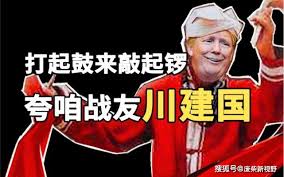
In China, the popular view cuts to the bone of Trump Administration posturing. His new nickname is 建国 (Jiànguó), a popular name given by parents to their infants especially during the nationalistic years of the Cultural Revolution. It means “Build the Country.” In other words, Trump Administration policies are widely seen as accelerating the same nationalistically-driven Sputnik-type race to advanced semiconductors, artificial intelligence, robotics and the tech future which the policies ostensibly are meant to forestall. Trump’s impulsive “Only I Can Fix It” approach playing to a grandstand of partisan supporters has made the challenge which Xi Jinping’s China presents the U.S. more acute. An approach which takes measured and deliberate stock of that challenge and which aligns interests and works closely with the U.S. business community and international partners would be far more effective. Pumping up nationalist sentiment in both the U.S. and China serves only to narrow options and increase risks of conflict spiraling.
The View from History
 A pithy take on Trump’s approach to the U.S.-China technology challenge comes from a widely-respected former colleague who has decades of high-level experience with China from political, national security, economic and think-tank perspectives. He writes “(Trump is like) King Canute trying to fight, instead of the ocean tides, the tides of technology.”
I’ll conclude with another, somewhat longer historical reference which illuminates Trump’s campaign of China-bashing as a central element of his re-election strategy. It is drawn (almost) verbatim from Episode 66 of The History of Rome podcast series by Mike Duncan:
“Conscious that his standing with the people was taking a hit, the Emperor decided he needed to find someone to take the fall for the fire. Someone he could point to and say it was them, not me, I didn’t have anything to do with it. But he couldn’t just grab someone off the street because, with his popularity sinking like a stone, that would just engender the further charge that he was setting up some innocent to take all the blame. What Nero needed was someone, some group that the people disliked even more than him, someone that the people were ready, willing and able to believe had done this horrible thing if for no other reason than that the people were looking for an excuse to round up and punish them. Enter the Christians. In the thirty odd years since the death of Christ, nascent Christian communities had begun cropping up throughout the Empire. At first, they were primarily Jewish in character but through the missionary work of St Paul, known later as the Apostle to the Gentiles, this new religion began to spread into the Greco-Roman world. By the Emperor’s reign, a tiny community of believers, led according to tradition by St. Peter, had established a religious beachhead in Rome itself. The problem the early Christians faced in Rome, though, was not just that their religion, in comparison to the wider pagan world, struck the average Roman as downright weird, but also that at this point most Christian adherents were non-citizen resident aliens in the city who spoke primarily Greek or Hebrew. So the Christians in Rome looked different, spoke a different language, usually came from the lower rungs of the social ladder, and belonged to a strange monotheistic cult that seemed to have cannibalistic overtones. All in all, they were capital O Other in every sense of the word. And as has been proven over and over again by history, whenever terrible things happen to a community – economic problems, floods, plagues, fires – it is the capital O Others who usually get blamed. So desperate to shift responsibility for the great fire away from himself, the Emperor looked at these Others and decided to lay it all on them.”
The only change I have made to this podcast text, recorded in August 2009, was my substitution of the central character’s title instead of his name. Even with that switch, there’s little surprise who that Emperor was.
Nero.
Volume 2, Number 2 in Global TECHtonics: U.S./China Fault-line series
One of the most memorable moments from the two months of A-100 training I received upon entry into the U.S. Foreign Service was a leadership training film about the 1985 Bradford City Football (Soccer) Stadium fire. A small fire, sparked in a code-violation trash pile, was quickly whipped by winds into a fire engulfing substantial portions of the stadium. The raging fire trapped spectators, killing 56 and injuring at least 265.
Filmed on-site during the panic, the key point in this very graphic film involved the challenge of communications in a crisis. As described by Wikipedia, “In the mass panic …, fleeing crowds escaped on to the pitch but others at the back of the stand tried to break down locked exit doors to escape, and many were burnt to death at the turnstiles gates, which had also been locked after the match had begun.” The specific problem was that people at the front of the mass of people trying to flee from the gates quickly recognized that those gates were locked but, in the panic, could not communicate the problem back to the people pressing forward from behind. Had clear communication been possible, everyone could have found an alternative exit. As it was, scores of people ended up pinned against the gates and perished.
The lesson for the U.S.-China technology upheaval currently underway is straightforward: the implications of the upheaval appear different to different parties, depending upon their position in the field of action, and there is danger of differing reactions and poor communications compounding the danger and likewise leading to tragedy.
The goal of this post is to set out in very general terms the different industry groups affected by the Trump Administration’s efforts to date to “decouple” the U.S. and Chinese tech spheres – denying various sub-sectors of the Chinese tech industry access to the U.S. market, incentivizing U.S. firms to bring their production from China back to the U.S., and also encouraging allied governments to reinforce both approaches. There are four major technology sub-sectors that, to date, have been affected by these policy moves. In addition to providing simple, thumbnail descriptions of each of these four sub-sectors and how they have been affected by the Trump Administration policy approach, we will also rank them in terms of national security risk and look at the potential for a seismic reaction being triggered.
A simple way of assessing national security risk and gauging the related potential for a Bradford Stadium-type chain of events is to think in terms of crisis management. Crisis management experts generally identify four distinct stages as a true crisis develops. The following is drawn from the Crisis Prevention Institute’s Crisis Development Model:
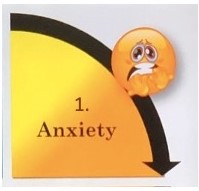
- Anxiety
Anxiety prompts changes in behavior and looking at things differently. It’s a time to listen and observe, not dictate what should happen next.
- Defensive Behavior
Defensive behavior can be a natural escalation of anxiety; it’s the point where actors in crisis begins to lose rationality.
- Risk Behavior
Risk behavior is displayed as actors enter crisis and reach the point of propensity to harm themselves or others.
- Tension Crisis
Every crisis reaches a point of meltdown or tension reduction. Crisis behaviors, as they escalate, expend a tremendous amount of energy.
So here we go …
 Level One
Among the earliest Trump Administration actions targeting technology products from China involved the use of tariffs. While the various rounds of tariff actions are too technical and convoluted to get into here, a few broad generalizations can be made. First, the tariff actions put into effect were more targeted to electronic components than to finished electronic consumer products. For instance, componentry for modems, routers and televisions were subject to two rounds of steep tariff increases and microelectronic chips were assessed a hefty 25% tariff while consumer products such as cellphones, laptops and video games, despite a series of threats by Trump to impose tariffs in the summer and fall of 2019, have still not been hit with any tariffs to date. The President’s advisors apparently convinced him, as the Christmas season approached, that voters would not take kindly to sudden price increases for these products. Second, there is little evidence to suggest that these tariffs inflicted enough pain on Chinese technology manufacturers and exporters to induce them to substantially change their behavior or to protest loudly to their government for relief. Tariff increases can be absorbed at any link in the supply chain stretching from the manufacturer and its supplier network (in China) to the importer, distributor and retail outlet (in the U.S.) or, alternatively, can end up simply be passed on to the consumer (in the U.S.). Preliminary analysis indicates that the U.S. side of the supply chain in technology products has likely absorbed as much pain from these rounds of tariff actions as the Chinese side has been forced to absorb. Third, tariffs are the quintessential sledgehammer used to crack open a peanut. Even if they actually hit the peanut, it tends not to yield anything worth the effort and can cause considerable damage to the surroundings.
At the same time that the Trump Admistration was rolling out waves of tariffs to target imported goods from China, they were also tightening and expanding limits on investment into the U.S. by Chinese technology companies – as well as certain other types of companies – on the grounds that they represent a risk to U.S. national security. The mechanism for achieving this was through expansion of the review powers of the Committee for Foreign Investment in the United States (CFIUS), an inter-agency body comprising nine cabinet-level departments and chaired by the U.S. Secretary of the Treasury.
As with the tariff actions, the heightened scrutiny of potential Chinese investments into the U.S. by CFIUS served primarily to send a political signal to the Chinese side that the commercial and economic climate was getting chillier for Chinese companies in the U.S. Chinese companies looked for work-arounds, adjusted their business plans, and in some cases looked to other world markets to take up the slack. These two sets of actions caused some tremors but did not cause the ground to fundamentally shift under U.S.-China relations. This represented, broadly speaking, the Anxiety Phase of the building crisis.
 Level Two
The first indication of a second, potentially more consequential level of tension occurred in the spring of 2018, as President Trump was repeatedly threatening to levy tariffs on China but before the imposition of the first round of tariffs in July of that year. That second front involved Shenzhen-headquartered ZTE, one of China’s largest makers of smartphones and telecommunications equipment. In March, two ZTE affiliates agreed to a civil and criminal penalty of $1.19 billion for having illegally shipped telecommunications equipment to Iran and North Korea. Two months later, after it was found out that ZTE had failed to reprimand and had, in fact, paid bonuses to the executives involved in those illegal shipments, a seven-year ban on the export of U.S. components to supply ZTE’s manufacturing facilities in China was instituted. This ban was widely viewed as a likely ‘death sentence.’ The manufacture of ZTE smartphones would not be possible without access to U.S.-made microelectronic hardware and Android operating system software. Moreover, the fact that ZTE had been designated as a risk to U.S. national security hung like a sword of Damocles over the country’s future. But, almost immediately, the sentence was lifted without clear explanation. On May 13th, President Trump tweeted “President Xi of China, and I, are working together to give massive Chinese phone company, ZTE, a way to get back into business, fast. Too many jobs in China lost. Commerce Department has been instructed to get it done.” One week later, the U.S. Commerce Department eased the restrictions and on June 7th a deal was reached whereby the Chinese company agreed to complete a $400 million escrow payment in return for the complete lifting of the seven-year export ban.
The whole sequence of events was somewhat baffling except for what it indicated about President Trump’s penchant for injecting himself personally into company-specific matters and for taking public and dramatic steps to build his rapport with President Xi. There is widespread speculation that Trump hoped, through this off-again on-again courtship of Xi, that he would get a trade deal which would allow for the lifting of the whole raft of “Level One” tariffs and give him a major trade deal to tout in the run-up to the 2020 elections.
It was not to be. U.S. and Chinese trade negotiators continued to slog through their negotiations inconclusively and an apparently frustrated Trump and the U.S. national security apparatus soon turned their attention to an even larger target than ZTE–Huawei, China’s national champion in that industry space. Founded in 1987 by Ren Zhengfei, a former army officer, and also headquartered in Shenzhen, Huawei employs 200,000 and manufactures telecommunications equipment, particularly equipment used in the infrastructural backbone of the new 5G standard for telecom, and consumer electronics, particularly smartphones. As was the case with ZTE, the Trump Administration voiced a specific legal concern and general national security concern in launching its campaign against Huawei. The legal matter concerned charges that Huawei too had created elaborate corporate structures to evade the U.S.-led “maximum pressure” sanctions regime against Iran. Specifically and most visibly, that legal issue crystallized around the detention in Canada of Ren’s daughter and Huawei CFO, Meng Wanzhou in early December 2018. The charges, unveiled publicly by the U.S. Justice Department in late January 2019, alleged a decade-long attempt by Huawei and Meng to steal trade secrets, to obstruct a criminal investigation and to evade economic sanctions on Iran. Canada was asked to extradite Meng to the U.S. to face trial on these charges.
The broader national security issue behind the campaign against Huawei centered on the charge that the Chinese government would be able to get access to the torrent of data coursing through next generation 5G telecom networks. To the extent that Huawei-supplied network components are built into the backbone of those networks, Huawei could gain access to the data. And, the thinking goes, that since Huawei is a China-based, PRC-supported champion company, Huawei would have no ability – protestations by the founder and company spokespeople to the contrary – to resist Chinese government requests for access to that data.
The two characteristics of the still on-going U.S. government-led campaign against Huawei which sharply distinguish it from the earlier actions against ZTE are its long duration and its expansion to the international field. Each one of these two characteristics presents complexity which defies easy summarization. Future posts will examine the international dimension of this campaign which has brought the Trump Administration some hard-won headway but also a sometimes stunning level of push-back and public repudiation from traditional allies.
For now, the point is simply that the initial evanescent campaign against ZTE and now the sustained campaign against Huawei can together be thought to represent the second level of effort, and risk, in forcing U.S.-China tech decoupling. Representing a natural escalation of the anxiety provoked by the various tariff rounds, these two sets of actions – and, particularly, the Huawei campaign — reveal factors of irrationality coming into play. On the Chinese side, the issue is a personal affront to Xi Jinping. It is also catnip for the millions of Chinese “netizens” who use nationalistic vitriol and memes to inflame public opinion which, in turn, further narrows the options available to Xi and his government policy makers. On the U.S. side, Trump Administration officials have tried to cajole other countries into raising their own costs and slowing their own transition to 5G by foregoing Huawei equipment without providing specific evidence of the claimed threats to help countries justify taking these steps. Domestically, the Administration has failed to provide a clear rationale and consistent messaging so that the public can assess the risks. Instead, the Administration has framed the issue in terms that are highly personalized to Trump and in a tone that is more macho than rational. It has become, in effect, a bullet point in Trump’s “I’m tougher on China than Sleepy Joe will ever be” reelection strategy.
The factor which has perhaps kept these actions from destabilizing U.S.-China relations even more is that the U.S. doesn’t have its own horse in the 5G sweepstakes. The two major competitors to Huawei are Ericsson (Sweden) and Nokia (Finland). The fact that European allies have been so reluctant to sign on to the U.S. campaign against Huawei, even though two major EU companies stand to gain competitively, underlines just how weak the national security case which Trump officials put forward has been. Over recent months, as the campaign has made some headway following an initial and embarrassing series of stalls out of the gate, Samsung (Sourth Korea) has also emerged as a potential provider of 5G telecom infrastructure components.
 Level Three
A third, but more nascent, level of conflict is now beginning to take shape around social media networks and search engine companies. The players at center-stage of this now emerging drama are the tech giants: Apple, Google, Facebook, Amazon and Microsoft in the U.S. and Baidu, Alibaba, and Tencent (the so-called ‘BAT’ trio) and Bytedance in China. For U.S. readers not familiar with the commercial landscape in China, Baidu, the weakest of the trio, makes money, somewhat like Netflix, principally through advertising and content subscription services built around its Baidu search engine. Alibaba, the strongest of the trio, operates a vast Amazon-like selling site for both business (B2B) and consumer (B2C) end-users. Leveraging extraordinary global reach and profitability with this base of operations in e-commerce sales and delivery, the Alibaba family of companies is increasingly branching into business areas as diverse as cloud computing, media and entertainment, microfinance and tourism. Tencent is the owner of WeChat, a multi-purpose messaging, social media and mobile payment app which has achieved far greater penetration in the Chinese market – and has become more of an indispensable feature in the lives of its users — than any comparable app has achieved in the U.S. Bytedance is the owner of the massively popular TikTok app.
The market access picture for U.S. firms in China has been markedly less open than that traditionally enjoyed by the above Chinese firms in the U.S. Put simply, there has not been reciprocity and the U.S. Big Five Tech Giants have long faced restrictions limiting their ability to do business in China. This is a direct reflection of the Chinese government’s sensitivity, verging on paranoia, about its citizenry’s ability to access sources of information beyond the government’s control. (The three pillars of control for the Chinese Communist Party (CCP) have been, even before assuming control of the nation in 1949, the so-called Three P’s – the Party, the PLA (People’s Liberation Army) and Propaganda). Of the five U.S. companies, Apple’s iPhone and Microsoft’s personal computers and LinkedIn business networking service have enjoyed relatively freer access to the Chinese market, though that access is nonetheless significantly constrained. Microsoft, which has had a presence in China since 1992, has fared the best. Its operating system controls more than a third of the market in China and through its research center in China (its second largest in the world), Microsoft works closely with major Chinese companies on innovative product development. Apple has enjoyed some access for its iPhones, however, the iPhone’s penetration has been limited in China by its high price-point and positioning as an aspirational brand undercut in price by Huawei and Xiaomi. The other three companies have been largely shut out of the market: Google by its refusal to accede to demands, explicit and implied, to make search results and other data available to the Chinese government; Facebook has flatly failed to get government permission to operate in the Chinese market despite years of personal lobbying by Mark Zukerberg (which included Zuckerberg learning Mandarin, recommending Xi Jinping’s book to his employees and even asking Xi Jinping to suggest a name in Chinese for his baby); and Amazon, which faced stiff price competition from Alibaba and JD.com, decided in early 2019 to shut down its uphill effort to build an e-commerce marketplace business in China.
While fierce competition is an undoubted factor in explaining some of this picture of limited presence by the U.S. tech giants in China, government policy is the paramount issue. As previously mentioned, an overriding element of the government’s restrictive policy has to do with control over information. An additional element has to do with the government’s drive – also seen in the aerospace and financial sectors – to give homegrown companies a protected space to grow domestically in order to develop into global competitors and foreign exchange earners. That this is inconsistent with commitments which China made upon entry into the WTO in December 2001 is a cause of concern for the global community. That it creates an unequal playing field for U.S. firms in China is a common concern shared by both political parties in the U.S. and needs to be addressed. That there is evidence of Chinese firms using their penetration of the U.S. market to conduct unauthorized data collection from U.S. citizens is even a greater matter of concern, one that demands strong and strategic counter-measures.
On this last point, it is an established and publicized fact that WeChat has been used to collect data from the devices of U.S. citizens on U.S. soil without the individual’s or the U.S. Government knowledge and, of course , without any legal authorization. Any and all information on a compromised device is at risk in these instances. The pattern of known instances of compromise suggests strongly that there has been a directed campaign by the PRC at work rather than a series of random or accidental intrusions by Tencent. Substantially more information on this vulnerability is known within U.S. government circles than has been shared to date through public sources.
It is this type of vulnerability which is the behind the Trump Administration’s announcement on August 6th of this year of signed Presidential orders to ban commercial transactions with WeChat’s parent company, Tencent, and with Bytedance, Tiktok’s parent. The fact that 60% of users of the TikTok platform are under the age of 24 make it seem, at first blush, to be an unlikely target for PRC government-directed surveillance. But closer inspection shows that risks are not negligible. There is the established precedent from WeChat. There is the vast user base – 85 million in the U.S and 1 billion worldwide. Also, as any expert will tell you, surveillance and espionage seek to exploit any vulnerability and one’s children can be a significant vulnerability. Finally, younger people are disproportionately represented in the workforce of some of the most innovative and cutting-edge industries.
I will have occasion in the future to post on several aspects of this emerging arena of U.S.-China conflict. One topic involves the “geo-commercial” advantage which China enjoys with its population size, its unmatched number of smart-phone users, and its lax privacy laws, standards, and public expectations. As a result of these factors, Chinese companies are able to develop algorithms for new products and services more effectively and efficiently than their competitors. Bytedance’s TikTok is itself an example of this phenomenon. A second topic will be ‘balkanization’ of the Internet which will accelerate as the U.S. and China continue to de-couple and de-globalize their tech interests. A third topic will be the decisive role which India is likely to play in this contest as it balances its position as a massive market for cut-rate, Chinese-made smart-phones and as an important English-language strategic partner for Facebook and other U.S. social media and internet content and service providers.
For now, we can wrap this section with the observation that this emerging front in U.S.-China tech de-coupling involves a unique level of risk. It is so entwined in the lives of so many users and it touches on the core interest of so many behemoth companies in both the U.S. and China that it is markedly different from the risks found on the ZTE and Huawei front. While we are likely just in the early days of this new sphere of competition, it brings the U.S.-China relationship clearly into the third, risk behavior phase of the crisis development cycle. As this front continues to become a focal point, the public attitude and corporate bottom-line interests at stake are so core that entry into a mutually-destructive cycle of action and counter-action is almost foreordained unless both sides exercise great discernment and discipline.
 Level Four
In last week’s post, Timing Matters, we touched on the issue of supply chains for semiconductors and advanced electronics. Because these products are the ‘brains’ behind entire emerging industries – artificial intelligence and robotics, autonomous vehicles, the commercialization of space, and others – this is where the United States’ and China’s economic competition is most fierce. Because these supply chains inextricably pass through Taiwan and Taiwan-headquartered industry leaders like TSMC – the economic risk is compounded by political risk.
The Assessing China ”Global TECHtonics: U.S./China Fault-line” series will delve much more deeply into this issue in the months ahead. Suffice it to say for now, that microelectronics and the global supply chains which help produce and distribute semiconductors and related products globally will be the fault-line which either ends up triggering a cataclysmic upheaval between the U.S. and China or, through inter-governmental negotiation, helps to settle the entire relationship on a new, more stable and sustainable basis.
“Nearly two-thirds of Americans believe the federal government should act more aggressively to combat climate change, and almost as many say the problem is already affecting their community in some way” according to a Pew Research Center survey released on June 23rd this year.
While Democrats and Republicans diverge sharply over the question of whether human activity is contributing “a great deal” (72% Democrats vs 22% Republicans) or only “some” (22% Democrat vs 43% Republicans) to climate change, strong majorities of both parties recognize the human contribution and want the government to do more about it.
The story of this post goes back some twelve years. It’s a story of how bipartisanship and cooperative outreach can lead change. It shows what can be achieved when we focus, with a grounding in science, on the common good. We’re not doing that successfully now with COVID-19. We’re not doing it successfully now with climate change either But it’s within reach to do better.
As the second term of the George W. Bush Administration was winding down, Treasury Secretary Hank Paulson sensed drift in the U.S.-China relationship. An avid birder and a passionate outdoorsman, Paulson found himself drawn to the environment as a possible new basis for cooperative engagement with China. If sufficient trust could be generated between the U.S. and China – especially among the career administrators responsible for climate policy in both countries – the quarter-century logjam that had impeded global action on climate change might free up.

What was that logjam? Ever since the mid-1970s, when the United Nations had first identified climate change as a long-term economic and political threat to the community of nations, the United States and China had never seen the issue eye-to-eye. The U.S., acting as the de facto leader of the developed nations, wanted joint action with the developing nations but didn’t want the developed nations to be forced to shoulder most costs. China, as de facto leader of the developing nations, wanted joint action but insisted the developing nations should foot most of the bill. Their argument, somewhat disingenuous but appealing in its simplicity, used a restaurant tab as an analogy. Why should developing nations, who had come late to the industrial revolution party, be splitting the bill for all the courses when they had only participated in the post-WWII dessert course? (The ploy buried in this argument is, of course, that the rates of consumption and carbon output of the post-WWII phase of industrial development outstripped significantly the previous century on a cumulative basis and the developing nations were on course to grow their consumption and carbon output in coming decades while developing nations were moderating theirs). In any case, this divergence of approach led directly to the breakdown of the Kyoto Protocol in 1999 (and also to the less consequential but unseemly debacle between President Obama and the Chinese delegation at the COP20 (20th UN Conference of Parties) meeting in Copenhagen in 2009).
So against this background, Secretary Paulson traveled to Beijing for discussions with his Chinese government counterparts about a new framework for coordination on global economic issues, resolution of trade disputes and strategic cooperation to mitigate climate change. While on that trip, Paulson traveled with his China-hand Deputy Chief of Staff, Taiya Smith, to Lake Qinghai to see first-hand the condition of that world-heritage lake and its wetland bird habitat. At the water’s edge, Paulson picked up some beverage cans and plastic bottles discarded there by fishermen and tourists. The Chinese officials traveling with him were surprised and impressed to see a Cabinet-level U.S. official stoop, literally, to help clear a Chinese lake of trash. In that moment, a ten-year run of strategic cooperation on clean energy and the environment between the U.S. and China was launched.
Over the past two academic years, I taught a masters level course for the University of Pennsylvania’s International Masters of Public Administration with the official Ten Year Framework (TYF) for U.S.-China Cooperation on Energy and Environment as the focal case-study. I could say a lot about it but, for the purpose of this post, I have only a single point to make.

The TYF is a case-study in the hard work of cooperation. Launched in late 2008 by a Republican administration, handed off post-inauguration to the Obama Administration in early 2009, and then officially signed by President Obama and President Hu Jintao in November 2019, the first four years of the TYF created a “safe place” – beyond the prying eyes of the press and partisan grandstanders — where officials from the U.S. and China could educate each other about what might be possible and what would be perilous to undertake in their respective administrative and political systems. In short, they learned to trust one another to move in a common direction. The result of this four years of hard work was another official public act by President Obama and the new Chinese President, Xi Jinping, in November 11, 2014. The two presidents announced with fanfare that, for the first time in over forty years, the U.S. and China were ready to work together to lead the world towards a climate change agreement. Once that announcement was made between the U.S. and China, all it took was thirteen more months for over 190 other nations to join with the U.S. and China in agreeing to the Paris Accord at the COP21 meeting.
The TYF is a lesson in leadership or, more precisely, co-leadership. But it’s over. What relevance does it have in August 2020? Less than six months into his Presidency, President Trump announced the withdrawal of the U.S. from the Paris Accord. Now, in the lead-up to the November elections, each day brings a new low in U.S.-China relations. As someone who was serving at the U.S. Consulate General in Shanghai before, during and after Tiananmen, I feel able to make the assessment that we are now at a lower point in the U.S.-China relationship than we were even then. The question is where to do we go from here?
That question is valid and complicated where our relationship is deeply fraught – advanced technology and global supply chains, minority rights in Xinjiang, political space for Hong Kong and Taiwan, military build-ups in the East and South China Seas – but the question is much simpler where our national interests are clearly aligned – in leading the world’s transition to lower-carbon energy in order to build resilience and mitigate climate change for the planet. Either the U.S. cedes a mega-industry of the future to China along with leadership of the Paris Accord community of nations or the U.S. steps forward again on the global stage with its unparalleled technology leadership and with renewed political vision. What will this look like? It will look like working with allies and not against them. It will involve not just supporting the planting of a billion trees globally and helping Big Coal capture and sequester carbon emissions underground but marshaling across-the-board governmental support to spur innovation across the entire spectrum of low-carbon solutions. It will require us to re-enter the Paris Accord and re-learn how to work productively with China in that particular arena while holding China to account in the many other arenas where our interests are at loggerheads.
Trump’s announcement of U.S. withdrawal from the Paris Accord was on June 1, 2017. The framers of the Paris Accord, mindful of political cross-winds that can blow in the U.S. and elsewhere in the world, included an Article 28 requirement that a four-year waiting period pass before any country’s withdrawal could be formalized. The date kicking off that waiting period for the U.S. is November 4, 2016, the day on which the Obama Administration secured ratification by Congress of U.S. entry into the Paris Accord. So, U.S. withdrawal cannot under any circumstance become official until the day after the upcoming November 3rd election in the U.S.
So there’s the Sixty-Seven Percent solution. With nearly two-thirds of Americans believing the federal government should act more aggressively to combat climate change and with the Paris Accord signatories able to be flexible and eager to welcome a Biden-led America back into the Accord, it’s time for a majority to stand up again in unison. For each of our poor souls, for our country, for the community of nations and for the planet.
E pluribus (67%) unum.
The following post comes courtesy of Sinosphere, the China blog for The New York Times. Like a flower poking out of the cracked pavement of a concrete jungle, this is another hopeful sign that ‘The Greening of Asia” is starting to blossom.
Q & A with Author Mark Clifford on “The Greening of Asia”
By Ian Johnson from Sinosphere, May 5, 2015 3:21am

A technician at Yingli Solar checks a solar panel on a production line at the company’s headquarters in Baoding, Hebei Province. Credit Kevin Frayer/Getty Images
After 20 years in Asia as a journalist, Mark Clifford took over as executive director of the Hong Kong-based Asia Business Council in 2007. His new book, “The Greening of Asia: The Business Case for Solving Asia’s Environmental Emergency,” explores how Asian companies are making strides in providing environmental solutions. China is a special focus because of the country’s huge emissions of carbon, but also because of its potential for innovation.

Mark Clifford.Credit Courtesy of Mark Clifford
In an interview, Mr. Clifford discussed the need to link businesses, governments and nongovernmental organizations to fight climate change:
Q.: How did you get interested in this topic?
A: I joined the Council in 2007 and inherited an almost-finished study on green buildings. That was pretty exotic in Asia back then, and we published a book on it. It got me thinking about the topic.
Q: Your angle is a bit more hopeful than some. Tell us how that came to be.
A: Originally, I thought I’d do a book along the lines of “The East Is Black.” And we do have an emergency here. In China, 1.2 million a year are dying prematurely. People need to know how bad it is, but then I got to thinking that this was pretty obvious. Instead, I thought that there are these much more positive responses underway, and people should know about them. The business community, which takes challenges and solves problems, was involved. So it is unabashedly a glass-half-full book, but that’s because it’s important to know there’s a way out. We can despair, we can do nothing, or we can work to solve one of the greatest challenges of our time.
Q; Do you see business being the main player in solving the issue?
A: No, it’s part of the solution. There has to be a three-legged stool of government, civil society and business, and each has to bring its strengths to the table. Only governments have the power to set rules — the laws and regulations, of course, but also the prices in the forms of taxes and subsidies as well as facilitating infrastructure developments. Media and NGOs make sure that business and government are doing what they promise.
Q: What was most surprising is how many companies are doing this in one form or another.
A: Yes, in the book I profile more than a dozen companies at length but also have an appendix of more than 50 companies that are involved with a variety of environmental initiatives. It was surprising to me what’s going on at the corporate level, but they’re doing things for good business reasons. Some are for the P.R. effect, but most look at it as necessary for survival.
Q: You focused one chapter on Hong Kong’s CLP Holdings, the electric power company.
A: Their work really sparked this project. In 2007, the then-chief executive, Andrew Brandler, announced that by mid-century, they would cut the carbon intensity of their electricity production by 75 percent. This pledge by one of Asia’s biggest private utilities — mostly coal-fired power plants — to effectively decarbonize by mid-century is unparalleled globally. I think this stems from the Kadoorie family, which owns a major stake in CLP. Michael Kadoorie challenges his top management to look at 50-year horizons. They do this for good reasons. They’re traditionally a coal-burning utility, but they think that this isn’t a good business model in 50 years.
Other companies think that water is underpriced, and in the future, it will be more realistically priced. Carbon also is underpriced, and other companies want to be ready for when it’s changed. But not all companies have long-term visions.To reach them, you need the other two legs of the stool. You need good, strong government policy, and you need NGOs to hold people accountable.
Q: What countries have had good policies?
A: Singapore has done an exemplary job. They decided very early on that water is of existential threat to the nation. So they have taken very firm policies, and it gives companies a form of certainty about costs.Not every country has the capacity that Singapore’s administration has, and it’s a small place with a forward-thinking government. It’s much harder in big countries like China and India, which are more fragmented.
Q: You have a lot on China.
A: The good news is we have good policies coming down from the top levels of the Chinese government. Where China continues to struggle is the implementation at the ground level. There’s not always enforcement, and there’s no civil society to act as a check. The time when China decides that the environment and energy issues are as much of a threat as the color revolutions were, or the Hong Kong protests were last year, that’s when we’ll know we have serious progress. We’ve seen with Chai Jing [whose popular documentary film on the environment, “Under the Dome,” was banned] that civil society is muted.
Q: We read a lot about air pollution, but you also think that water is crucial.
A: Increasingly, water is a hard-stop issue. Air pollution is horrible, but most people affected by it are still living. But no one can live without water. I don’t know what people will do when the water stops. In China, projects like the South-North Water Diversion Project just delay the day of reckoning. What concerns me is that even most otherwise far-sighted governments are not facing up to the challenges. For example, what do you do if you’re a municipal official, and you have an industry, say semi-conductors, which uses a lot of water? What do you do when you have to make a choice: water for the factory or the town? These are the kinds of choices that aren’t going to happen today or tomorrow, but governments will face this.
Q: And yet there are signs of hope in China.
A: China is about to overtake Germany as having the largest amount of installed solar power capability. It also has large wind turbine facilities. All of this is important because China burns half the world’s coal and accounts for 30 percent of carbon dioxide emissions. So to fix China, we need to cut coal use. Coal is supposed to peak in 2030, but it could happen a lot faster. So these are huge challenges, but China is potentially further ahead than many people realize.
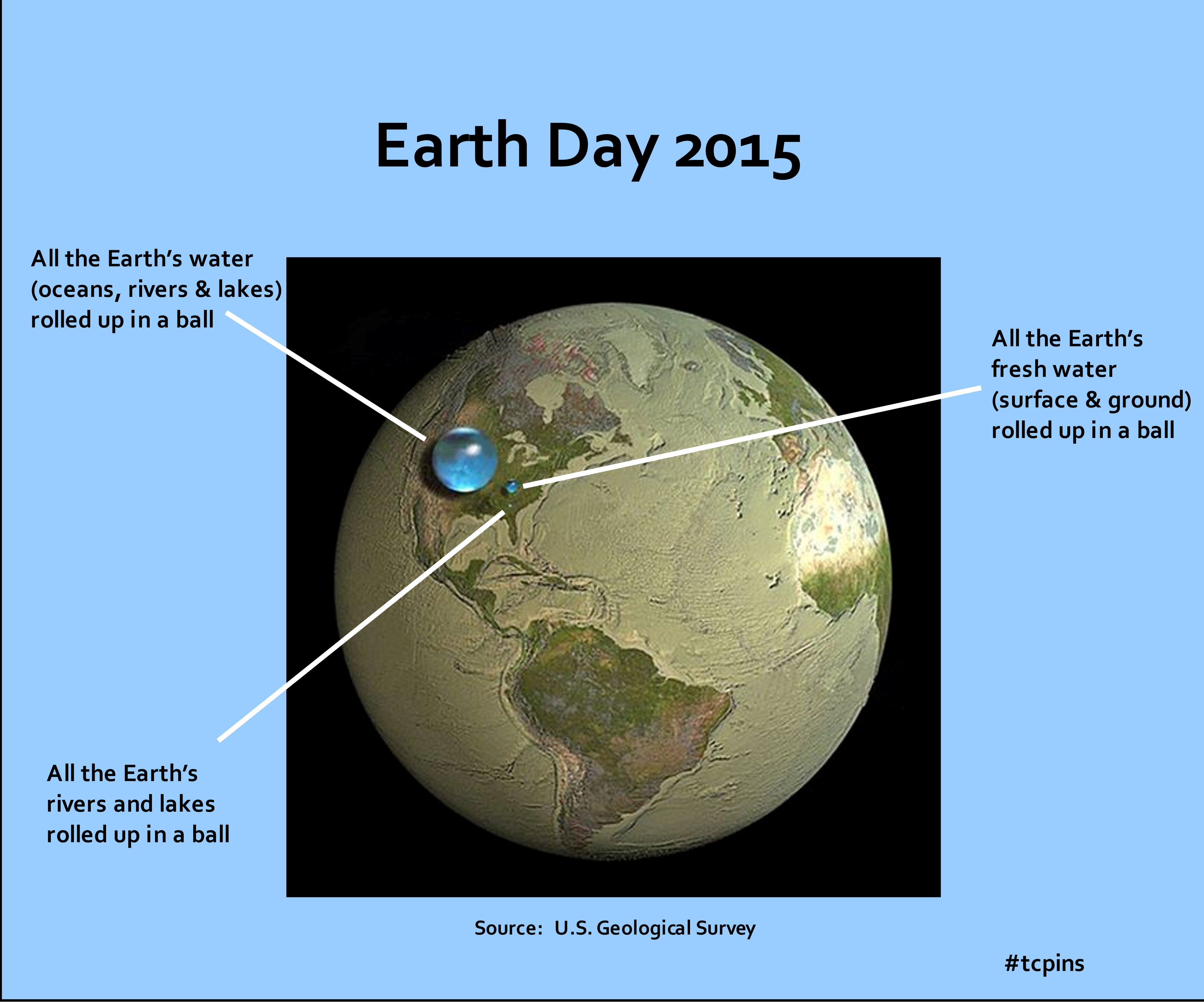
Hard to believe? Here’s the data behind it. Three cheers for water!


 ______Assessing China / The TEA Collaborative______
