
You are currently browsing the tag archive for the ‘energy’ tag.
What are eco-cities in China? Why are so many popping up in China’s second-tier urban locations? What are the main drivers for this trend and what makes a sound eco-city development project or zone? Finally, what opportunities exist for foreign companies? TCBN Green Channel Editor Terry Cooke interviews Piper Stover, strategic advisor of China Dynamics, LLC, on China’s eco-cities initiative.

Background
China policy on eco-cities:
• The 11th 5 Year Plan included goals of lowering energy consumption per unit of GDP, specifically, energy consumption per unit of GDP should have decreased by 20 percent in 2010 compared to 2005.
•The draft for the 12th Five-Year Program (2011-2015), with additional policy overseeing eco-city development, will be finalized by China’s National People’s Congress in March, 2011.
China Eco-cities in the news:
Eco-city development projects have been announced in over 100 cities across China, however not all have been officially endorsed by China government regulatory authorities. Tongi University has conducted research citing nearly 170 self-proclaimed eco-cities.
China’s National Development and Reform Commission (NDRC) launched a national low-carbon province and low-carbon city experimental project in Beijing in August, 2010. The project is being implemented in five provinces: Guangdong, Liaoning, Hubei, Shaanxi and Yunnan, and in eight cities: Tianjin, Chongqing, Shenzhen, Xiamen, Hangzhou, Nanchang, Guiyang and Baoding.
Notable China Eco-city or Sustainable Community projects also include:
• Tangshan Caofeidian International Eco-city
• Sino-Singapore Tianjin Eco-city
• Chongming Dongtan Eco-city (currently inactive)
• Shenzhen Guangming Eco-city, Guangdong Province
• Yangzhou Eco-city, Jiangsu Province
• Nanjing Eco-city, Jiangsu Province (several eco-cities and eco-business parks are under development)
• Huaibei Eco-city, Anhui Province
• Langfang Eco-city, China (outside of Beijing)
• Mengtougou Eco-city (outside of Beijing)
• Meixi Lake Eco-city, Changsha, Hunan Province (there are several additional eco-cities planned for this region)
• Rongcheng Eco-town and Weihai City, Shandong Province
• Huangbaiyu (currently abandoned)
• Chengdu, Sichuan
• Xiamen Eco-city “retrofit”
• Guiyang, Guizhou
• “US-China Eco-city Initiative” between the US Department of Energy (DOE)and China’s Ministry of Housing and Urban-Rural Development (MOHURD). Both sides are developing guidelines and policies to support the integration of energy efficiency and renewable energy into city design and operation. January, 2011.
Research and policy development
• Tongi University has conducted research citing over 160 eco-cities in China. UNEP-Tongji University Institute of Environment for Sustainable Development
Useful Eco-city Case Studies:
• Sino-Singapore Tianjin Eco-city Project, released by World Bank on January 11, 2011
• Asian Development Bank’s overview on Eco-cities in China, “Eco-City Development: A New and Sustainable Way Forward?: November 2010
2011 Eco-city Events:
• The World Eco-city Summit, Montreal 2011, held August 22-26, 2011
www.ecocity2011.com
Interview Transcript
Terry Cooke: This is Terry Cooke, editor of TCBN’s Green Development Channel. I’m here with Piper Lounsbury Stover. Piper’s been active in China for the last 20 years working with companies on the ground. On recent years she’s had involvement with a number of eco-city projects. Piper, welcome.
Piper Lounsbury Stover: Thanks, Terry.
TC: We’re talking about eco-cities in China. For starters, can you just let us know what eco-cities are and why they seem to be popping up at a fast rate?
PLS: Sure. “Eco” – meaning ecologically sustainable cities. I think in the late – well, early to mid-90s, the Chinese Ministry of Environmental Protection started to develop these ‘eco-city’ guidelines, which were really a series of key performance indicators (KPIs) to try to reduce greenhouse gas emissions and to conserve energy and water resources in several cities across China, starting as pilot project, and now expanding to hundreds of cities.
The main drivers to this development – China is facing massive migration right now. Almost 50% of China’s population currently lives in over 600 cities in China. Nearly 300 million will move from rural areas to Chinese cities in the next ten years, so this is a massive influx of people and China’s going to have to invest up to $3.6 trillion in urban infrastructure to handle that migration by 2020.
So with that, there’s going to be a growth of 2nd tier cities to handle the migration. And with that growth there is going to be continued strain on resources. So to conserve energy needs China’s has to implement policies. China will be increasing energy needs by 150% by 2020 and will have water issues. Water reclamation and water policies are going to be important because China, for its populations, has only a fourth of the world’s average water per capita. So it’s a big issue that the China Daily started reporting on in 2005 or 2006; we are seeing more and more domestic reports on water issues.
TC: And currently there’s a drought right now.
PLS: Exactly. So to address this from a policy perspective, the 11th Five Year Plan and the 12th Five Year Plan have advocated objectives to promote sustainability in these eco-cities. And that means opportunity – opportunity for companies, and certainly land and real estate developers to try to meet the challenge.
TC: Well we’ll get to that investment and commercial opportunity in just a moment. Before we do, Piper, could you just say a word about where these eco-cites are which are the biggest?
PLS: Sure. I mentioned the 2nd tier cities earlier. I think it’s important because when we think of the 1st tier cities in China we think of Beijing, Shanghai, Hong Kong, areas, but these 2nd tier cities are growing, and provides opportunities for real estate development that did not exist previously. The biggest ones right now are occurring in these 2nd tier areas. We have two greenfield projects that are the largest – 30 sq km areas. One in is Tangshan, called the Caofeidian International Eco-city. I believe that is an eco-city in coordination with the government of Sweden. There is the Sino-Singapore Tianjin Eco-city – that’s a 30 sq km also sq area in Tianjin. And then there was the Kingdom Chongming Dongtan Eco-city. That was a really big eco city planned for an island off of Shanghai that hasn’t really gone anywhere, as I do not think the investment and the original plan worked out. While those are the obvious biggest, I have a whole list of others that I’d be glad to post after the call, including some in Shenzhen, in Jiangsu Province, in Anhui Province. There are many.
TC: Ok Piper. And you were just talking about the real estate development angle. You mentioned three premier projects, two of which seem to be moving forward well and one that seems to be stalled. From a project development and investment standpoint, what makes a sound eco-city project? What are the signs investors should look for?
PLS: Sure, there are probably five signs that I would look for if I were looking at a project. One would, obviously, be significant local and central government level support. You want to make sure the Ministry of Environmental Protection (MEP) or the Ministry of Housing and Urban Development (MOHURD) are backing these projects with key performance indicators approved by these two organizations to make sure they’re on track with national standards.
And of course the land acquisition. That’s important. You want to make sure that these projects are not encroaching on farmland or other areas where inhabitants are living, and certainly converting non-arable wasteland has been one way to look at better utilizing land.
TC: Just to clarify that one, Piper, there’s a risk that if the local government has misappropriated land there would be political risk attached to that.
PLS: Certainly. That is one key issue, but also it is a higher cost in some areas to actually to move people. It’s very costly. So for those two reasons it is important to find out how the land was acquired and how it will be used (for the whole system).
And then there is location. You want to find out how far away these eco-cites are from an old city center – whether transportation is going to be convenient or not. Some of these eco-cities are located very close to rail lines or high-speed rails planned for the future, so that of course would be of interest to me.
The fourth and fifth would include: at what speed would the purchasing power of these cities develop? I know for 2nd tier cities this can be questionable. You want to make sure the economy will continue to grow, and you want growth predictions to be based on sound plans.
The fifth would be competition in the same area. If your company is looking at either investing or moving into one of these eco-cities, what is the competition around you? What human capital talents exist? And what are either other cities nearby or neighboring counties also doing to attract similar industries, or even your own competitors?
TC: Good. Those are key points for an investor to keep their eye on. What about the opportunity more broadly, for foreign businesses across the board to participate in and benefit from this trend of eco-cities throughout China?
PLS: Certainly with an opportunity to pursue either a green field investment or rehabilitation of some cities, opportunities exist for green building, green technology companies, green energy – renewable wind, solar, CHP, and other types of renewable energy technologies, as well as water and waste technologies. For all of these eco-cities. With already nearly 170 of these so-called eco-cities popping up around China, imagine the opportunity for green technologies in each of these cities.
So that is one area: products and services in the sustainable building sector. The other would be finance and investment opportunities – for R&D and start-ups. I could imagine incubators/ R&D facilities established in some of these areas outside of larger cities, depending on the location in China.
And then third – knowledge-based economy opportunities: in new media, computer networking, IT/ back office outsourcing-types of IT services, and problem solving and consulting. Certainly with the growing concern that China has scarce resources, there is a natural and understandable inclination to try to move from industrialization and heavy machinery/heavy energy and water-using industries to higher-value, knowledge-based services. The eco-cites would be targets to offer or create such knowledge-based service opportunities for companies looking for such.
TC: Piper you commented on the investment outlook and also the commercial opportunities. What about the durability of this trend in China from a business standpoint?
PLS: I would say that certainly we all understand the top-down policies either promulgated from the 11th or 12th Five Year Plan (to be reviewed in March 2011), are central to understanding where growth will happen, and that funding will be diverted to these eco-cites to make them a success, so can trust in that. However, at the same time we need to think about the greater economy and health at the local or regional level where these eco-cites are located, as well as the national level.
And because eco-cities are a more expensive operation to create (to meet stringent KPIs), you’ve got some very sensitive systems that do need management and attention. There is a danger that some shortcuts would be made to save money. I’ve heard one story in the past couple years where in an eco-city in a more remote location, the energy was considered expensive and so the lights were basically turned out during the winter to meet KPIs. In general, looking at the five or six points I mentioned earlier about making sure you’re researching the right eco-city and ensuring it is in a location that is sound and associated with strong economic growth, things should be okay.
TC: Piper earlier in our talk you identified three particular projects and then ticked off the names and a couple others that you will post to the TCBN website. One project that I did not hear you mention was the Chicago-Shanghai Eco-city agreement. Could you tell us a little bit about that particular agreement?
PLS: Well it’s a bit of a different animal, but I’m glad you mentioned that. I think, dating back to the Clinton administration, there was an effort to create a more cooperative information exchange, particularly between the DOE and China’s counterparts. I think that in the 2010 September timeframe, the DOE announced a new Chicago-Shanghai Eco-city. It’s basically a way for the two cities to trade best practices and to work together to develop standards and to help each other understand what could be possible in cities located throughout not only China but also the United States. So I think in this effort, if I’m not mistaken, there are 7 or 8 cities in the US and in China that may be paired together in this US-China-India Integrated Cities Initiative that is being coordinated by the US Department of Energy via the Brookhaven National Lab. It will help not only create more transparency and understanding of some of the standards that could evolve, but also to provide more of a quality control so that companies can have a bit of political cover in understanding which eco-cites are going to be considered sound and which are not.
TC: All right, well time’s drawing to a close, but in closing, Piper, let me just ask whether there’s just one project you’d like to highlight as a case study?
PLS: You know, in some of the research that I’ve done, I found one report to be very useful, which has made me think that this particular eco-city could be a success: the Sino-Singapore Tianjin Eco-city. A case study written by the World Bank, or I believe prepared based on a grant application that the Tianjin Eco-city had submitted to the World Bank. It is on the web and available to the public, and I think the study is the most recent comprehensive report I’ve found on eco-cities in China.
TC: Well great! Piper, thank you for your thoughts and your insights. We’ll possibility try to get back to you in a year or so and see how the progress with eco-cities has been.
PLS: Sounds great, Terry. Thanks. And I will post those cities for everyone to take a look at.
TC: Thank you. Bye bye.
TCBN’s Green Development Channel Editor Terry Cooke is the Founder of GC3 Strategy Inc., helping U.S. technology and investment firms since 2002 to create and sustain commercial partnerships in Greater China and India. >>See more on his profile>>
Piper Lounsbury Stover is the Principal for China Dynamics LLC, based in Vermont. She has nearly 20 years of experience in China business and policy.
We’re pleased to share here an invited submission by James Wheatcroft, picking up and advancing the conversation from the previous post about rising levels of Chinese clean energy investment in various regions of the U.S. (as well as from the Jan 3rd BusinessWeek article cited in that post). Here’s the expert sounding which James takes on the rising level of Chinese investment. My conclusion? We’re in the trough of a wave.
China’s Suntech in Arizona — Reflections on Real-world Globalization by James Wheatcroft
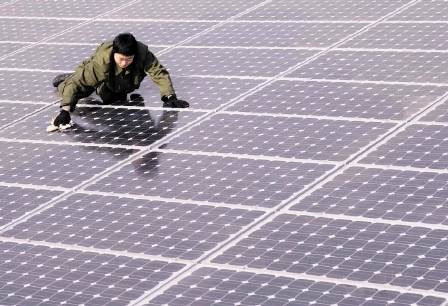
“The move by Suntech to invest in a US manufacturing facility is positive news for Phoenix and a triumph for Barry Broome, CEO of the Greater Phoenix Economic Council. Barry like thousands of regional business development organisations in the West are trying to figure out how to attract Chinese money into their area, and are prepared to offer grants and incentives to do so.
So: why have the Chinese done this?
Cynics would say that this is a move by the Chinese to circumvent US “Buy American” trade clauses. They would also say that this facility is tiny compared to the vast plants that Suntech and other Chinese PV manufacturers have in China. I say this is an emerging trend that will continue; in fact I know of another very large Chinese State Owned energy company that is seriously considering a European plant.
To me this is more about nationalism, carbon footprint and true globalisation.
Nationalism
There is a real national fervour in China these days. People and businesses are more confident and look to demonstrate this confidence abroad. China has long had a “go abroad” policy in many industries, and this reflects the fact that many State Owned Enterprises are awash with capital and are seeking to balance their portfolio of investments- by investing outside China.
The logic is very obvious. If “Buy American” becomes a serious purchasing standard, the bar is raised in terms of price, allowing US wage levels to be built into the cost base. Therefore a small facility in the US becomes well worth the risk for Suntech.
Carbon Footprint
There is much talk in Europe about a possible tariff system based on carbon footprint. Certainly in the UK market, where I operate, regional councils and housing associations (who are all looking at installing panels), are beginning to include carbon footprint as a purchasing criterion. It is not a legal requirement but it is increasingly being seen as a form of ‘best practice.’ In the long term, carbon footprint taxes on a Pan-European basis are possible. From a Chinese perspective therefore there is now a good argument that if you wish to win public sector business in the EU, you need to have a base in the EU..
Globalisation
Globalisation is no longer, as we saw in the late 20th – early 21st centuries, only about US and European companies either tapping global markets or sourcing from them. Chinese and Indian companies are already leading this investment trend. US PV makers that are feeling the pinch from Asia are building PV plants in China. This turnaround – where Chinese companies are feeling the pinch from ‘Buy American’ clauses and building plant in the US,- is merely the next step in true globalisation, and if you ask Barry Broome or the 75 people working at Suntech Phoenix- they would tell you that they’re pretty happy about it.
James Maclean Wheatcroft, based in the UK is a consultant in the Chinese green energy, media and communications markets. His team of consultants on the ground in China has delivered more than $80 million per year in energy joint ventures. James is currently working with both Chinese and European companies and governments to benefit from the current boom in Chinese energy
The headline to watch during China President Hu Jintao’s State Visit to the US later this month? His itinerary. Rather than the standard shuffle between DC and NYC, this itinerary includes a stop in the ‘real America’ outside of the ‘bubbles’ of Washington DC and New York City. For the purposes of this trip, ‘real America’ is Chicago.
This represents, of course, a polite and deft gesture of respect to the hometown of Hu’s host at the State Dinner in Washington. But the itinerary signifies far more: a shift in China’s outward focus from Wall Street to Main Street.
In the post-GFC landscape, this is a tectonic tremor worth heeding. Expect a visit to a Main Street company with Chinese ownership and lots of U.S. employees in an embattled industry sector. Expect the U.S.-China storyline in 2011 to shift in degree from currency rates and the U.S. bond market toward rates of Chinese foreign direct investment (FDI) and in-bound support of the U.S. job market.
For USA regions angling for Chinese FDI to support their local jobs & their regional economic development, the key to success will be aligning regional assets with US-China national level priorities — whether in clean energy or in other strategic sectors. Several key vectors of national/regional alignment were created this fall when the U.S. Department of Energy and other Federal agencies awarded:
- Detroit and the University of Michigan with a U.S.-China Clean Energy Research Center (CERC) for Clean Energy Vehicles;
- The University of West Virginia lead role in a consortium for a U.S.-China CERC for Clean Coal;
- The Lawrence Berkeley Lab with a U.S.-China CERC for Building Efficiency;
- Greater Philadelphia and Penn State University with a national Energy Innovation Hub for Building Efficiency — the Greater Philadelphia Innovation Cluster (GPIC) — at the Navy Yard.
The first half of the Obama Administration’s engagement with China to tackle the challenge of 21st energy took place in Washington and New York. The next chapter will take place in Detroit, the Bay Area, Philadelphia and other regional markets around the country. As China reinvents itself, it will partner with regions that step forward to reintroduce themselves on the global dance-floor.
It will be an awkward dance at times. But not a dance that will pay to sit out. The dance ticket is to tomorrow’s world.
BusinessWeek took an excellent snapshot of this moment’s step in the global pas-de-deux with its January 3, 2011 piece on “Chinese Plants Grow on U.S. Turf.”
Thanks to BBC, 2.5 million people have already enjoyed this but it DOES pack 200 years of history into 4 minutes. It also drives home the key dynamic for us all to internalize about the natural impact which China (and India) are bringing to the world today… and why ultimately it’s a very good thing. An exhilarating 4 minute ride through 2 centuries of global history and a peek around the corner to tomorrow’s world…

More about this programme:http://www.bbc.co.uk/programmes/b00wgq0l Hans Rosling’s famous lectures combine enormous quantities of public data with a sport’s commentator’s style to reveal the story of the world’s past, present and future development. Now he explores stats in a way he has never done
There’s a curious disconnect in discussions about China’s ability to innovate. Yes, there’s no question that China lacks the chemistry to produce tomorrow’s Google — rigid educational system, lack of intellectual property rights protection, constricted flow of ideas, top-down control of ‘right thinking,’ etc. But what tends to get overlooked in this discussion is China’s headlong embrace of the future, the attitudinal openness to change. It perhaps took the searing experience of the Cultural Revolution to burn into the consciousness of present-day China where never to return and thereby to point the way to where to head — a modern and global future. We should be able to respect China’s focus on the future and, in doing so, avoid getting too comfortable in our present.
This article by James Allworth at at the Forum for Growth and Innovation at Harvard Business School puts this issue into clear perspective.

How the U.S. Could Avoid Being Disrupted by China by James Allworth, Harvard Business Review, 1:12 PM Tuesday December 21, 2010,
Last week, President Obama met with the CEOs of 20 of the largest corporations in the U.S. It was a widely praised meeting. But given what the President is hoping to achieve — creating sustained economic growth, which in turn leads to jobs — listening to much of what these guys have to say is the wrong approach. And asking them to start hiring misses the point. Obama is talking to the wrong people.
The U.S.’s position as a global economic leader has been based on one thing more than anything else: its ability to innovate. From Detroit to Silicon Valley, America has always been at the center of the “next big thing”. Each of the industries that have sprung up around these innovations has become an engine for America’s economic growth. Amazingly, each time as one has begun to slow down, the next one has picked up.
But this cycle is being jeopardized… [and in danger of] falling into the trap that leads to disruption — the same one that snares executives in many successful companies. Just as talented corporate leaders gradually shift their focus further and further upmarket in service of their best customers, the U.S.’s political leadership is increasingly doing that, too, by catering to the largest American companies… These are companies at their zenith. They have been through periods of exponential growth, but now they’re mature. America’s economic future is not dependent on the companies that are peaking now; the future is going to depend on the companies and industries that will peak in ten or 20 years time from now, the companies that are about to go through a period of break-out growth.
Unlike the startups that represent America’s future, the big players have an inherent bias toward protecting the status quo. They play a defensive game and face a different set of issues to their smaller brethren; fixing these issues is their priority when talking to politicians. The problem with this is that America’s economic competitiveness has always been built upon its ability to disrupt what it already has with something better. That’s a game played by smaller — not larger — companies.
Tilting the power balance in favor of large companies changes America’s winning formula. Here are just a few examples of where the big players and their undue influence in the political process have hurt America’s competitiveness, particularly relative to the U.S.’s emerging economic competitor, China:
• Big oil and big coal have stymied the growth of green energy within the U.S. Their lobbying and advertising have made it practically impossible to form political consensus. Putting aside the debate about the science, if the rest of the world believes global warming is real and is committed to stopping it, they’re going to want to get clean energy from somewhere. Right now, that’s not going to be the U.S. — it’s going to be China. What should be even more concerning to the U.S. is that while it remains too early to call, the green revolution looks like it’s going to be “the next big thing”, and the U.S. is set to miss out.
• The builders of every technical revolution — engineers — are being turned out at incredible rate in China. Compare the Chinese government’s attitude to that of the U.S. government. American politicians (at the behest of big content businesses) have tied federal funding of universities to anti-piracy efforts on campus. Do you think it makes sense to tie a country’s ability to innovate to protecting a business model that’s in the process of being disrupted?
• Intellectual property protections — frequently cited by big companies as being critical to innovation — are lacking in China. Ironically, this lack of IP is making China a more innovation-rich environment. The reason? The only protection you get in China is being able to innovate at such a rate that nobody else can catch you. Compare this to the U.S., where you create your IP and then rely on the legal system to keep your competitors at bay. This approach doesn’t work if your competitor doesn’t respect your IP laws. Further compounding the issue for America is that its current system strongly favors the big players. If a startup becomes a threat to a large company, then a common tactic is to rely on a long, drawn-out IP infringement lawsuit. Most startups don’t have the resources to fight back.
Over the past 20 years, America has gotten away with this shift in attitude, simply because it has had no competition. China changes that. The Chinese are determined to become a global hub for innovation, so America will have to compete to be the best environment in which to create the “next big thing” If the U.S. doesn’t want to lose its position and threaten its future prosperity, it’s going to need go back to its roots. The starting point is getting our political leaders to stop talking to the CEOs of large corporations and talk to entrepreneurs instead.
James Allworth is a Fellow at the Forum for Growth and Innovation at Harvard Business School.
Find the complete article at http://blogs.hbr.org/cs/2010/12/how_the_us_could_avoid_being_d.html
Today’s industry press on the renewable energy industry in China carries an instructive piece of analysis on dynamics in the photovoltaic solar market — i.e., the ‘chips’ on solar panels that do the photovoltaic conversion from sunlight to transmission-ready electricity.
Currently, this is a boom industry in China. One city in Shandong province, Dezhou, is alone home to more than 100 PV manufacturers. When the critical supply input for this industry — polysilicon — tightened in global markets, the full statecraft apparatus of the PRC central government got into gear to assure supply for this sector, a story well described by Jason Dean, Andrew Brown and Shai Oster in a frontpage Wall Street Journal article on November 16, 2010. Since supply is being ramped up by these ‘investor euphoria’ factors and because demand is constrained by State Grid’s ability to integrate new PV-generated power into the national grid, prices are dropping. As reported by RenewableEnergyWorld.com in September 2010, “the late-August round of bids for utility-scale solar power projects in China yielded a new milestone in the economics of solar power in China: a sub-Yuan/kWh price for solar power. To achieve this impressive number, the Chinese government has used the state-owned sector (and particularly enterprises under the direct control of the central government) to help subsidize the price of solar power, to the point where the economics appear to be unsustainable.”
So, if the factors above give the background to the current moment, the analysis below shows where this situation is likely to lead in 2011 in the Chinese domestic market.
One final observation — since the Chinese PV solar panel is strongly export-oriented, the oversupply situation in China will lead to falling prices in international markets. Falling prices of imported Chinese panels will undercut the ability of U.S.-manufacturers to compete at cost and this will in turn add to the pressures on the bilateral U..S.-China bilateral relationship. The U.S. Steelworkers presented an omnibus complaint against Chinese unfair trade practices in renewable energy in September but USTR and the Obama administration chose in December to take up officially only the wind power component of that complaint.
The pressures building up in the global market for PV solar mean that the Obama administration may be under pressure in 2011 to broaden their trade action in renewables to include PV solar products.
ANALYSIS – BOOM IN CHINA’S PV INDUSTRY HARD TO CONTINUE IN 2011 – Asia Pulse (December 30, 2010)
China’s domestic photovoltaics firms have achieved remarkable performances in 2010 boosted by surging demand in domestic and overseas markets. But the boom is hard to continue in 2011 upon oversupply in domestic market and no further growth in international demand. According to statistics from Wind Info, 58 solar companies listed on China’s A-share market achieved combined net profits of 12.1 billion yuan (US$1.82 billion) in the first three quarters of 2010, up 46 per cent year on year from 8.29 billion yuan. However, high expectations on the outlook for the PV industry have attracted a good number of companies to take up the production of PV products, which is very likely to result in oversupply in 2011. Besides, international PV demand is unlikely to see further growth in 2011, therefore the boom in China’s PV industry in 2010 is unlikely to carry on into 2011.
Surging demand boosts performance of PV firms in 2010.
Since the beginning of 2010, international demand for PV products has continued to surge, growing threefold in Germany. Emerging PV markets such as Italy, the Czech Republic, and the US also stepped up construction of PV power plants. This has directly driven the demand for PV products, and led to a relatively long duration of short supply of PV products, including silicon wafers and solar cell modules, which greatly benefit domestic PV giants. Leading PV producers like Suntech, LDK Solar, and Yingli Green Energy all registered better-than-expected performances in the first three quarters of 2010. Among the 58 domestically-listed PV companies, 20 reported their net profits doubled in the first three quarters, and their sales margins increased by 5 percentage points year on year. Besides this, 23 companies have forecast increasing net profits for the whole year of 2010, and 16 of them expected over 50 per cent growth in net profits. Not only have PV producers turned in sound performances, but also have domestic PV equipment manufacturers benefited from the surging demand. Zhejiang Jinggong Science and Technology (002006.SZ), a manufacturer of polycrystalline silicon ingot production furnaces, expect net profits of 60 to 65 million yuan for 2010, up 150 to 180 per cent year on year.
Oversupply of PV products expected in 2011
China is very likely to face overcapacity and oversupply of PV products on diminishing international demand and continuous enthusiasm of domestic PV producers for capacity expansion. Zhou Yanwu, chief analyst with Research In China, said that more than 90 per cent of China’s domestic PV companies are heavily reliant on exports, and the export destinations are mainly concentrated in Europe. However, European countries, the world’s largest PV solar market, recently announced they are to cut back subsidies to PV projects. Germany has trimmed total subsidies to PV projects by 3 per cent since October. Spain is planning to cut the on-grid price of solar power-generated electricity generated by 45 per cent. The Czech Republic is also mulling over reducing its investment in a 700MW solar power plant. Solarbuzz, the PV market research specialist, believes that the policy changes will reduce demand for China’s domestic PV products, and this will take effect from the beginning of 2011. There is a consensus that China’s PV industry is not likely to maintain its fast growth in 2011. An insider with Suntech predicted that in certain periods of 2011 international PV demand may be lower than in 2010. However, despite of unfavorable changes in the solar power policies of European countries, China’s domestic PV companies are actively expanding their production capacity.
— Risen Energy (300118.SZ) on Wednesday announced that it plans to invest 800 million yuan to build a 300MW crystalline silicon production line, which will double its current production capacity.
— Shanghai Aerospace Automobile Electromechanical (SSE:600151) and Hengdian Group DMEGE Magnetics (SSZ:002056) recently announced they are to jointly invest more than 1 billion yuan to expand solar-cell production capacity.
— Leading PV producers like Suntech, Yingli, JA Solar, and LDK in China have already released their expansion plans for 2011, which all involve a 10-odd per cent increase in production capacity.
According to China’s development plan for the PV industry, China is aiming to increase PV installed capacity to 20GW by 2020. But judging by the current rate of expansion, it is likely to top 50GW by then. Meanwhile, the entire PV industry, including PV cells and PV modules, may face periodical oversupply in 2011 due to concentrated operation of newly added production capacity. According to statistics, there will be 11 solar cell producers with production capacities exceeding 1GW in 2011. A PV producer noted that China’s solar cell production capacity is expected to reach 35GW in 2011, while total international demand would not surpass 20GW. If all domestic production capacity is fully operated, there will be 50 per cent oversupply of solar cell products in 2011. In the face of a gloomy outlook for international PV demand, domestic PV companies may encounter challenges in getting a return on investment in the short term. Oversupply will force the prices of PV products to drop further in 2011.
I include some excerpts here from an interview which Energy Secretary Steven Chu just gave with Platts Energy Week television (http://www.plattsenergyweektv.com/) an independent all-energy news and talk show with ownership links to McGraw Hill.
The U.S. engine for clean energy innovation and economic growth is a four-cylinder engine but only three cylinders are firing now. Technology innovation, investment and state-level policy are all producing horsepower but federal level policy to create a long-term framework in support of technology innovation, long-term investment, and state support is seized up.

These extracts from Sec. Chu represent to my mind the best way forward and perhaps, in a time of polarized partisanship, the only way forward:
The White House, its Democratic allies and Republicans need to “look for the things that the vast majority of Americans will say, ‘This is good for me, this is good for America, this is good for my state,’ and move forward on those issues,” Chu told program host Bill Loveless. The interview, available at this link, airs in Houston tonight and was aired Sunday in Washington, D.C.
The House passed a comprehensive energy and climate-change bill last year that would have put a price on carbon emissions, but the measure died in the Senate. Nevertheless, Chu said there were other options for moving the U.S. towards a clean-energy future.
“Absent a price on carbon, what are the things you can do? Well, you can create a demand for this thing, whether it be wind or solar or any form of renewable energy [and] say, ‘This is where we are heading,'” Chu said. “These are many of the things that we as a country should wrestle with and think about.”
In the interview with Platts, Chu struck a conciliatory note, saying it wasn’t up to him to pick the policy — such as a price on carbon or low-carbon energy-use mandates — that would support renewable energy “or clean energy” projects.
“This is a discussion that has to be held with Congress, with the American people,” Chu said. “What the country really wants, and what business really wants, are those long-term signals to say, ‘This is where the country is heading.’ “
He also said there would be other opportunities for common ground with Republicans in Congress, such as retrofitting buildings and homes to cut down on energy bills.
“We are working on ways to do this so it doesn’t require massive public-sector investment, but it is private-sector investment because it is going to be saving money,” Chu said. “I think that is a common ground.”
The full article on this interview is available at http://bit.ly/eVBdWp
Dominique Doms of the International Trade Examiner shared the following observations on the recent clumsy steps in the pas-de-deux between the U.S. and China on climate change and clean energy policy coordination. These missteps are beginning to follow a regular rhythym. Last November, the COP15 in Denmark stumbled into acrimony when the Chinese negotiating team responded to Obama’s open hand with a pointed finger and the meeting broke up without a global framework deal to support cap-and-trade. The approach to this November’s COP16 meeting in Mexico is already looking wobbly in light of two issues:
- The filing on September 9, 2010 of a trade action by the United Steelworkers against China for unfair subsidization of its renewable energy exports. (Bearing in mind the ringside seat perspective I had on the U.S.-Japan auto trade dispute in the early 1990s, I see this move by U.S. labor on the global chessboard as natural and expected but hardly commendable. At best, it will serve as a palliative and not a remedy).
- The clumsy steps China took to embargo strategic minerals essential for the manufacture of many clean energy products without official explanation.
Whatever happens in Mexico, the dance will have to go on. As Bloomberg New Energy Finance has pointed out, the U.S. and China are effectively “joined at the hip” as a de-facto G2 burdened with the responsibility of maintaining global environmental and economic sustainability.
The ultimate remedy will be for U.S. policymakers to look into the mirror and understand that the real issue is not an either/or issue of cooperation v. competition with China, though both are inescapable facts of the matter. The ultimate challenge is for us to realistically assess what we have and have not done to move our country into the future. We can compare ourselves with China but that comparison must be based on a realistic assessment of how our national systems are different and on different pathways we will need to follow to move our country forward. Just like with Sputnik, our goal should not be to hold China’s clean energy development back, it should be to marshall our resources to move our country’s clean energy development forward. In the final analysis, the U.S. and China will need to be partners in this global effort but that global partnership — in order to be effective — must be based on maximum effort by each of the partners as well as on a respectful and realistic understanding of the strengths and weaknesses of each partners system. tc
Beginning of Dominique Doms comment:
“Clean and renewable energy production has become a new dispute between the US and China and centers around Chinese subsidies that unfairly give an advantage to local companies and price US producers out of the market. Stephen Chu, US Energy Secretary, told the international press that the US government welcomes Chinese green companies but that there has to be a level playing field for US companies as well.
At the center of the dispute are large subsidies to Chinese manufacturers of solar panels and wind turbines that allow them to gain an unfair and competitive advantage over US companies that are not entitled to the same government stimulus. The US is requesting from China, through the World Trade Organization, that US companies that manufacture green energy components have access to the same stimulus funds as their Chinese owned counterparts. It is expected that China will ultimately reach an agreement with the US as both countries believe that government subsidies are a key factor in the development and manufacturing of green and renewable energy sources.
The goal of both countries is to further reduce carbon emissions to halt global warming by lowering global pollution. China holds an advantage over the US as the largest manufacturer of solar panels. The edge in the global market with a very high demand for renewable energy sources is the direct result of China’s near monopoly of the rare earth minerals market.
China controls 93% of the RE market both in raw materials as well as its alloys that are used in solar panel reflection mirrors. The US has reopened some of its RE mines again after having been absent in the market for 20 years. That alone may not be sufficient to close the competitive gap with China but subsidies to American producers may result in a better pricing balance.
Discussions between Mr. Chu and his Chinese counterparts have been ongoing since the opening of the US-China Clean Energy Research Center last week.
The center is the largest research center of its kind where scientists from both countries will jointly develop green and renewable technologies. A permanent agreement may be reached prior to the COP-16 meeting to be held in Mexico from November 29 through December 10.”
(end of Dominique Doms comment)
I wrote around to some contacts yesterday including a link to this article by Thomas M. Hout and Pankaj Ghemawat in the current issue of Harvard Business Review.
China vs the World: Whose Technology Is It? – Harvard Business Review 
Emon Wang, a partner at Spirea Capital, wrote back with some insight of his own:
“Interesting and impressive… maybe the best English article on this topic I read this year.
However, as a native Chinese who works in cross-border deals in cleantech from Europe I`d like to add some words:
– The relationship between Beijing and local governments are very complicated and subtle. For foreign players, knowing how to play with both side is critical. Tip for beginners: it`s practical to make friend first with local governments.
– Instead of complaining, in order to maintain competitive power, foreigners might spend more time and money on R&D at home, to ensure a leading position and be one step head of China and other emerging powers. Without continuous innovation, being caught up on is only a matter of time. VW shared its technology with China for so many years and is still the No.1 seller in the country, a hell of money they have made and I don`t think they lose any of their core technology strength. IMHO, if your stuff can be easily copied, then it makes theoretically no sense to over-protect it and increase the cost of simple technology artificially.
– What China lacks is exactly the ground of technology innovation and R&D competence. Not the available technology itself. Consider the growing number of high-educated Chinese both domestically and oversea, the next generation needs the infrastructure. The government is now building this up.
– Technology in exchange for market is a fair trade. No one is forced to share his technology (take Google for example, you can quit if you want). On the micro level it`s about greed. On the political level it`s about p/l and jobs at these multinational corporations. And it`s about negotiation. If you did your homework badly and made too many enemies, you can`t expect a good deal.
– All in all, if you really understand the Chinese history, you will understand why own technology competence is so important in the culture. It`s not about taking profit from the foreign corporation or about a technology war whatsoever.”
Tim Giesecke, author of the forthcoming EcoCommerce 101, made the following comment and asked for some clarification from me on Emon’s last paragraph.
Tim’s comment: “Perhaps the timeline is the most telling – China becomes the #1 economy in 500 AD – looses the title in 1850AD – poised to regain it soon. We Americans will need to recognize asap that we can sit and be entertained, but not all the time.”
Tim’s question: “If you can help me tie the ends of the last paragraph – technology competence is so important in the culture…is it to prevent themselves of becoming vulnerable to market forces, negoiations?”
My attempt at clarification: “There’s a tactical level that has to do with negotiations (Sun Tzu’s Art of War and all that) but it is mostly a culturally-patterned value deeply embedded in Chinese (read ’embedded in the Han majority’ comprising 95% of the Chinese population) as a result of centuries of real and perceived humiliation on the global stage after centuries of preeminence. They don’t want to ever go back to that historical place of weakness and technology is their ladder out.”


 ______Assessing China / The TEA Collaborative______