
You are currently browsing the tag archive for the ‘microchips’ tag.
My March 30th post (Taiwan’s Historic Split Screen) was written as President Tsai Ing-wen arrived in New York in transit on her diplomatic visit to Central America. That piece promised a follow-up on the occasion of her return transit to Los Angeles — and meeting with Speaker of the House Kevin McCarthy — en route back to Taiwan. The Tsai-McCarthy meeting took place 6 days ago on April 5th but I delayed following up until today because my interview with Forbes on this topic was in the works.
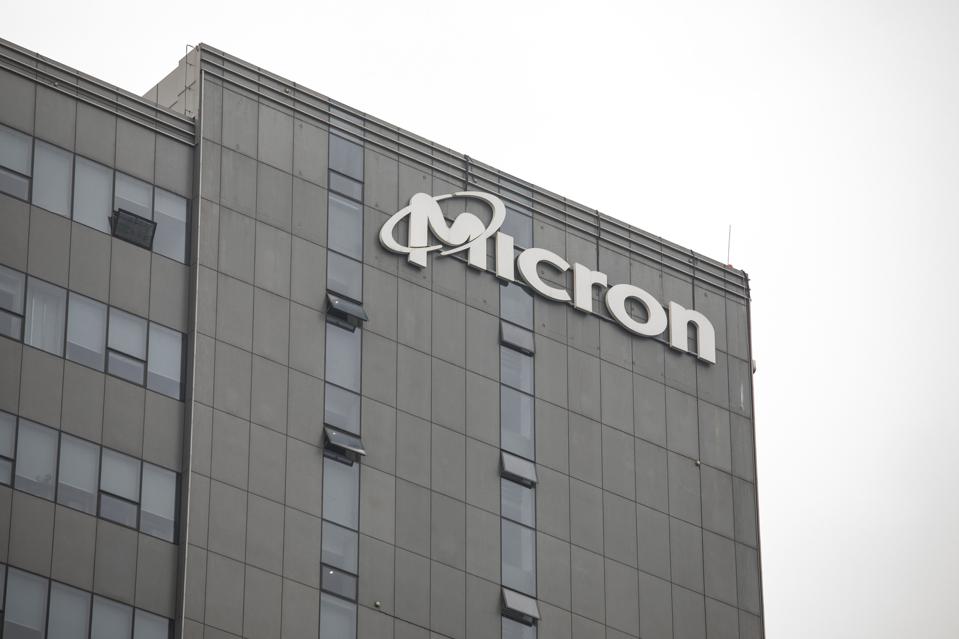
That Forbes interview was published yesterday and can be found here (including 12 minute audio version). I am also reproducing that interview below to capture it in the Assessing China blog. It begins with several scene-setting paragraphs by Forbes Editor at Large Russell Flannery. The interview itself begins below the photograph of Micron headquarters in Shanghai.
(Begin article)
Micron Probe May Hurt China’s Efforts To Attract Foreign Investment
Beijing today wound down its latest large-scale military exercises in the waters around Taiwan but overall tension between the U.S. and China remains high. China’s moves followed a high-profile meeting last week between U.S. House Speaker Kevin McCarthy and Taiwan President Tsai Ing-wen in Los Angeles criticized by mainland leaders who claim sovereignty over self-governing Taiwan.
On the commercial front, the semiconductor industry remains an elevated point of stress. Beijing earlier this month announced a cybersecurity review of U.S. chipmaker Micron aimed, it said, at protecting the country’s information infrastructure and national security. The probe comes at a time when China has been seeking to boost foreign investment to accelerate its economic recovery from “zero-Covid” policies that slowed growth.
What’s next for U.S.-China ties and also for the CHIPS Act, the U.S. law enacted last year aimed at reversing the declining American share of global semiconductor production?
To learn more, I spoke on Saturday in the Philadelphia area with Terry Cooke, a senior fellow at the Foreign Policy Research Institute, a think tank focused on U.S. national security and foreign policy. Cooke, a former career U.S. senior foreign commercial service officer with postings in Shanghai, Taipei, Tokyo and Berlin, currently leads ReGen250, a non-profit that focuses on U.S.-China green energy collaboration as well as environmental regeneration initiatives in the tri-state Greater Philadelphia region.
Cooke believes China’s move against Micron will have “a chilling effect for potential foreign investors — definitely on the U.S. business community” at a time when China is trying to win new foreign investments following the end of “zero-Covid” policies at the end of last year that had harmed economic growth. Beijing high-profile efforts to pressure Taiwan militarily may also be counterproductive if Taipei successful builds itself up as “an important force” in a larger, more influential network of democracies. Edited excerpts follow.
© 2023 BLOOMBERG FINANCE LP
Flannery: What do you make of the military exercises around Taiwan this month?
Cooke: There are two ways of looking it. One is that going into the Tsai-McCarthy meeting, the decision had already been made (in Beijing) that this is the new normal, that whenever there is an uncomfortably high-level contact between the U.S. government and the Taiwanese government, we (the Chinese government) are just going to keep demonstrating our ability to militarily squeeze Taiwan through maneuvers of this sort.
There is, however, another way of thinking about it: the way the McCarthy-Tsai meeting was conducted may, in fact, have been the determinant of the maneuvers. Beijing may have been in a wait-and-see mode. They of course issued their standard and predictable verbal denunciations in advance of Tsai’s transit stops.
I think they were waiting to see how low-key the meeting in L.A. with McCarthy would prove to be. The entry through New York was very low-key. The State Department utterances for most of the trip also kept things low-key. And there was ample precedent for this given Tsai’s previous six transit visits to the U.S. so the State Department position was that there was no reason for Beijing to make an issue out of it.
But the optics of McCarthy meeting – with all the diplomatic trappings of a government-to-government meeting save for flags set up on the table – made it look very much like an official meeting. And I don’t think that went over well in Beijing. That could have triggered the decision to trot out the military.

Flannery: So what’s next?
Cooke: Just as the U.S. is maybe on its back foot with the new realities in the Middle East, I think China may be on its back foot in terms of the game of diplomatic recognition when it comes to Taiwan. Yes, Taiwan just lost Honduras on the eve of Tsai’s U.S. trip. Now, Taiwan is down from 14 to 13 countries that it has diplomatic recognition with.
But I think there’s really a more important game in town now than adding up the number of formal diplomatic allies. This new game in town probably started around February 2021 with the Biden administration moving into the White House. To many people’s and particularly Beijing’s surprise, Biden kept Trump’s tough China policy. He also introduced into his speeches and policies a clear and consistent autocracy-vs-democracy contrast.
Within the context of this U.S.-led “reframing” of the global picture, Taiwan now has the opportunity to reposition itself within the team democracy global network of supporters in a way that it’s not strictly about formal recognition and UN membership. It’s about being recognized, and in some ways, held up as an important force in this network of democracies.
Flannery: How will Taiwan’s presidential elections next year affect these three-way ties?
Cooke: From the U.S. governmental standpoint, the outcome – whether it is a victory for Tsai’s Democratic Progressive Party or the opposition KMT party – will change hardly at all. This is because the U.S. government’s official position – whether it involves the outcome of an election in Taiwan or changes to the cross-strait status quo initiated by China – is that what the 24 million people of Taiwan choose for themselves is what the U.S. government will support. I don’t think our basic diplomatic posture and our support for Taiwan would change unless there was some evidence — which I would not expect at all — of some malfeasance happening with the election.
Flannery: What do you make of China’s probe into Micron?
Cooke: We can dissect it into several elements. One is a desire for reciprocity and being seen on an equal plane. And so with Biden’s CHIPS Act, and the singling out of TikTok and a lot of different Chinese companies in U.S. security investigations, it’s to be expected that there is going to be some reciprocal action that China is going to want to take to be seen as a peer power demanding reciprocity.
That diplomatic posturing is understandable but it does have a chilling effect for potential foreign investors — definitely on the U.S. business community. Close allies in Europe and elsewhere notice it, and it doesn’t help China’s post-pandemic effort to show a welcoming face to foreign investment.
I think there is also a third element of it that is interesting: perhaps as another data-point showing a lack of coordination in Chinese policy and messaging that we see from time to time. And we’re living in a world where nobody is a paragon and the U.S. has its own challenges with coordinating its message. But in China, as we saw recently with ‘wolf-diplomacy’ and the balloon incident, people lower in the governmental hierarchy vie to please their superiors, and end up getting out in front of the intended policy and in front of what would be an optimal coordinated policy for China. And I’m wondering personally whether Micron might be an instance of that.
Flannery: Speaking about both semiconductors and Taiwan, does the U.S. rely on Taiwan too much for chips?
Cooke: It’s actually in almost everyone’s interest at this point to have a greater degree of global diversification. It’s outright dangerous to have close to 90% of production of the world’s most advanced semiconductors taking place only 90 miles away from the Chinese mainland.
Flannery: Does the CHIPS Act go far enough in striking a new balance?
Cooke: Before the CHIPS Act, Taiwan Semiconductor Manufacturing Company (TSMC) was already taking steps (to diversify from Taiwan). There are currently moves afoot in Germany for automotive chip production — not the most advanced chips in the world — but also with Japan for consumer electronics and with Arizona for an advanced generation of chips. (See related post here.) For the foreseeable future, production of ultra-advanced chips will stay in Taiwan. But I think a lot of production capacity for quite advanced chips is being pushed out of Taiwan to these other global nodes.
The CHIPS Act is to my mind pretty fascinating. As a response to China’s Made-In-China-2025 ambitions and its military upgrading, it’s a bulls-eye in my view. But, as a policy undertaking in the U.S. domestic context, it is something of a potential third rail in the sense that, as a country, we’ve never been comfortable or particularly skilled at industrial policy. And it is clearly industrial policy.
Interestingly, I think there is enough bipartisan support right now that the industrial policy-political debate on Capitol Hill is not the traditional debate of “no industrial policy” versus, let’s say, the Clinton era’s “auto industrial policy for Japan.” Nobody at this point seems to be openly challenging the need for an industrial policy response to China’s advanced technology challenge.
So the debate currently is one about “clean” industrial policy versus industrial policy with social agenda items folded into it, like childcare support for workers. (Either way) it is important as a signal to the market about U.S. government resolve.
Flannery: Is it enough? And if it’s not enough, what’s the next step?
Cooke: If, in version one, the sum had been significantly higher than $52 billion, it would have been almost setting itself up for failure, because there are so many things that can go wrong in operationalizing and implementing something like this.
By analogy in the military sphere, we have put in a very robust sanctions regime against Russia following the invasion of Ukraine. But it was kind of uncharted territory. There’s been a lot of analysis about what’s been working and what hasn’t been working. We’re groping our way forward and want to keep some powder dry.
The CHIPS Act is similar in the commercial sphere — kind of uncharted territory. One of the things it has going for is that Commerce Secretary Gina Raimondo is an astute leader of the process. In the current political environment, any sign of dropping the ball would be pounced on. What is actually more important than the amount of money is the fact that it has happened in an initial iteration. There can be subsequent iterations, but it’s important to operationalize the first iteration as well as possible and to learn from that process to inform a potential second iteration.
Flannery: There is controversy about social goals being attached to it.
Cooke: The Act was passed by Congress last year, and it went into a kind of holding period where no one knew what the process was going to be for a company to apply. When the guidelines were only recently announced, it became clear that there was quite a lot of conditionality put on the ability of a company to apply. One set of conditions has to do with an applicant limiting its China business for a 10-year period. Another quite different set has to do with an awarded company providing childcare for its employees.
I think the criticism about these conditions is a fairly predictable output from the Washington DC political meat grinder. Because these are tax-payer dollars, the back-and-forth is highly political. Placing limitations on future China business for awardees makes sense to the average American voter. However, those limitations raise serious concerns for the CEO of a sizable company that doesn’t want to decouple from the China market but does want to access CHIPS Act support. On the separate issue of childcare, this requirement is meant as an incentive to help overcome the problem of a shortage of chip production workers in the U.S but it obviously becomes a red meat talking point for politicians who position themselves as anti-woke in U.S. culture wars skirmishing.
This goes back to what we were talking about before with Micron. China is currently unable to respond in a meaningfully reciprocal way when the U.S. does things like put Chinese billionaires onto an entities list. They just don’t have a global finance tool that is anywhere near as sharp and strong as is found in the U.S. Treasury toolkit. For the U.S., putting companies on an entities list works— it catches the attention of targeted individuals and there is an important and broad public messaging dimension to it as well. Of course, to make sanctions really bite, there’s a lot of operationalization that needs to happen but doesn’t always happen.
What I personally believe is: China’s main effort now is to try to knock the dollar off its post-World War II throne. Others have tried and failed and it will be a hard thing for China to pull off. But I believe that’s this the main thrust of their effort and the primary aim of a long-term, patient strategy.
See related posts:
U.S. Businesses Look To De-Risk, Not Decouple, Their China Ties
U.S.-China Collaboration Could Cut Development Time, Cost For New Cancer Treatments
TSMC Will Triple Arizona Investment To $40 Billion, Among Largest Foreign Outlays
Taiwan’s Biggest Silicon Wafer Maker Eyes U.S. Solar Industry Investment
@rflannerychina
Send me a secure tip.
(End article)
I join Russell in inviting you to leave your thoughts or questions in the Comment section below. (Because of netizen ire in China, I have not always kept the Comments section open in Assessing China but it is open for this post. I would love to hear from you).
After a puzzling on-again, off-again trade action against China’s information and communications technology (ICT) giant ZTE in 2018, the Trump Administration began sanctioning China’s number #1 ICT player Huawei in May 2019. The sanctioning action involved putting Huawei on a Commerce Department “entity list” and thereby restricting U.S. suppliers from selling their goods and technology to Huawei.
As with all of Trump’s trade actions against China, impulse outweighed well thought-out execution in the Huawei crackdown. Initially, some sales were allowed and others denied without clear criteria being communicated to U.S. industry. Later, without preparatory signaling, the Huawei campaign was intensified by expanding U.S. government authority to require licenses for sales of semiconductors made abroad with American technology.
The fitfulness of this policy can be measured by (1) the number of licenses (and dollar value of affected goods and technology) pending but held up in the inter-agency process and (2) the number of licenses (and dollar value of affected goods and technology) which had been applied for by U.S. companies but not processed towards the end of the Trump Administration. (As things stood at the time of the November 3rd election, the expectation was that products in both categories which had clear 5G application would likely be rejected while non-5G products would likely be processed on case-by-case basis.)
Meanwhile, in the international sphere, the Trump Administration pursued a parallel campaign to try to persuade traditional allies to disallow Huawei technology from 5G infrastructural build-out in their respective markets on the grounds that – despite price and performance competitiveness — Huawei’s products represent a national security threat. The results of this international campaign were mixed at best, not least because many of these traditional allies had themselves been targets of different tariff sanctions under Trump’s America First trade policy. Without delving into the changing fortunes of this campaign at different times in different parts of the world, a summary headline on November 3rd might have read “Trump’s 5G Campaign Against Huawei: Embraced in India, Accommodated in the UK, Begrudged in Germany and Repudiated in Thailand and Elsewhere.”
The Biden Administration, while making a quick and clean break from Trump Administration trade policy in the area of climate change mitigation and clean energy technology, has largely kept the Trump Administration domestic policy of restrictive licensing for sales of advanced ICT goods in place. At least, it has made clear that no substantive change should be expected until after the completion of a whole-of-government review of China trade policy and a parallel review of strategic global supply chains which includes semiconductors. In the international arena, it has relaxed the narrowly-focused pressure campaign against Huawei adoption in favor of a more broadly-conceived alliance strategy to rally traditional allies and other democracies to rise to the 21st century challenge posed by China’s autocratic model.
So where do things stand today? The restriction of supplies of U.S. advanced semiconductors to Huawei under both the Trump and Biden Administrations has taken the biggest toll on Huawei. Less impactful but still a headwind for Huawei has been the doubt sown internationally as the U.S. and China edge closer towards global confrontation and supply chain de-coupling. The result? Huawei reported last Friday its third straight quarterly decline in revenues, falling a significant 38% against 2021Q1 results.
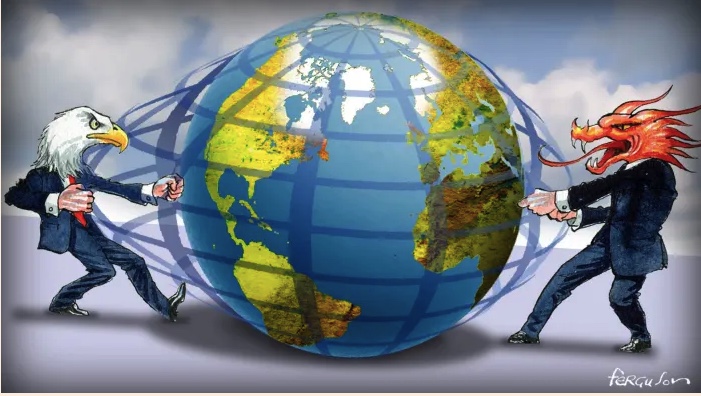
Huawei is likely to remain at the center of a highly-fraught tug-of-war between the U.S. and China over 5G. On one side, China has ability to leverage the world’s largest installed base of advanced mobile phone users in the world. On the other, the U.S. dominates the global market for the advanced microchip designs on which advanced telecom markets depend. And the U.S. maintains close partnerships with the world’s leading microchip fabricators in Taiwan and the makers of the world’s leading fabrication equipment in the Netherlands and elsewhere.
Expect more tremors and seismic activity on this fault-line for the foreseeable future. Just last week, the PRC government issued retaliatory actions against Huawei’s main Western rivals – Sweden’s Ericsson AB and Finland’s Nokia, among others. And, as fall-out from the recent spread of the SARS-COV-2 Delta-variant in China, it was announced over the weekend that the World 5G Conference – scheduled for August 6-8 in Beijing – would be postponed indefinitely. Pressure continues to mount while chances to release that pent-up pressure close off.

Last week, ReGen 250 — the 501c3 non-profit with which the TEA Collaborative is associated — celebrated its 10th Anniversary. To mark the occasion, it’s timely to cast an eye back and quickly survey the road traveled to fix where the TEA Collaborative stands today.
We’ll cover the tech perspective, the energy & environment perspective and the PRC planning ambitions perspective in separate T-series, E-series and A-series posts this week.

My focus on technology issues, especially supply chain issues for advanced ICT (information and communications technology) products involving the U.S.-China-Taiwan triangle, was most intense prior to the founding of ReGen250 in 2011. Some highlights include:
- Three-time Invited Congressional Commission Expert Witness at the U.S.-China Economic and Security Review Commission’s Public Hearings on Global Supply Chains and Cross-Straits Security Issues (109th, 108th, and 107th Sessions of the U.S. Congress)
- Director and Head of Partnership Development, Asia at the World Economic Forum (with strategic focus on ICT, Energy, Transportation, Finance industries)
- Author of The Politics of Greater China’s Integration into the Global Info Tech Supply Chain in The Journal of Contemporary China, Vol. 13, No. 40; and of Taiwan’s FTA Prospects from the Global IT Supply Chain Perspective in Economic Integration, Democratization and National Security in East Asia, edited by Peter C.Y. Chow
- Green Team Leader on Cross-Straits Economics, U.S. Dept. of Defense/Defense Intelligence Agency Strategic Coercion Wargame convened by Science Applications International Corporation (SAIC)
- Invited Non-Governmental Expert Participant, Asian Scenario Seminar Game at the Army War College, Carlisle, PA
- Co-organizer of The Role of Taiwan in the Post-WTO Global Supply Chain Workshop at the 19th Modern Engineering & Technology Seminar
- Official Host (“Ambassador”) for the Taiwan Delegation at World Congress on Information Technology XV in Austin TX
- Featured Speaker & Seminar Consultant – RAND Corporation, MITRE Corporation
- Keynote/Plenary Speaker at large scale media (Forbes, BusinessWeek, Reuters, The Economist Conference Group) and investor (Berkshire-Hathaway-themed 3rd Annual Global Investment Conference, China’s Financial Markets Conference, New York Cleantech Investors Forum, National Association of Business Economists/NABE) conferences
- Moderator at Fabless Semiconductor Association and Wharton China Business Forum annual conference events
- Advisor on Global Business Outreach, The Lauder Institute, University of Pennsylvania
- Invited Think-tank Speaker: CSIS, AEI, Heritage, Brookings, etc
For the TEA Collaborative, this perspective has been brought to bear in a number of recent posts:
- Timing Matters — situates Taiwan’s role in the global supply chain for microchips and other advanced ICT products
- U.S./China Tech De-Coupling: 4 Levels of Risk — assesses the Trump Administration’s fitful tech policy toward China
- Fiddling Around with U.S.-China Tech – brings perspectives from the boardroom, the cultural sidelines and from history in reviewing Trump Administration tech policy toward China
- TikTok Endgame Against the Timeclock – surveys tensions between the U.S. and China as relates to social media companies in general and TikTok in particular
- Taiwan Straddles U.S.-China Microchip Supply Chain Fault-line – takes a sounding of Taiwan’s position as supplier of 40% of the world’s chips and 80% of the world’s most advanced chips
- 21st C. Tech Tug-of-War between China and the U.S. – takes a look at what it will take for the U.S. to compete more effectively against China to retain tech preeminence in the 21st century
This are representative of the most consequential questions and challenges underlying U.S.-China relations at the present moment. They are at the core of the whole-of-government policy review towards China now being coordinated by Kurt Campbell and the National Security Council. Ironically, these issues were dismissed by the American Enterprise Institute when Ambassador Jim Lilley introduced me to AEI for a day-long series of interviews preparatory to a possible appointment back in 2002. AEI’s conclusion at the end of the day as their senior leadership explained their decision not to make an offer? These were all questions which the free market would sort out and there’s no role for AEI or policy makers to play. Ideologically consistent perhaps but hardly prescient.

“We are in competition with China and other countries to win the 21st century,” Biden said on April 28th. “We are at a great inflection point in history. We have to do more than just build back better. … We have to compete more strenuously.”
The question we are examining today is what does “compete more strenuously mean.” I’ll be identifying four distinct fields in which heightened competition is likely to come to the fore but first some context and disclaimers.
The first point to note is that, in President Biden’s own words, some partial answers are already clear. Biden has made clear that he sees this 21st century competition as one between the US and its democratic allies on the one side versus Xi, Putin and other autocratic leaders on the other side. in other words, the heart of the competition is democracy versus autocracy. What Biden has also made clear involves timing, that the competition will not be joined in earnest until the U.S. has emerged from the worst of the COVID-19 pandemic and largely revitalized the performance of the U.S. domestic economy.
Two caveats are also in order. The analysis provided below is strictly my own. The Biden administration – under Kurt Campbell, deputy assistant to the President and coordinator for Indo-Pacific Affairs at the National Security Council — is currently directing an assessment under which cabinet-level departments and some agencies are re-viewing their policies and procedures as they relate to China. These departments and agencies will be reporting their findings to the White House later this year at which point Kurt Campell, his senior director for China Laura Rosenberger, and their staff will be synthesizing these inputs and articulating an updated “whole of government” policy towards China. (This process is consistent with the ‘get our house in order now’ before focusing on generational competition with China, as referenced above.) Clear answers to the question we’re examining today likely won’t be rolled out by the Administration until that process is complete.
In the meantime, the single best open-source for a quasi-authoritative readout of Biden’s thinking on what heightened US- China technology competition will look like may be the Penn Biden Center. While I am affiliated with Fox Leadership International under the School of Arts and Sciences at Penn, I want to make clear that this blog post does not draw on any information from that source. This is my analysis and I bear sole responsibility for any deficiencies.
So, on to the substance …
At the broadest level, the U.S. needs to up its game in four areas of traditional strength to respond more effectively to the 21st century tech challenge from China:
Field 1: Industry Sector Focus
NASA’s manned mission to the moon and DARPA’s role in the creation of the internet are the most storied examples of U.S. Government success in mid-wiving new high technology industries. What has changed since those early post-war successes is the subsequently accelerated pace of technology innovation and development in the Fourth Industrial Age. In fields as diverse as semiconductor design and fabrication, 5G telecommunications, artificial intelligence and robotics, quantum computing, EV batteries and biotechnology, U.S. government policy is currently nowhere near as focused in positioning its support role as is China. What is called for is not a return to 20th century “industrial policy” (and its poor record of picking company-level winners and losers) but a new, 21st century approach to policy support to better prepare eco-system support for the emergence of entire new industries.
Field 2: Funding for Innovation & Regulation of Foreign Acquisitions
Despite the recent trend-line of falling investment in basic research in the U.S. and increasing levels of basic research investment in China, the fact remains that China is still no match for the U.S. in terms of the breadth, depth and quality of its basic research or of the commercial potential of the developments it spins off. This is readily apparent in cutting-edge fields like advanced semiconductor design and gene therapy. In these fields, China can’t put a home-grown team onto the field but instead tries to snap up foreign talent and fledgling foreign companies in hit-or-miss hopes of leveraging that into a domestic breakthrough. Committee on Foreign Investment in the U.S. (CFIUS) and other related government entities need more focus on the dynamics underpinning tomorrow’s industries and less on yesterday’s. Likewise, less silo-ing between basic research and commercial development is urgently needed.
Level 3: Rule of Law
Perhaps no societal field offers greater contrast between the U.S. and China than the field of law and legal practice. The U.S. system of case law based on precedent stretches back to the time of the Saxon Kings of England (with very occasional admixtures from the Roman system of law more common to Continental Europe). As enshrined in the U.S. constitution, ours is the rule of law, not the rule of men (or women). While the Chinese Communist Party (CCP) has borrowed legal ‘parts’ from a wide variety of sources since 1949, the legal system it has assembled from those parts is principally designed to serve the interests of the governing party rather than to protect inherent rights of its citizens or its private companies. It is rule by law, rather than rule of law, as was vividly demonstrated with the imposition of the new security law in Hong Kong in the summer of 2020. Despite the slowness and costs associated with it, the U.S. legal system provides a level of predictability and protection for investors and businesspeople which can’t be matched in China. We can expect to see the Biden Administration act to shore up the foundations of this legal system following the strains put on it by the previous administration.
Level 4: Wellsprings of Economic Vitality
Two of the deepest sources of support and revitalization for technology innovation in the U.S. are immigration and our capital markets. Immigration brings a steady stream not only of young and eager workers but also on occasion transformational business talent such as Sergey Brin and Elon Musk. Our capital markets spread risk over a broad pool of investors and investment vehicles, incentivize iconoclastic thinking and efficiently channel capital to the points of likely greatest return. While China has through its tax policy been impressively building an investment-led structure for its markets, the efficiency and speed of execution of the U.S. capital markets can’t be matched in China. In broad view, China currently tries to leverage its centralized leadership and ‘command economy’ model to try to neutralize this U.S. advantage as well as hoping to ride the momentum from its high-growth domestic macro-development over the last four decades (and the internationalization of that development model over the last ten years). How China fares in field of competition in the years ahead as it emerges from its fast-growth phase of development and collides with a dire demographic imbalance will be one of the more consequential questions of the early 21st century.

Editorial Note: Upcoming posts in the TEA Collaboratives T-series on technology topics will pick up and expand on some of the topics identified above. Our focus in this Technology Competition sub-series will mostly fall under the industry and innovation topics identified above but we will also have occasional invited guest experts to delve more deeplly the legal and capital markets topics. Also, it’s important to note explicitly that the viewpoint expressed in this post and other future posts in the series are obviously a perspective from the U.S.-side. We will present the ‘emic’ view (as seen through the eyes of Chinese government planners and officials) separately through our A-series (Ambitions) posts which appear on Fridays.
As a final note, the Technology Competition sub-series posts introduced in today’s post will alternate on Mondays with our TECH-tonics sub-series posts (which focuses exclusively on issues associated with the micro-electronic supply chain fault-line between the U.S. and China passing through Taiwan). In any given month, we’ll be producing in alternating fashion two posts in the TECHtonics and and two poss in the Tech Competition sub-series.
On June 8th, the Biden Administration announced immediate actions it was taking to address near-term vulnerabilities in four critical supply chains as identified by a 100-day America’s Supply Chains assessment initiated in late February. The four critical supply chains included in this announcement are: semiconductor manufacturing and advanced packaging; large capacity batteries, like those for electric vehicles; critical minerals and materials (so-called “rare earths”) used in smart phones, electric vehicles, wind turbines and other advanced technologies; and pharmaceuticals and active pharmaceutical ingredients (APIs) used in vaccines and other applications.
Today’s post takes an initial high-level view of the critical supply chain for semiconductor manufacturing and examines the shifting fault-line of vulnerability. Subsequent posts in the Global TECHtonics series will take a much closer look at these and related issues.
Photo: barks/Adobe Stock
What is the Fault-line?
The semiconductor supply chain fault-line runs directly under Taiwan, whose chip foundries produce 92% of the world’s most advanced microchips (which have transistors less than one-thousandth the width of a human hair). The small island is caught between the tectonic forces of the China market (which accounts for 53% of global semiconductor consumption and the U.S. market (which accounts for the vast majority of the advanced designs on which Taiwan chip production is based). In addition to these market forces, political dynamics add to the stresses along this fault-line. While China claims Taiwan as an inalienable part of its territory, the U.S. has been serving as the guarantor of Taiwan’s de facto independence since 1949. In more recent years, the Trump Administration’s “Tariff War” against China has given impetus to a process of technology “de-coupling” which is forcing Taiwan companies – especially its preeminent foundry manufacturer Taiwan Semiconductor Manufacturing Company (TSMC) – to choose between the fast-growing China market (34% revenue growth since 2014) and its slower growing (4% growth) but highly strategic U.S. customers, including the U.S. military. The fact, for instance, that 14 of TSMC’s 17 foundries worldwide (and all of its foundries capable of higher-end production above the 16 nanometer level) are located in Taiwan at a distance of just 90 miles from the PRC mainland adds to the tectonic friction.
What is the Trend-line?
Subsequent posts in the Global TECHtonic series (approximately two per month) will examine a broad range of dynamics in detail to include the impact of the COVID-19 pandemic on global microchip supply chains, specific dynamics within microchip subproduct categories (logic chips, analog chips, memory chips, etc), TSMC’s strategic response to the increasing global pressure and detailed analysis of trends within the U.S. semiconductor industry. Today’s post will limit itself to two broad brush-strokes to suggest the general trend-line: (1) the twenty-year trend-line since 2001 and (2) the one-year trend-line since 2020.
- The accession of China and Taiwan to the World Trade Organization (WTO) in 2001 led to hopes that Information and Communications Technologies (ICT) supply chain tensions might start easing but, from 2008 at least, the opposite has proved true. Following the Global Financial Crisis, market forces and competitive tensions increased pressures on ICT supply chains markedly and these pressures further accelerated starting in 2012 following the 18th Chinese Communist Party Congress in 2012. (Readers interested in a deeper understanding of the ICT supply chain dynamics covering the period 2001-2008 can refer to Congressional Commission testimony I provided during the 107th, 108th and 109th Sessions of Congress as well as to my article in the edited volume Economic Integration, Democratization and National Security in East Asia (Peter Chow, Elgar Publishing) and my article in The Journal of Contemporary China (Volume 13, Number 40, 2006).
- The past year has shown some notable shifts along this fault-line. In Taiwan, policies instituted by President Tsai Ing-wen have led to a small shift in Taiwan’s trading dependence on China and to larger shifts in the pattern of outbound and inbound investment involving China. Specifically, the Tsai Administration’s New Southbound Policy has shifted a small portion of Taiwan’s trade in consumer electronics away from China in favor of Southeast Asian markets. More notably, the “Invest Taiwan” program has exceeded its targets and much of the reinvestment in Taiwan comes as a result of production being repatriated from the mainland. As for outbound investment from Taiwan in ICT sectors, recent trends favor the U.S. as a destination rather than China. In March 2020, TSMC announced that it would be building a $12 billion microchip production plant in Arizona. Meanwhile, tighter regulations by Taiwan’s Investment Commission has led to a 60% drop in outbound investment to the mainland since 2018.
It is for these and other reasons that the New York Times recently proclaimed “pound for pound, Taiwan is the most important place in the world.” The Strait of Hormuz may have been the world’s most dangerous fault-line in the 20th century oil economy. In the 21st century, the tectonic pressures of the global economy now converge on the Strait of Taiwan.
Volume 2, Number 2 in Global TECHtonics: U.S./China Fault-line series
One of the most memorable moments from the two months of A-100 training I received upon entry into the U.S. Foreign Service was a leadership training film about the 1985 Bradford City Football (Soccer) Stadium fire. A small fire, sparked in a code-violation trash pile, was quickly whipped by winds into a fire engulfing substantial portions of the stadium. The raging fire trapped spectators, killing 56 and injuring at least 265.
Filmed on-site during the panic, the key point in this very graphic film involved the challenge of communications in a crisis. As described by Wikipedia, “In the mass panic …, fleeing crowds escaped on to the pitch but others at the back of the stand tried to break down locked exit doors to escape, and many were burnt to death at the turnstiles gates, which had also been locked after the match had begun.” The specific problem was that people at the front of the mass of people trying to flee from the gates quickly recognized that those gates were locked but, in the panic, could not communicate the problem back to the people pressing forward from behind. Had clear communication been possible, everyone could have found an alternative exit. As it was, scores of people ended up pinned against the gates and perished.
The lesson for the U.S.-China technology upheaval currently underway is straightforward: the implications of the upheaval appear different to different parties, depending upon their position in the field of action, and there is danger of differing reactions and poor communications compounding the danger and likewise leading to tragedy.
The goal of this post is to set out in very general terms the different industry groups affected by the Trump Administration’s efforts to date to “decouple” the U.S. and Chinese tech spheres – denying various sub-sectors of the Chinese tech industry access to the U.S. market, incentivizing U.S. firms to bring their production from China back to the U.S., and also encouraging allied governments to reinforce both approaches. There are four major technology sub-sectors that, to date, have been affected by these policy moves. In addition to providing simple, thumbnail descriptions of each of these four sub-sectors and how they have been affected by the Trump Administration policy approach, we will also rank them in terms of national security risk and look at the potential for a seismic reaction being triggered.
A simple way of assessing national security risk and gauging the related potential for a Bradford Stadium-type chain of events is to think in terms of crisis management. Crisis management experts generally identify four distinct stages as a true crisis develops. The following is drawn from the Crisis Prevention Institute’s Crisis Development Model:
- Anxiety
Anxiety prompts changes in behavior and looking at things differently. It’s a time to listen and observe, not dictate what should happen next.
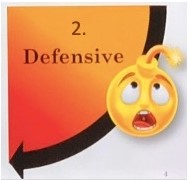
- Defensive Behavior
Defensive behavior can be a natural escalation of anxiety; it’s the point where actors in crisis begins to lose rationality.
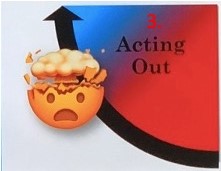
- Risk Behavior
Risk behavior is displayed as actors enter crisis and reach the point of propensity to harm themselves or others.
- Tension Crisis
Every crisis reaches a point of meltdown or tension reduction. Crisis behaviors, as they escalate, expend a tremendous amount of energy.
So here we go …
 Level One
Among the earliest Trump Administration actions targeting technology products from China involved the use of tariffs. While the various rounds of tariff actions are too technical and convoluted to get into here, a few broad generalizations can be made. First, the tariff actions put into effect were more targeted to electronic components than to finished electronic consumer products. For instance, componentry for modems, routers and televisions were subject to two rounds of steep tariff increases and microelectronic chips were assessed a hefty 25% tariff while consumer products such as cellphones, laptops and video games, despite a series of threats by Trump to impose tariffs in the summer and fall of 2019, have still not been hit with any tariffs to date. The President’s advisors apparently convinced him, as the Christmas season approached, that voters would not take kindly to sudden price increases for these products. Second, there is little evidence to suggest that these tariffs inflicted enough pain on Chinese technology manufacturers and exporters to induce them to substantially change their behavior or to protest loudly to their government for relief. Tariff increases can be absorbed at any link in the supply chain stretching from the manufacturer and its supplier network (in China) to the importer, distributor and retail outlet (in the U.S.) or, alternatively, can end up simply be passed on to the consumer (in the U.S.). Preliminary analysis indicates that the U.S. side of the supply chain in technology products has likely absorbed as much pain from these rounds of tariff actions as the Chinese side has been forced to absorb. Third, tariffs are the quintessential sledgehammer used to crack open a peanut. Even if they actually hit the peanut, it tends not to yield anything worth the effort and can cause considerable damage to the surroundings.
At the same time that the Trump Admistration was rolling out waves of tariffs to target imported goods from China, they were also tightening and expanding limits on investment into the U.S. by Chinese technology companies – as well as certain other types of companies – on the grounds that they represent a risk to U.S. national security. The mechanism for achieving this was through expansion of the review powers of the Committee for Foreign Investment in the United States (CFIUS), an inter-agency body comprising nine cabinet-level departments and chaired by the U.S. Secretary of the Treasury.
As with the tariff actions, the heightened scrutiny of potential Chinese investments into the U.S. by CFIUS served primarily to send a political signal to the Chinese side that the commercial and economic climate was getting chillier for Chinese companies in the U.S. Chinese companies looked for work-arounds, adjusted their business plans, and in some cases looked to other world markets to take up the slack. These two sets of actions caused some tremors but did not cause the ground to fundamentally shift under U.S.-China relations. This represented, broadly speaking, the Anxiety Phase of the building crisis.
 Level Two
The first indication of a second, potentially more consequential level of tension occurred in the spring of 2018, as President Trump was repeatedly threatening to levy tariffs on China but before the imposition of the first round of tariffs in July of that year. That second front involved Shenzhen-headquartered ZTE, one of China’s largest makers of smartphones and telecommunications equipment. In March, two ZTE affiliates agreed to a civil and criminal penalty of $1.19 billion for having illegally shipped telecommunications equipment to Iran and North Korea. Two months later, after it was found out that ZTE had failed to reprimand and had, in fact, paid bonuses to the executives involved in those illegal shipments, a seven-year ban on the export of U.S. components to supply ZTE’s manufacturing facilities in China was instituted. This ban was widely viewed as a likely ‘death sentence.’ The manufacture of ZTE smartphones would not be possible without access to U.S.-made microelectronic hardware and Android operating system software. Moreover, the fact that ZTE had been designated as a risk to U.S. national security hung like a sword of Damocles over the country’s future. But, almost immediately, the sentence was lifted without clear explanation. On May 13th, President Trump tweeted “President Xi of China, and I, are working together to give massive Chinese phone company, ZTE, a way to get back into business, fast. Too many jobs in China lost. Commerce Department has been instructed to get it done.” One week later, the U.S. Commerce Department eased the restrictions and on June 7th a deal was reached whereby the Chinese company agreed to complete a $400 million escrow payment in return for the complete lifting of the seven-year export ban.
The whole sequence of events was somewhat baffling except for what it indicated about President Trump’s penchant for injecting himself personally into company-specific matters and for taking public and dramatic steps to build his rapport with President Xi. There is widespread speculation that Trump hoped, through this off-again on-again courtship of Xi, that he would get a trade deal which would allow for the lifting of the whole raft of “Level One” tariffs and give him a major trade deal to tout in the run-up to the 2020 elections.
It was not to be. U.S. and Chinese trade negotiators continued to slog through their negotiations inconclusively and an apparently frustrated Trump and the U.S. national security apparatus soon turned their attention to an even larger target than ZTE–Huawei, China’s national champion in that industry space. Founded in 1987 by Ren Zhengfei, a former army officer, and also headquartered in Shenzhen, Huawei employs 200,000 and manufactures telecommunications equipment, particularly equipment used in the infrastructural backbone of the new 5G standard for telecom, and consumer electronics, particularly smartphones. As was the case with ZTE, the Trump Administration voiced a specific legal concern and general national security concern in launching its campaign against Huawei. The legal matter concerned charges that Huawei too had created elaborate corporate structures to evade the U.S.-led “maximum pressure” sanctions regime against Iran. Specifically and most visibly, that legal issue crystallized around the detention in Canada of Ren’s daughter and Huawei CFO, Meng Wanzhou in early December 2018. The charges, unveiled publicly by the U.S. Justice Department in late January 2019, alleged a decade-long attempt by Huawei and Meng to steal trade secrets, to obstruct a criminal investigation and to evade economic sanctions on Iran. Canada was asked to extradite Meng to the U.S. to face trial on these charges.
The broader national security issue behind the campaign against Huawei centered on the charge that the Chinese government would be able to get access to the torrent of data coursing through next generation 5G telecom networks. To the extent that Huawei-supplied network components are built into the backbone of those networks, Huawei could gain access to the data. And, the thinking goes, that since Huawei is a China-based, PRC-supported champion company, Huawei would have no ability – protestations by the founder and company spokespeople to the contrary – to resist Chinese government requests for access to that data.
The two characteristics of the still on-going U.S. government-led campaign against Huawei which sharply distinguish it from the earlier actions against ZTE are its long duration and its expansion to the international field. Each one of these two characteristics presents complexity which defies easy summarization. Future posts will examine the international dimension of this campaign which has brought the Trump Administration some hard-won headway but also a sometimes stunning level of push-back and public repudiation from traditional allies.
For now, the point is simply that the initial evanescent campaign against ZTE and now the sustained campaign against Huawei can together be thought to represent the second level of effort, and risk, in forcing U.S.-China tech decoupling. Representing a natural escalation of the anxiety provoked by the various tariff rounds, these two sets of actions – and, particularly, the Huawei campaign — reveal factors of irrationality coming into play. On the Chinese side, the issue is a personal affront to Xi Jinping. It is also catnip for the millions of Chinese “netizens” who use nationalistic vitriol and memes to inflame public opinion which, in turn, further narrows the options available to Xi and his government policy makers. On the U.S. side, Trump Administration officials have tried to cajole other countries into raising their own costs and slowing their own transition to 5G by foregoing Huawei equipment without providing specific evidence of the claimed threats to help countries justify taking these steps. Domestically, the Administration has failed to provide a clear rationale and consistent messaging so that the public can assess the risks. Instead, the Administration has framed the issue in terms that are highly personalized to Trump and in a tone that is more macho than rational. It has become, in effect, a bullet point in Trump’s “I’m tougher on China than Sleepy Joe will ever be” reelection strategy.
The factor which has perhaps kept these actions from destabilizing U.S.-China relations even more is that the U.S. doesn’t have its own horse in the 5G sweepstakes. The two major competitors to Huawei are Ericsson (Sweden) and Nokia (Finland). The fact that European allies have been so reluctant to sign on to the U.S. campaign against Huawei, even though two major EU companies stand to gain competitively, underlines just how weak the national security case which Trump officials put forward has been. Over recent months, as the campaign has made some headway following an initial and embarrassing series of stalls out of the gate, Samsung (Sourth Korea) has also emerged as a potential provider of 5G telecom infrastructure components.
 Level Three
A third, but more nascent, level of conflict is now beginning to take shape around social media networks and search engine companies. The players at center-stage of this now emerging drama are the tech giants: Apple, Google, Facebook, Amazon and Microsoft in the U.S. and Baidu, Alibaba, and Tencent (the so-called ‘BAT’ trio) and Bytedance in China. For U.S. readers not familiar with the commercial landscape in China, Baidu, the weakest of the trio, makes money, somewhat like Netflix, principally through advertising and content subscription services built around its Baidu search engine. Alibaba, the strongest of the trio, operates a vast Amazon-like selling site for both business (B2B) and consumer (B2C) end-users. Leveraging extraordinary global reach and profitability with this base of operations in e-commerce sales and delivery, the Alibaba family of companies is increasingly branching into business areas as diverse as cloud computing, media and entertainment, microfinance and tourism. Tencent is the owner of WeChat, a multi-purpose messaging, social media and mobile payment app which has achieved far greater penetration in the Chinese market – and has become more of an indispensable feature in the lives of its users — than any comparable app has achieved in the U.S. Bytedance is the owner of the massively popular TikTok app.
The market access picture for U.S. firms in China has been markedly less open than that traditionally enjoyed by the above Chinese firms in the U.S. Put simply, there has not been reciprocity and the U.S. Big Five Tech Giants have long faced restrictions limiting their ability to do business in China. This is a direct reflection of the Chinese government’s sensitivity, verging on paranoia, about its citizenry’s ability to access sources of information beyond the government’s control. (The three pillars of control for the Chinese Communist Party (CCP) have been, even before assuming control of the nation in 1949, the so-called Three P’s – the Party, the PLA (People’s Liberation Army) and Propaganda). Of the five U.S. companies, Apple’s iPhone and Microsoft’s personal computers and LinkedIn business networking service have enjoyed relatively freer access to the Chinese market, though that access is nonetheless significantly constrained. Microsoft, which has had a presence in China since 1992, has fared the best. Its operating system controls more than a third of the market in China and through its research center in China (its second largest in the world), Microsoft works closely with major Chinese companies on innovative product development. Apple has enjoyed some access for its iPhones, however, the iPhone’s penetration has been limited in China by its high price-point and positioning as an aspirational brand undercut in price by Huawei and Xiaomi. The other three companies have been largely shut out of the market: Google by its refusal to accede to demands, explicit and implied, to make search results and other data available to the Chinese government; Facebook has flatly failed to get government permission to operate in the Chinese market despite years of personal lobbying by Mark Zukerberg (which included Zuckerberg learning Mandarin, recommending Xi Jinping’s book to his employees and even asking Xi Jinping to suggest a name in Chinese for his baby); and Amazon, which faced stiff price competition from Alibaba and JD.com, decided in early 2019 to shut down its uphill effort to build an e-commerce marketplace business in China.
While fierce competition is an undoubted factor in explaining some of this picture of limited presence by the U.S. tech giants in China, government policy is the paramount issue. As previously mentioned, an overriding element of the government’s restrictive policy has to do with control over information. An additional element has to do with the government’s drive – also seen in the aerospace and financial sectors – to give homegrown companies a protected space to grow domestically in order to develop into global competitors and foreign exchange earners. That this is inconsistent with commitments which China made upon entry into the WTO in December 2001 is a cause of concern for the global community. That it creates an unequal playing field for U.S. firms in China is a common concern shared by both political parties in the U.S. and needs to be addressed. That there is evidence of Chinese firms using their penetration of the U.S. market to conduct unauthorized data collection from U.S. citizens is even a greater matter of concern, one that demands strong and strategic counter-measures.
On this last point, it is an established and publicized fact that WeChat has been used to collect data from the devices of U.S. citizens on U.S. soil without the individual’s or the U.S. Government knowledge and, of course , without any legal authorization. Any and all information on a compromised device is at risk in these instances. The pattern of known instances of compromise suggests strongly that there has been a directed campaign by the PRC at work rather than a series of random or accidental intrusions by Tencent. Substantially more information on this vulnerability is known within U.S. government circles than has been shared to date through public sources.
It is this type of vulnerability which is the behind the Trump Administration’s announcement on August 6th of this year of signed Presidential orders to ban commercial transactions with WeChat’s parent company, Tencent, and with Bytedance, Tiktok’s parent. The fact that 60% of users of the TikTok platform are under the age of 24 make it seem, at first blush, to be an unlikely target for PRC government-directed surveillance. But closer inspection shows that risks are not negligible. There is the established precedent from WeChat. There is the vast user base – 85 million in the U.S and 1 billion worldwide. Also, as any expert will tell you, surveillance and espionage seek to exploit any vulnerability and one’s children can be a significant vulnerability. Finally, younger people are disproportionately represented in the workforce of some of the most innovative and cutting-edge industries.
I will have occasion in the future to post on several aspects of this emerging arena of U.S.-China conflict. One topic involves the “geo-commercial” advantage which China enjoys with its population size, its unmatched number of smart-phone users, and its lax privacy laws, standards, and public expectations. As a result of these factors, Chinese companies are able to develop algorithms for new products and services more effectively and efficiently than their competitors. Bytedance’s TikTok is itself an example of this phenomenon. A second topic will be ‘balkanization’ of the Internet which will accelerate as the U.S. and China continue to de-couple and de-globalize their tech interests. A third topic will be the decisive role which India is likely to play in this contest as it balances its position as a massive market for cut-rate, Chinese-made smart-phones and as an important English-language strategic partner for Facebook and other U.S. social media and internet content and service providers.
For now, we can wrap this section with the observation that this emerging front in U.S.-China tech de-coupling involves a unique level of risk. It is so entwined in the lives of so many users and it touches on the core interest of so many behemoth companies in both the U.S. and China that it is markedly different from the risks found on the ZTE and Huawei front. While we are likely just in the early days of this new sphere of competition, it brings the U.S.-China relationship clearly into the third, risk behavior phase of the crisis development cycle. As this front continues to become a focal point, the public attitude and corporate bottom-line interests at stake are so core that entry into a mutually-destructive cycle of action and counter-action is almost foreordained unless both sides exercise great discernment and discipline.
 Level Four
In last week’s post, Timing Matters, we touched on the issue of supply chains for semiconductors and advanced electronics. Because these products are the ‘brains’ behind entire emerging industries – artificial intelligence and robotics, autonomous vehicles, the commercialization of space, and others – this is where the United States’ and China’s economic competition is most fierce. Because these supply chains inextricably pass through Taiwan and Taiwan-headquartered industry leaders like TSMC – the economic risk is compounded by political risk.
The Assessing China ”Global TECHtonics: U.S./China Fault-line” series will delve much more deeply into this issue in the months ahead. Suffice it to say for now, that microelectronics and the global supply chains which help produce and distribute semiconductors and related products globally will be the fault-line which either ends up triggering a cataclysmic upheaval between the U.S. and China or, through inter-governmental negotiation, helps to settle the entire relationship on a new, more stable and sustainable basis.


 ______Assessing China / The TEA Collaborative______
