
You are currently browsing the category archive for the ‘BRI’ category.
Xi Jinping departed Moscow eight days ago following his three-day state visit. In broad brush, the trip removed some uncertainties about the basic direction of Xi’s positioning on the global stage. No, this was not a peace-broker’s mission. Xi clearly prioritized propping up a faltering “friend without limits” over any serious — or even half-hearted — effort to play the honest broker. Washington and Kyiv still want Xi to talk with Zelensky (likely) or perhaps even visit Kyiv (unlikely) but the aim is not for any mediation by Xi but rather to reinforce the messaging to Xi about not sending lethal armaments to Russia. And, no, Xi seems quite clearly to be prioritizing the recovery of his wobbly economy over the risk of sanctions from the U.S., Europe and key Asian partners should he defy the Biden Administration red-line against China supplying Russia with lethal armaments.
As the third door opens, it’s now possible to glimpse some of the finer brush-strokes of Xi’s long-term plan to counter the liberal, rules-based world order. These are revealed in the 9-point joint statement released by Putin and Xi at the conclusion of Xi’s Moscow visit as well through related moves by China on the world stage. Five of the more subtle brush-strokes to observe:

- Xi used his trip to signal to Washington and to NATO and its other democratic allies that China now largely has Russia under its thumb. It can draw increasingly on Russia as a plentiful supply of heavily-discounted oil and other energy resources. Similarly, it can address its own food insecurity and inflation concerns by throwing its market open to Russian food commodities at cut-rate prices. It can force Russian banks and the Russian financial system to do its bidding (see next point). And it can count on Russia to parrot its propaganda line with particular focus on Africa, South America and the Pacific region. All of this serves to prop up Putin and prolong the war, serving Xi’s interests without triggering retaliation against China.
- Xi revealed that his weapon of choice to counter the post-WWII world order will not be lethal armament deliveries to Moscow but the Chinese yuan (RMB, renminbi). Moreover, he put the brush in Putin’s hand for this particular stroke. Towards the end of the summit, Putin pointedly stated “We (Putin and Xi) are in favor of using the Chinese yuan for settlements between Russia and the countries of Asia, Africa and Latin America.” From a broad strategic perspective, it makes perfect sense that Xi would choose this approach. Why risk retaliation by getting involved in a hot war in Europe (where Russia is losing ground), when China can force Russia to support a Chinese-led challenge to U.S. dollar domination elsewhere throughout the world. The standing of the dollar as the world’s reserve currency is arguably the United States’ most potent, non-military asset globally. Others have tried to dislodge it and have failed. But, as the world’s second largest economy, as the de facto leader of the developing world for the past 50 years, and as a vise-grip political command structure, Xi clearly sees this approach as his best bet for now (while the Taiwan issue still hangs unresolved in the background).
- Putin’s statement comes not as an announcement of any new undertaking by Xi but rather as an exclamation point on an ever-evolving geo-strategic campaign which Xi has been conducting in Asia, Africa and Latin America since 2012 in the form of Belt and Road Initiative (BRI). There is particular urgency to this campaign now in the wake of the COVID pandemic and the recent rapid rise in U.S. interest rates. As a result of these developments, many BRI partner/client countries now find themselves unable to service their earlier loan obligations to China. To adjust, China has been forced to dramatically increase its overall lending through loan restructurings to keep major BRI projects afloat. As a result, Chinese lending to debt-ridden countries now stands at more than $40 billion, not far off the level of the traditional, post-WWII lender of last resort, the International Monetary Fund (IMF), whose loan exposure stands at more than $65 billion. While a strain on PRC finances, this hefty lending posture gives Xi the ability to speak softly (through Putin) while carrying a big stick against the dollar-denominated international order.
- China’s burst of Mid-East diplomacy is a further brush-stroke filling out this picture. The opportunistic stage-craft positioning PRC Foreign Minister Wang Yi as the go-between in the mid-March entente between Saudi Arabia and Iran — which was happening anyhow — was meticulously executed. Likewise, the bullhorn which the Foreign Ministry has used to welcome the possibility of rapprochement between Saudi Arabia and Syria is notable. All of this is leading up to a summit between Iran and the six-nation Gulf Cooperation Council in Beijing in the fall. Against the broad backdrop of events, it is certainly not a coincidence that Mohammed bin Salman, Saudi Arabia’s leader, has been mentioning under his breath the possiblity of settling more of his country’s oil exports with the Chinese yuan.
- A final point is the deep planning behind what is now unfolding. None of this reflects ad hoc or reactive moves in response to the Ukraine crisis. Instead, this plan is organically tied to the development of the ten-year-old Belt and Road Initiative and signs of it became clearer with the convening of the 20th Party Congress last October, with the unveiling of the CCP’s newest Five Year Plan (FYP) and with the announcement of the country’s new ministerial line-up at the Two Sessions meetings in Beijing earlier this month. In hindsight, the strongest proof of this is in the meeting just concluded with Putin. Ukraine was just a minor, slightly discomfiting blip for Xi in Moscow last week, just as it was only a blip for Xi when Putin invaded Ukraine just days after their meeting in Beijing in February 2022 on the eve of the Olympics. Xi is extolled in China as being “unswerving.” At least as far as his plan to offer an alternative world order is concerned, this characterization is apt. No swerving from the plan just because of an unprovoked invasion of a sovereign nation by his Russian friend. As Alexander Korolev’s (University of New South Wales) observed regarding the Xi-Putin 9-point joint statement: “It looks like a strategic plan for a decade or even more. It’s not a knee-jerk reaction to the war in Ukraine.” Fits in well with the three 5-year chapters through which Xi has been telling his heroic ‘rejuvenation of China’ story. A story that can’t end well for Xi without closing the book on Taiwan.
With the 20th National Congress of the Chinese Communist Party (CCP) kicking off this coming Sunday, it’s useful to step back from the game of handicapping short-term odds and to take for a moment a longer-term perspective. We can return to anticipating the likely ‘chutes and ladders’ of 20th National Congress outcomes later this week: the (near-certain) likelihood of Xi Jinping securing a third term as President, unprecedented in the post-Mao era, and an examination of the ascendent and dimming stars of various Standing Committee incumbents and candidates and what that portends for the next five years. For now, it’s useful to step back and evaluate how it came to be — and what it means for China’s future — that Xi stands on the threshold of entering the CCP pantheon with near-totalitarian power. The key question to consider is whether Xi managed to bend the CCP and the country to his will or whether Xi’s rise reflects what the CCP has willed for China’s future.

The two best authorities on this question are Elizabeth Economy (The Third Revolution: Xi Jinping and the New Chinese State [2018] and The World According to China [2022]) and Kerry Brown (Xi: A Study in Power [2022]). Informed by their insights, I will attempt a super-summary of the forty-years which have led up to Sunday’s moment in history and then tackle that key question.
~ ~ ~
The market reforms which the CCP started experimenting with behind the curtain in 1978 and which it then publicly introduced in 1982 had an extraordinary run of success in elevating China’s economy. This occurred first under Deng Xiaoping’s informal leadership from 1982 through 1997 and then continued, in somewhat overlapping fashion with Deng’s tutelage, under the more regularized leadership of, first, Jiang Zemin (1993-2003) and then, starting in 2003, Hu Jintao. By 2007, post-WTO economic reforms were coming on stream, more far-reaching liberalizations were on the horizon, and a new system of divided authority and orderly succession in the Standing Committee was taking shape. (Under this system, the posts of President and Premier as well as the seven (usually) Standing Committee slots could not be held by any one person for more than two five-year slots. If at the time of a National Congress, occurring every five years, a one-term incumbent was 67 years old or less, he (virtually always a ‘he’) would be eligible according to the “seven up, eight down” rule to serve another five year term. If he was 68 or older, however, he would be obliged to step down.)
In 2007, Western observers, myself included, could be forgiven for thinking that China was on a development path in line with Western values and the post-WWII world order. But starting with the Financial Crisis and then, over the next fifteen years, this alignment started to diverge. Progressively, in step with Xi’s anointment as President in 2012 following his leadership struggle with Bo Xilai and his subsequent consolidation of power through his signature “Tigers & Flies” anti-corruption campaign, Xi started positioning his “Rejuvenated” China as deserving equal political stature on the world stage with the United States and equal, if not superior, stature to the West in matters of values and culture. His triumphalist speech at the 2017 National Congress made this claim explicitly and emphatically for all the world to hear. The Belt & Road Initiative and the Zero-COVID policy became Xi’s monumental stages — internationally and domestically — for playing this claim out for all the word to see.
Despite serious setbacks in 2022 with an imploding real estate market and a diminished tech sector, with COVID lockdowns and social discontent, and with the embarassment which his “friend without limits” has caused Xi personally in Ukraine, Xi looks set to enter the CCP pantheon this Sunday to be installed on a pedestal he has made for himself — higher than Deng Xiaoping’s and not lower than Mao Zedong’s.
This enthronement could not have been scripted by one man. The near absolute consolidation of power in the hands of one person could not be the work of one person unless there were far more evidence of resistance and rebellion in the ranks of other CCP power-brokers whose oxen had been gored. As this incisive opinion piece by Kerry Brown in yesterday’s New York Times persuasively argues, Xi’s leadership ethos is the CCP’s ethos and Xi’s laser-focus on making China “strong, respected and feared” will remain as strong even when Xi leaves the stage. It will remain for as long as the CCP can keep the lights on and the stage lit.
On February 4th, at the conclusion of their day-long summit in Beijing, Vladimir Putin and Xi Jinping declared that the friendship between Russia and China “has no limits.” That same day, the Beijing Winter Olympics officially began, ending a little more than two weeks later on February 20th. On February 24th, Russia’s full-scale invasion of Ukraine began.

There has been extensive analysis of the three major miscalculations Putin has made up to this point: (1) his overestimation of the readiness and effectiveness of his military machine; (2) his underestimation of the resilience and fighting spirit of the Ukrainian people; and (3) the speed and scale with which NATO and EU countries, along with many others, have come together to sanction Russia and to support Ukraine (in all ways short of direct military involvement on, or in the air above, Ukrainian territory). It is too early to tell whether a fourth major miscalculation may have to do with Putin’s misplaced faith in the degree of economic, financial and trade support which China would provide Russia to backfill against these sanctions).
But what about Xi Jinping? What is his calculus for advancing (his interpretation of) China’s interests through this crisis? And what miscalculations has he appeared to have made so far?
Xi’s first miscalculation was immediate and damaging. He is known to have had some discussion with Putin on Feb. 4th about the imminent “special operation” in Ukraine. It is not clear whether Putin lied to him or Xi simply failed to ask the right questions to take Putin’s measure. In either case, Xi Jinping is known to have been caught by surprise and ‘perturbed’ by the scale, duration and ruthlessness of Putin’s “special operation.” As described in my February 4th post “Four Seismic U.S.-China-Russia Shifts,” Putin’s move forced Xi, unexpectedly and very publicly, to choose between his new-found friendship without limits and adherence to China’s mantra-like stated policy of non-interference in the affairs of sovereign nations, as enunciated in 1954 in Zhou Enlai’s Five Principles of Peaceful Co-existence (and championed explicitly with regard to Ukraine’s territorial integrity following Russia’s annexation of Crimea in 2014)
Evidence of Xi’s miscalculation of Putin’s intentions in Ukraine became apparent in the initially hesitant and fence-sitting response by the PRC officials during the first two weeks of the crisis. On the one hand, Chinese officials refused to refer to the invasion publicly with any term other than Putin’s Orwellian “special operation” terminology; pivoted reliably to blaming the crisis on NATO rather than Russia aggression; blocked a series of actions from being taken against Russia in the U.N. Security Council; amplified Russian disinformation about the U.S. operating bio-military labs in Ukraine (a play out of the FSK, formerly KGB, playbook which suggests that Putin is contemplating the use of bio- or chemical weapons and is ready to throw sand in the world’s eyes by blaming the U.S. and/or NATO for their eventual use); and has even embedded Chinese journalists with Russian military units on the ground in Ukraine. On the other, China says its the friend of both Ukraine and Russia; talks about the need for the cessation of violence; offers publicly to mediate between the two sides while not actually taking any steps toward a mediation effort); and repeats the mantra of its Five Principles of Peaceful Coexistence as if Putin’s actions in Ukraine were taking place in some parallel universe.
There have been other related miscalculatiions. For instance, the PRC Government has been repeatedly caught off balance by the Biden Administration’s aggressive use of classified U.S. intelligence findings, with his Administration quickly de-classifying key reports and pushing the information out into the public sphere, both domestically and internationally. This began with President Biden’s sharing in real-time with the world the U.S. intelligence community’s pre-invasion assessments that Putin had made the decision to invade. This very public use of previously hush-hush intelligence findings marks a clear break from past White House precedent and has also been aimed at China in recent weeks: first, in divulging the fact that Xi Jinping had prior knowledge of the invasion from his Feb. 4th meeting with Putin and that Xi had, in fact, asked Putin to hold off on initiating that military operation until after the conclusion of the Beijing Winter Olympics; and, second, in disclosing publicly on the eve of Secretary of State Anthony Blinken’s March 14th meeting with China’s top diplomat Yang Jiechi the fact that Beijing had received requests from Moscow for military and economic assistance to aid its war effort. These and other revelations have punctured China’s contrived public posture and shown that, behind the peaceful resolution rhetoric and thin veil of neutrality in the conflict, the reality is that China is not sitting on the fence but has indeed been coming down on Russia’s side.
The initial confusion in China’s response and now the growing evidence of China’s support, up to a point, for Russia were probably to be expected : under-the-table support for Putin was inevitable given the top-down nature of Chinese government decision-making and the personal investment which Xi had made in Putin and Russia just weeks earlier. Just as powerfully through, China wants to keep some fig-leaf semblance of its Five Principles of Peaceful Coexistence policy because its repudiation would roil China’s international relations, among others, with its Belt & Road Initiative partner countries. Equally, it does not want to run afoul of the trip wire of U.S.-led financial and economic sanctions by aiding Russia overtly with military aid, financial relief or with trade in sanctioned commodities like microchips, especially following the stern warning delivered by Secretary Blinken earlier this week.
Over the last week, there are signs that the Beijing leadership is trying to “elevate” its initial indecision and aloofness into what it believes can be a long-term winning strategy for coming out ahead of the West when flames die out and the dust settles from the Ukraine conflagration. The Zhongnanhai thesis is that it is not worldwide supporters of post-WWII liberal democracy that are rallying to support Ukraine as much as it is a “civilizational” struggle between a Russian identity promulgated by Putin and a Western identity and set of values represented primarily by the U.S. and Europe. The thinking goes that, if China stands back from this clash, it can pick up the pieces and emerge stronger than either of the two depleted civilizational antagonists. This accords with Xi Jinping’s decade-long championing of the rejuvenation, and even superiority, of Han identity and the Chinese model. In Xi’s thinking, this policy of studious and disciplined aloofness — limited to cheering on Russia with “dog-whistle” encouragement and forms of back-channel support it can get away with while seizing opportunities to denigrate the West to his domestic audience and to countries in Central Asia, the Pacific, and Africa — has two clear advantages: (1) it avoids any risk for Xi in decisively backing ‘a loser’ in Putin, an outcome already sealed in his international pariah status and increasingly likely on the battlefield even if Kiev is taken and the war shifts to an insurgency; and (2) it gives Xi space to attend to the many immediate challenges facing him in the run-up to the critical Party Congress this fall where he is bidding for a third, controversial term as President. Those challenges include: a sharp fall-off in economic performance (brought on in part by excesses of his own Common Prosperity policy introduced over the past year; rapidly rising Covid case-counts and lock-downs in Shenzhen and Donguan in the south, in Shanghai and in Jilin to the northeast; and the recent hardening of attitudes toward China throughout much of the world as ably analyzed by Elizabeth Economy in The World According to China and in her Jan/Feb 2022 article in Foreign Affairs.
The jury is out but I submit that this policy of official aloofness may well prove to be Xi Jinping’s biggest and longest-lasting miscalculation with regard to Ukraine. Xi may think in ethno-nationalist terms, but much of the world’s response is underpinned by non-Western allies such as Japan, South Korea and Singapore who have benefitted from, and are committed to upholding, the post-WWII order based on national sovereignity and the rule of law. In fact, it is Taiwan which represents and symbolizes the fullest repudiation of Xi’s thesis. Absent some mis-adventure by North Korea (which is a disturbing possibility) or a premature move by Xi to extinguish the symbol Taiwan represents (which I consider very unlikely in the near-term), Xi’s official ‘aloofness’ and sub-rosa support for Putin will be remembered by the world in the wake of the Ukraine conflict. There are times when a person, or a nation, must choose sides. Not choosing sides in such situations is, in fact, a choice that is noticed and remembered. Pretending not to choose sides while actually backing the ‘wrong side’ is morally repugnant. There is not a middle way.

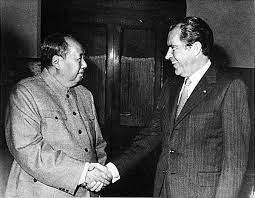
The Shanghai Communiqué was signed on the evening of February 27, 1972 at the Jinjiang Hotel in Shanghai, home to a restaurant my wife and I frequented weekly during my posting to the U.S. Consulate in Shanghai from 1988 to 1990. The Communiqué, as distilled by Wikipedia, “pledged that it was in the interest of all nations for the United States and China to work towards the normalization of their relations, and affirmed a mutual interest in détente.”
Earlier this week, a China-hand friend of long-standing texted me to ask my thoughts about the South China Morning Post’s report on the ceremony conducted a few days ago by the Chinese Government to commemorate this event. Specifically, she asked my thoughts on the comment by PRC Foreign Minister Wang Yi to the effect that China was “willing to work with the US on the Build Back Better World, a G7-led global infrastructure plan, and would welcome Washington joining its Belt and Road Initiative (BRI).” (This comment was contextually painted by Wang into a broader picture of how Nixon was far wiser than the current administration in engaging cooperatively with China and that the US should immediately cease and desist from its current posture seeking “hegemony” in Asia.)
Here’s my reply:
“Wishful thinking on Wang Yi’s part. 77 years of U.S. international development assistance have been based on principles of democracy promotion, free market strengthening, transparency and anti-corruption. BRI projects tend to work best where none of those values flourish and instead where those projects serve the personal interests of autocratic (and near-autocratic) leaders. The Rajapaksa family in Sri Lanka and Lukashenko in Belarus are prime examples (with Ukraine being the oddball exception which proves the general rule). Right-thinking US Govt officials have ZERO interest, I believe, in joining BRI projects or in allowing PRC entities to participate in Build Back Better World initiatives until PRC intl-econ-dev standards rise to the level of US/European/Japanese standards. Until that happens, the focus is on out-competing China in the less autocratic BRI countries and with working particularly closely with Japan and Australia in the Asian arena of development assistance competition.”
“So summing up: Wang Yi’s statement is a non-serious and unrealistic throw-away line but one that sounds warm and fuzzy to say on the occasion of the 50th anniversary of signing the Shanghai Communiqué. It has the added advantage of having no prospect of actually going anywhere.”


 ______Assessing China / The TEA Collaborative______