
You are currently browsing the tag archive for the ‘china’ tag.
Hello TEA Collaborative Subscribers,
It has been some time. I remain deeply appreciative for your interest in the TEA Collaborative over past years. You will have noticed that activity on the TEA Collaborative trailed off to full silence during the pandemic but you were never given an explanation for this trailing-off or told what to expect.
I am writing to address that now. The TEA Collaborative was a “triad x 2” model of Teaching, Engagement and Analysis focused on Technology, Energy and (Political) Ambition in China. Due to the pandemic, my masters-level course at Penn (“The U.S. & China in the 21st Century”) was abruptly and quite disappointingly discontinued in July 2020. With the loss of that teaching role, the raison d’être of the TEA Collaborative also vanished.
However, I am continuing the Engagement and Analysis pieces of the TEA Collaborative with as much passion as ever and with a sharpened focus on competition between the U.S. and China in three specific areas: semiconductor industries, artificial intelligence development and AI infrastructures (energy, workforce, etc). I am doing some of that work through my GC3 Strategy consultancy business, some of through my Senior Fellow role at the Foreign Policy Research Institute (FPRI) and some of it through my new China Now & Then publication on Substack.
I am writing today not just to say goodbye but also hello. I will be discontinuing the TEA Collaborative website on WordPress over the months ahead but I am opening up a new China Now & Then publication series on Substack. I am excited about this new platform and warmly invite you to join me on it here.
You will notice that this is just getting underway and that the China content is not yet disaggregated from the other themes. That will happen though and the China content will brought together in its own publication with a modest subscription fee. I am encouraging you to subscribe now — free of charge — and am offering you as a TEA Collaborative subscriber the chance to receive a free lifetime subscription to China Now & Then before it is offered to the public on a fee-basis.
If you are interested, please do so today by Subscribing here. Please note that, for this offer, you will need to select Subscribe from the prompt (remember it’s free now and will remain so for you) rather than Follow.
Hope to see you there soon.

My March 30th post (Taiwan’s Historic Split Screen) was written as President Tsai Ing-wen arrived in New York in transit on her diplomatic visit to Central America. That piece promised a follow-up on the occasion of her return transit to Los Angeles — and meeting with Speaker of the House Kevin McCarthy — en route back to Taiwan. The Tsai-McCarthy meeting took place 6 days ago on April 5th but I delayed following up until today because my interview with Forbes on this topic was in the works.
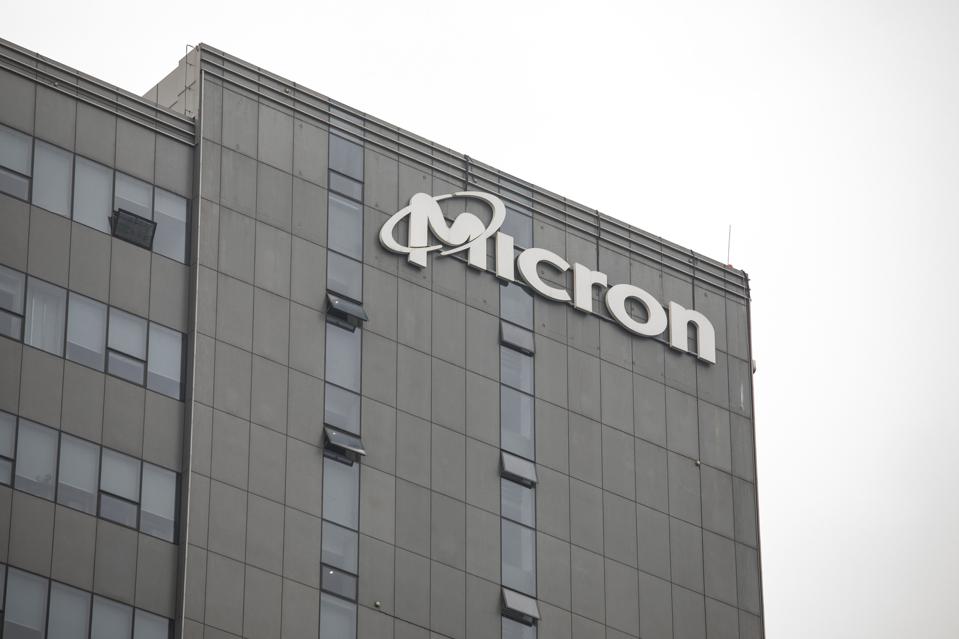
That Forbes interview was published yesterday and can be found here (including 12 minute audio version). I am also reproducing that interview below to capture it in the Assessing China blog. It begins with several scene-setting paragraphs by Forbes Editor at Large Russell Flannery. The interview itself begins below the photograph of Micron headquarters in Shanghai.
(Begin article)
Micron Probe May Hurt China’s Efforts To Attract Foreign Investment
Beijing today wound down its latest large-scale military exercises in the waters around Taiwan but overall tension between the U.S. and China remains high. China’s moves followed a high-profile meeting last week between U.S. House Speaker Kevin McCarthy and Taiwan President Tsai Ing-wen in Los Angeles criticized by mainland leaders who claim sovereignty over self-governing Taiwan.
On the commercial front, the semiconductor industry remains an elevated point of stress. Beijing earlier this month announced a cybersecurity review of U.S. chipmaker Micron aimed, it said, at protecting the country’s information infrastructure and national security. The probe comes at a time when China has been seeking to boost foreign investment to accelerate its economic recovery from “zero-Covid” policies that slowed growth.
What’s next for U.S.-China ties and also for the CHIPS Act, the U.S. law enacted last year aimed at reversing the declining American share of global semiconductor production?
To learn more, I spoke on Saturday in the Philadelphia area with Terry Cooke, a senior fellow at the Foreign Policy Research Institute, a think tank focused on U.S. national security and foreign policy. Cooke, a former career U.S. senior foreign commercial service officer with postings in Shanghai, Taipei, Tokyo and Berlin, currently leads ReGen250, a non-profit that focuses on U.S.-China green energy collaboration as well as environmental regeneration initiatives in the tri-state Greater Philadelphia region.
Cooke believes China’s move against Micron will have “a chilling effect for potential foreign investors — definitely on the U.S. business community” at a time when China is trying to win new foreign investments following the end of “zero-Covid” policies at the end of last year that had harmed economic growth. Beijing high-profile efforts to pressure Taiwan militarily may also be counterproductive if Taipei successful builds itself up as “an important force” in a larger, more influential network of democracies. Edited excerpts follow.
© 2023 BLOOMBERG FINANCE LP
Flannery: What do you make of the military exercises around Taiwan this month?
Cooke: There are two ways of looking it. One is that going into the Tsai-McCarthy meeting, the decision had already been made (in Beijing) that this is the new normal, that whenever there is an uncomfortably high-level contact between the U.S. government and the Taiwanese government, we (the Chinese government) are just going to keep demonstrating our ability to militarily squeeze Taiwan through maneuvers of this sort.
There is, however, another way of thinking about it: the way the McCarthy-Tsai meeting was conducted may, in fact, have been the determinant of the maneuvers. Beijing may have been in a wait-and-see mode. They of course issued their standard and predictable verbal denunciations in advance of Tsai’s transit stops.
I think they were waiting to see how low-key the meeting in L.A. with McCarthy would prove to be. The entry through New York was very low-key. The State Department utterances for most of the trip also kept things low-key. And there was ample precedent for this given Tsai’s previous six transit visits to the U.S. so the State Department position was that there was no reason for Beijing to make an issue out of it.
But the optics of McCarthy meeting – with all the diplomatic trappings of a government-to-government meeting save for flags set up on the table – made it look very much like an official meeting. And I don’t think that went over well in Beijing. That could have triggered the decision to trot out the military.

Flannery: So what’s next?
Cooke: Just as the U.S. is maybe on its back foot with the new realities in the Middle East, I think China may be on its back foot in terms of the game of diplomatic recognition when it comes to Taiwan. Yes, Taiwan just lost Honduras on the eve of Tsai’s U.S. trip. Now, Taiwan is down from 14 to 13 countries that it has diplomatic recognition with.
But I think there’s really a more important game in town now than adding up the number of formal diplomatic allies. This new game in town probably started around February 2021 with the Biden administration moving into the White House. To many people’s and particularly Beijing’s surprise, Biden kept Trump’s tough China policy. He also introduced into his speeches and policies a clear and consistent autocracy-vs-democracy contrast.
Within the context of this U.S.-led “reframing” of the global picture, Taiwan now has the opportunity to reposition itself within the team democracy global network of supporters in a way that it’s not strictly about formal recognition and UN membership. It’s about being recognized, and in some ways, held up as an important force in this network of democracies.
Flannery: How will Taiwan’s presidential elections next year affect these three-way ties?
Cooke: From the U.S. governmental standpoint, the outcome – whether it is a victory for Tsai’s Democratic Progressive Party or the opposition KMT party – will change hardly at all. This is because the U.S. government’s official position – whether it involves the outcome of an election in Taiwan or changes to the cross-strait status quo initiated by China – is that what the 24 million people of Taiwan choose for themselves is what the U.S. government will support. I don’t think our basic diplomatic posture and our support for Taiwan would change unless there was some evidence — which I would not expect at all — of some malfeasance happening with the election.
Flannery: What do you make of China’s probe into Micron?
Cooke: We can dissect it into several elements. One is a desire for reciprocity and being seen on an equal plane. And so with Biden’s CHIPS Act, and the singling out of TikTok and a lot of different Chinese companies in U.S. security investigations, it’s to be expected that there is going to be some reciprocal action that China is going to want to take to be seen as a peer power demanding reciprocity.
That diplomatic posturing is understandable but it does have a chilling effect for potential foreign investors — definitely on the U.S. business community. Close allies in Europe and elsewhere notice it, and it doesn’t help China’s post-pandemic effort to show a welcoming face to foreign investment.
I think there is also a third element of it that is interesting: perhaps as another data-point showing a lack of coordination in Chinese policy and messaging that we see from time to time. And we’re living in a world where nobody is a paragon and the U.S. has its own challenges with coordinating its message. But in China, as we saw recently with ‘wolf-diplomacy’ and the balloon incident, people lower in the governmental hierarchy vie to please their superiors, and end up getting out in front of the intended policy and in front of what would be an optimal coordinated policy for China. And I’m wondering personally whether Micron might be an instance of that.
Flannery: Speaking about both semiconductors and Taiwan, does the U.S. rely on Taiwan too much for chips?
Cooke: It’s actually in almost everyone’s interest at this point to have a greater degree of global diversification. It’s outright dangerous to have close to 90% of production of the world’s most advanced semiconductors taking place only 90 miles away from the Chinese mainland.
Flannery: Does the CHIPS Act go far enough in striking a new balance?
Cooke: Before the CHIPS Act, Taiwan Semiconductor Manufacturing Company (TSMC) was already taking steps (to diversify from Taiwan). There are currently moves afoot in Germany for automotive chip production — not the most advanced chips in the world — but also with Japan for consumer electronics and with Arizona for an advanced generation of chips. (See related post here.) For the foreseeable future, production of ultra-advanced chips will stay in Taiwan. But I think a lot of production capacity for quite advanced chips is being pushed out of Taiwan to these other global nodes.
The CHIPS Act is to my mind pretty fascinating. As a response to China’s Made-In-China-2025 ambitions and its military upgrading, it’s a bulls-eye in my view. But, as a policy undertaking in the U.S. domestic context, it is something of a potential third rail in the sense that, as a country, we’ve never been comfortable or particularly skilled at industrial policy. And it is clearly industrial policy.
Interestingly, I think there is enough bipartisan support right now that the industrial policy-political debate on Capitol Hill is not the traditional debate of “no industrial policy” versus, let’s say, the Clinton era’s “auto industrial policy for Japan.” Nobody at this point seems to be openly challenging the need for an industrial policy response to China’s advanced technology challenge.
So the debate currently is one about “clean” industrial policy versus industrial policy with social agenda items folded into it, like childcare support for workers. (Either way) it is important as a signal to the market about U.S. government resolve.
Flannery: Is it enough? And if it’s not enough, what’s the next step?
Cooke: If, in version one, the sum had been significantly higher than $52 billion, it would have been almost setting itself up for failure, because there are so many things that can go wrong in operationalizing and implementing something like this.
By analogy in the military sphere, we have put in a very robust sanctions regime against Russia following the invasion of Ukraine. But it was kind of uncharted territory. There’s been a lot of analysis about what’s been working and what hasn’t been working. We’re groping our way forward and want to keep some powder dry.
The CHIPS Act is similar in the commercial sphere — kind of uncharted territory. One of the things it has going for is that Commerce Secretary Gina Raimondo is an astute leader of the process. In the current political environment, any sign of dropping the ball would be pounced on. What is actually more important than the amount of money is the fact that it has happened in an initial iteration. There can be subsequent iterations, but it’s important to operationalize the first iteration as well as possible and to learn from that process to inform a potential second iteration.
Flannery: There is controversy about social goals being attached to it.
Cooke: The Act was passed by Congress last year, and it went into a kind of holding period where no one knew what the process was going to be for a company to apply. When the guidelines were only recently announced, it became clear that there was quite a lot of conditionality put on the ability of a company to apply. One set of conditions has to do with an applicant limiting its China business for a 10-year period. Another quite different set has to do with an awarded company providing childcare for its employees.
I think the criticism about these conditions is a fairly predictable output from the Washington DC political meat grinder. Because these are tax-payer dollars, the back-and-forth is highly political. Placing limitations on future China business for awardees makes sense to the average American voter. However, those limitations raise serious concerns for the CEO of a sizable company that doesn’t want to decouple from the China market but does want to access CHIPS Act support. On the separate issue of childcare, this requirement is meant as an incentive to help overcome the problem of a shortage of chip production workers in the U.S but it obviously becomes a red meat talking point for politicians who position themselves as anti-woke in U.S. culture wars skirmishing.
This goes back to what we were talking about before with Micron. China is currently unable to respond in a meaningfully reciprocal way when the U.S. does things like put Chinese billionaires onto an entities list. They just don’t have a global finance tool that is anywhere near as sharp and strong as is found in the U.S. Treasury toolkit. For the U.S., putting companies on an entities list works— it catches the attention of targeted individuals and there is an important and broad public messaging dimension to it as well. Of course, to make sanctions really bite, there’s a lot of operationalization that needs to happen but doesn’t always happen.
What I personally believe is: China’s main effort now is to try to knock the dollar off its post-World War II throne. Others have tried and failed and it will be a hard thing for China to pull off. But I believe that’s this the main thrust of their effort and the primary aim of a long-term, patient strategy.
See related posts:
U.S. Businesses Look To De-Risk, Not Decouple, Their China Ties
U.S.-China Collaboration Could Cut Development Time, Cost For New Cancer Treatments
TSMC Will Triple Arizona Investment To $40 Billion, Among Largest Foreign Outlays
Taiwan’s Biggest Silicon Wafer Maker Eyes U.S. Solar Industry Investment
@rflannerychina
Send me a secure tip.
(End article)
I join Russell in inviting you to leave your thoughts or questions in the Comment section below. (Because of netizen ire in China, I have not always kept the Comments section open in Assessing China but it is open for this post. I would love to hear from you).
It has been a long journey to reach this moment …
- In 1972, Nixon traveled to China
- In 1973, the Philadelphia Orchestra became the first international orchestra to perform in China
- In 1974, I began to study Mandarin at college
- In 1976, Mao died (and the Cultural Revolution with him)
- In 1978, Deng and the CCP began experimenting with economic reforms
- In 1979, Carter normalized relations
- In 1980, I traveled to the mainland for the first time
- 1n 1982, at its 12th National Party Congress, China adopted economic reforms as its priority policy
Just this past week — forty years later at its 20th Party Congress — China under Xi has formally abandoned economic growth as its top priority for national development (along with the international partnerships on which that growth depended for trade, investment, access to capital markets and innovation) and prioritized instead “security” (with all the ideological baggage which that entails in Xi’s worldview).
Put simply, Xi has just crossed the Rubicon …

I wrote on Monday in Ideologues Meet Markets that I would share my considered view on the implications of the just concluded 20th National Party Congress after a few days of rumination and reflection. I am doing so now. Xi has just crossed the Rubicon. His move not only upends a forty-year trajectory of the most dynamic economic growth ever witnessed in the world, it threatens — more ominously — the foundations of the post-WWII international order and the unprecedented seventy-year run of (relative) peace the world has enjoyed at the global level.
An extremely well observed account of what this moment means is contained in the political economist Yuen Yuen Ang’s opinion piece in today’s New York Times. I reproduce below that piece in its entirety:

China’s Era of Reform Has Officially Ended
By Yuen Yuen Ang
Forty-four years ago, Deng Xiaoping kicked off the period of “reform and opening up” that transformed China from a poor, autarkic nation into an emerging global power.
President Xi Jinping officially ended that era last week. He emerged from the Chinese Communist Party’s congress in Beijing with unchallenged authority and plans for China that revolve around his obsession with control and security — even if that means harming the economy.
It’s a momentous change in outlook.
Deng Xiaoping’s strategy for China’s spectacular economic achievements had two main components. The first was a collective leadership arrangement within the Communist Party. Deng rejected Western-style democracy, but China’s tumultuous decades under Mao Zedong had taught him that one-man rule is dangerous. He and the party introduced partial checks and balances into politics at the highest level, including term limits. The second component was a single-minded pursuit of economic growth that, Deng famously declared, would be China’s “hard principle.” Officials throughout China dove headlong into promoting growth at all costs — bringing prosperity but also corruption, inequality and heavy industrial pollution.
Last week in Beijing, Mr. Xi dismantled those foundations. He ensured that he would remain paramount leader of China for a third term — if not for life — and packed the party’s leadership with loyalists while heavily prioritizing national security over the pursuit of economic growth.
In his speech to the party congress at the Great Hall of the People on Oct. 16, he mentioned “security” significantly more often than “economy,” a major break with precedent. He went further, declaring unambiguously, “National security is the bedrock of national rejuvenation, and social stability is a prerequisite for building a strong and prosperous China.”
In Chinese politics, small changes in wording can herald big shifts in ideology and policy. If there were any remaining doubts about Mr. Xi’s intentions, he dispelled them by vowing that China would stick to its zero-Covid policy, “without wavering.” His government’s approach to the pandemic, a public health policy in name, is in reality the most powerful security tool devised by the Communist Party, restricting access to the country and controlling who can go where, underpinned by tracking apps that citizens and visitors must have on their smartphones.
For observers long accustomed to Deng’s growth-first ethos, Mr. Xi’s policy choice is mind-boggling. The Covid controls are angering citizens, crippling China’s economy, decimating domestic consumption, disrupting manufacturing and logistics, and repelling foreign and local investors alike.
Why is the most powerful Chinese leader in decades so obsessed with security and domestic control that he would sacrifice the economy? The answer lies in an array of domestic and foreign challenges, some worsened by Mr. Xi’s own policy choices.
Politically, he probably fears the proverbial knife in the back after making enemies through a decade-long anti-corruption campaign in which thousands of officials — possibly including potential political rivals — were punished and is doubling down on repression out of his instinct for self-preservation.
On the economic front, he faces smoldering crises, including an economy that is slowing sharply, a property sector meltdown and record-breaking youth unemployment. These problems have been exacerbated by the Covid controls and by Mr. Xi’s “common prosperity” campaign — a strategy for narrowing inequality and addressing monopolistic behavior by big tech firms and other private companies, which was punctuated by an abrupt and sweeping regulatory crackdown last year that has alarmed investors. The market backlash was intense: Within months, more than a trillion dollars in value at many of China’s most innovative companies evaporated.
On foreign policy, Mr. Xi has projected an ambition to challenge American primacy. The Trump administration’s chaotic handling of the pandemic prompted Mr. Xi to boast that “the East is rising and the West is declining.” But his triumphalism was premature. China is far from an even match with the United States in economic, military or technological power. And while American democracy is in crisis, the United States remains strong, a true superpower and a free country able to criticize and renew itself. Mr. Xi criticizes the West for seeking to contain China, but his hubris and aggressive approach helped bring about this threat.
To be sure, Mr. Xi does not intend to completely abandon the capitalist success that rejuvenated China and brought global respect and influence. And to his credit, he has confronted serious problems that his predecessors swept under the rug, particularly corruption and economic inequality. His vision of a powerful China, respected on the global stage, is warranted given his country’s size and economic clout.
But addressing China’s myriad problems will require measured steps that Mr. Xi seems disinclined to take. Putting out fires in China’s economy must begin with relaxing Covid restrictions and importing more effective vaccines, something that his government has prevented. These won’t be miracle cures, but they are necessary first steps that will go a long way toward alleviating stress on China’s people and reassuring investors that his leadership team has not lost all sense.
Mr. Xi has plunged China into a vicious cycle: A hubristic and authoritarian leader, unaccountable to society and unchallenged even by his own advisers, makes poor policy choices, which add to his problems, exacerbating his fears of a revolt and leading to more repression.
The consequences of his decision to emphasize security over economic vibrancy will be global. China is the world’s second-largest economy and the biggest trading partner of dozens of countries. A prolonged economic slowdown in China will increase the risk of a global recession, with many countries sharing the pain. In the long run, there may be winners as China’s waning competitiveness hastens a shift in global supply chains to other emerging economies. But if China turns inward, it will lose. Chinese tech companies are already expanding overseas to compensate for a restrictive home environment.
China’s great capitalist revolution under Deng and his successors is now history. So is Mr. Xi’s first 10 years in office, when there was at least a minimal layer of checks on his power from moderate, non-loyalist officials. China under Mao and the former Soviet Union proved that absolute dictatorships fail miserably at making nations prosperous and strong. They bring only impoverishment and false security. Mr. Xi is likely to relearn those lessons in the coming years.
Yuen Yuen Ang (@yuenyuenang) is a political economist and the author of “Chinaʼs Gilded Age” and “How China Escaped the Poverty Trap.”
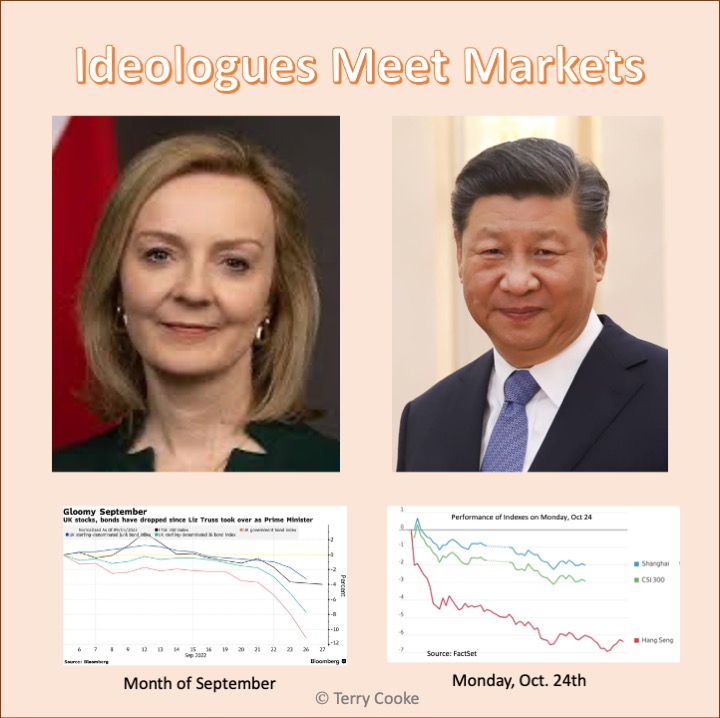
I’ll give my wrap on the conclusion of the 20th Party Congress in Beijing later in the week after some further digestion and rumination.
Meanwhile, here’s a graphic putting today’s market reaction to Xi’s consolidation of power into some context. Entirely different timelines and denouements but same implacable forces at work …

Throughout WWII, the U.S., the Soviet Union and the Kuomintang (KMT) Party of China were formal allies. But in 1949, Mao Zedong’s Chinese Communist Party (CCP) forced the KMT to flee to Taiwan. On October 1st 1949, Mao formally announced the founding of the People’s Republic of China. The strategic triangle shifted as the U.S. lost a putative (and highly authoritarian) KMT ally in China and the Soviet Union gained a Communist comrade-in-arms with the CPP.

The chumminess of this 1958 photo of Mao Zedong and Nikita Khrushchev belies the deep rifts — both ideological and geopolitical — which had been developing in the Sino-Soviet relationship since 1956. Despite efforts to patch over the differences, the divisions continued to grow until Mao announced the split in 1964 followed by a series of formal statements. Monolithic global Communism had ceased to exist.

Fifty years ago today, Air Force One touched down in Beijing bringing President Nixon and the First Lady for their historic meeting with Mao Zedong. The Nixons’ visit to China lasted from February 21-28, 1972. It was then followed by years of rapprochement efforts — including the historic performance by the Philadelphia Orchestra in 1973 — and culminated in the establishment of formal diplomatic relations between the U.S. and China under President Carter in 1979. The Soviet Union was left out in the cold.

Today — February 21, 2022 — Russia announced its formal recognition of two breakaway, largely Russian-speaking enclaves in eastern Ukraine. The post-WWII order of sovereignty, rule of law, and cooperation is being challenged. Two weeks earlier, Xi Jinping chose to support Putin’s Ukraine power-play, overturning decades of official “Five Principles of Peaceful Coexistence” policy. The U.S.-China-Russia ground has shifted yet again.
Looking back on these seventy-five years of U.S.-China-Soviet/Russia relations, I expect that I will always pause to reflect on February 21 as each year passes. February 21, 1972 was deeply promising. February 21, 2022 is deeply foreboding. In a professional sense, today’s date will likely be for me somewhat like what I feel personally as other calendar days each year remind me of my mother’s and father’s deaths (and of their lives). Artificial and arbitrary dates on a calendar which nonetheless carry deep and lasting human meaning and consequence.

On January 13th of this year, President Trump abruptly ordered the termination of the U.S.-China EcoPartnership Program. Seven days before leaving office and without notice, Trump turned the lights off on this 10-year old program, pulling the rug out from under 36 committed and on-going bi-national projects to lower carbon-emissions at global scale.
The Biden Administration is assessing its options for re-vitalizing, in some shape or form, this model of innovative and impactful public-private collaboration to put a dent in global greenhouse gas emissions. This might involve replication of the program to India. ReGen250 is already in the starting gate with a U.S. Mid-Atlantic/State of Maharashtra candidate program should that take shape, as is described on pages 8-9 of our article published last month in the peer-reviewed science journal Environmental Progress and Sustainable Energy.
In the meanwhile, we are pressing forward with unofficial support from the two U.S. Government agencies which ran the EcoPartnership program for ten years — the U.S. Department of State and the U.S. Department of Energy — on a purely private and sub-national basis. Our goal in China looking forward is to explore the possibility of expanding from a regional effort (low-carbon collaboration between the U.S.-Mid-Atlantic and the Jing-Jin-Ji (京津冀) region of Beijing, Tianjin and Hebei Province to national scale.
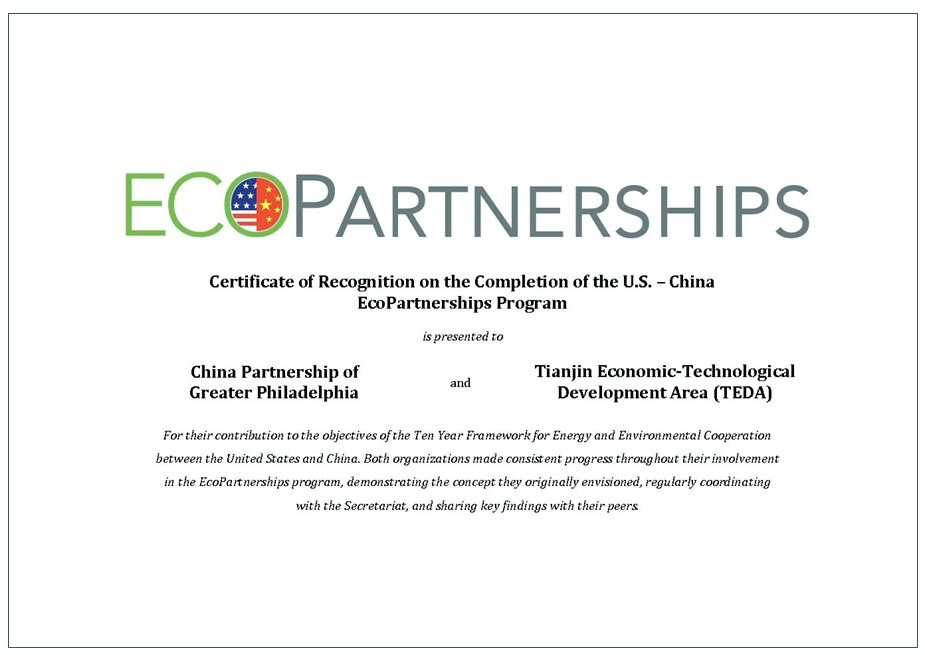
How will we accomplish this without the direct support of the U.S. Government? The first step was to confirm the Biden Administration’s encouragement of trade with China in support of Paris Accord goals and then to renew our region-to-region BE Better program partnership with our primary partner in China, the TEDA EcoCenter. These steps were taken last quarter.
The next steps involve exploring prospects for the resumption of the Sino-U.S. Eco Park national-level opportunity with the Green Development League as outlined at the 2020 U.S.-China EcoPartnership Summit. (As described in detail in a prior post, the Green Development League comprises the 36 top-ranked NETDZs throughout China and the GDL Secretary-General is our original EcoPartnership partner (the TEDA EcoCenter and its Director Madame Yuyan Song).
As the exclusive U.S.-based working group member for the proposed Sino-U.S. Eco Park, China Partnership would leverage expertise and input from (1) our region-to-region BE Better program partners (experts in “energy-efficient, smart and healthy built environments” for industrial park users) as well as (2) our U.S.-China BEST Cities partners (with additional constituencies of support to include the U.S.-China Business Council, the U.S. Industry Advisory Board of the U.S.-China Clean Energy Research Center for Building Energy Efficiency (CERC-BEE), the National Governors Association, and the National League of Cities) in order to identify a comprehensive range of U.S. clean energy technologies and infrastructures from across eastern, central and western regions of the United States to be incorporated into the Sino-U.S. BE Better Eco Park model.

The primary impact of this milestone — CPGP’s formally joining the Green Development League’s working group for design of a Sino-U.S. Eco Park with scalability and replicability to multiple locations throughout China — is literally “to put the U.S. on the map” alongside eight other similar International Eco Parks already functioning in China under PRC Ministry of Commerce auspices. These eight other Eco Park projects represent mostly Sino-European collaborations (e.g., Sino-German Eco Park, Sino-Swiss Zhenjiang Eco Park, Sino-Austrian Eco Park, Sino-Finland Beijing Eco Park) and, to date, none represents a Sino-U.S. collaboration. The CPGP/U.S.-China BEST Cities model was selected, following the March 27, 2018 deadline for application, due to its unique structure of open collaboration designed to introduce U.S. urban clean energy infrastructures and technologies to TEDA and the 35 other top National Economic-technological Development Zones (NETDZ) in the Green Development League.
Using comparables drawn from the realized, real-world experience of the Sino-German Eco Park in Dalian but adjusted to account for the relatively greater GDP of the U.S., a Sino-U.S. BE Better Eco Park leveraging our EcoPartnership’s platform of energy-efficient, smart, healthy built environment and clean manufacturing for industrial park application should reasonably be expected to realize within its initial 5 years:
• As many as 300 signed project agreements (with nearly 60% of those either in production or under construction during that timeframe) representing total investment of 100 billion RMB (approx. USD 15 billion at today’s exchange rate)
• As many as 90 of these projects would be expected to fall in the high-end manufacturing and new energy field with total investment of 67.5 billion RMB (approx. USD 10 billion at today’s exchange rate)
• As many as 80 of these projects would be expected to fall in the advanced services sector with total investment of 35 billion RMB (approx. USD 5 billion at today’s exchange rate)
We are now actively exploring the most practical route for realizing this goal which would involve resumption, post-Trump Administration, of our primary partnership model with (a) TEDA, (b) the 36 GDLs and (c) the 219 NETDZs. Additionally, we have recourse to a secondary partnership model focused on the Jing-Jin-Ji/Xiongan New Area mega-development project.
With respect to the 35-year macroeconomic development effort ushered in by Deng Xiaoping and the Shenzhen and Pudong macro-development projects, Xiongan has both continuities and distinctive differences. One similarity is the size envisioned for the Xiongan New Area -– roughly 50% bigger than Pudong (east of Shanghai) and slightly larger than Shenzhen (to the north of Hong Kong). While Xiongan can be thought of as culminating the coastal progression of these macro-projects–- starting in the south with Shenzhen in the 1980s and moving to the central coast with Pudong in the 1990s -– the final, northern leg of this triad was wobbly at first. President Hu Jintao and Premier Wen Jiabao initially envisioned the third macro-project leg as being Binhai to the northeast of Tianjin. Post-2012, however, plans for Binhai lost most of their momentum and it was only with President Xi Jinping’s emergence in power that priority was shifted from Binhai to Xiongan. It is more in the discontinuities between Xiongan and the earlier Shenzhen and Pudong macro-projects that Xiongan’s significance can best be understood. The first 30 years of the PRC’s post-Cultural Revolution industrial development was based on a high-carbon model. (This is frequently referred to in China by the phrase 先污染后治理 meaning “pollute first, clean up (or remediate) later”). In contrast, the Xiongan industrial model championed by Xi Jinping focuses on a different set of values for the next 30-year-or-so phase of China’s development in the 21st century: the goals of (1) promoting and putting into practice low-carbon industrialization and sustainability innovations and (2) lessening social inequality and narrowing the gap between rich and poor in shared benefits of industrialization and economic development.
Last week, ReGen 250 — the 501c3 non-profit with which the TEA Collaborative is associated — celebrated its 10th Anniversary. To mark the occasion, it’s timely to cast an eye back and quickly survey the road traveled to fix where the TEA Collaborative stands today.
We’ll cover the tech perspective, the energy & environment perspective and the PRC planning ambitions perspective in separate T-series, E-series and A-series posts this week.

My focus on technology issues, especially supply chain issues for advanced ICT (information and communications technology) products involving the U.S.-China-Taiwan triangle, was most intense prior to the founding of ReGen250 in 2011. Some highlights include:
- Three-time Invited Congressional Commission Expert Witness at the U.S.-China Economic and Security Review Commission’s Public Hearings on Global Supply Chains and Cross-Straits Security Issues (109th, 108th, and 107th Sessions of the U.S. Congress)
- Director and Head of Partnership Development, Asia at the World Economic Forum (with strategic focus on ICT, Energy, Transportation, Finance industries)
- Author of The Politics of Greater China’s Integration into the Global Info Tech Supply Chain in The Journal of Contemporary China, Vol. 13, No. 40; and of Taiwan’s FTA Prospects from the Global IT Supply Chain Perspective in Economic Integration, Democratization and National Security in East Asia, edited by Peter C.Y. Chow
- Green Team Leader on Cross-Straits Economics, U.S. Dept. of Defense/Defense Intelligence Agency Strategic Coercion Wargame convened by Science Applications International Corporation (SAIC)
- Invited Non-Governmental Expert Participant, Asian Scenario Seminar Game at the Army War College, Carlisle, PA
- Co-organizer of The Role of Taiwan in the Post-WTO Global Supply Chain Workshop at the 19th Modern Engineering & Technology Seminar
- Official Host (“Ambassador”) for the Taiwan Delegation at World Congress on Information Technology XV in Austin TX
- Featured Speaker & Seminar Consultant – RAND Corporation, MITRE Corporation
- Keynote/Plenary Speaker at large scale media (Forbes, BusinessWeek, Reuters, The Economist Conference Group) and investor (Berkshire-Hathaway-themed 3rd Annual Global Investment Conference, China’s Financial Markets Conference, New York Cleantech Investors Forum, National Association of Business Economists/NABE) conferences
- Moderator at Fabless Semiconductor Association and Wharton China Business Forum annual conference events
- Advisor on Global Business Outreach, The Lauder Institute, University of Pennsylvania
- Invited Think-tank Speaker: CSIS, AEI, Heritage, Brookings, etc
For the TEA Collaborative, this perspective has been brought to bear in a number of recent posts:
- Timing Matters — situates Taiwan’s role in the global supply chain for microchips and other advanced ICT products
- U.S./China Tech De-Coupling: 4 Levels of Risk — assesses the Trump Administration’s fitful tech policy toward China
- Fiddling Around with U.S.-China Tech – brings perspectives from the boardroom, the cultural sidelines and from history in reviewing Trump Administration tech policy toward China
- TikTok Endgame Against the Timeclock – surveys tensions between the U.S. and China as relates to social media companies in general and TikTok in particular
- Taiwan Straddles U.S.-China Microchip Supply Chain Fault-line – takes a sounding of Taiwan’s position as supplier of 40% of the world’s chips and 80% of the world’s most advanced chips
- 21st C. Tech Tug-of-War between China and the U.S. – takes a look at what it will take for the U.S. to compete more effectively against China to retain tech preeminence in the 21st century
This are representative of the most consequential questions and challenges underlying U.S.-China relations at the present moment. They are at the core of the whole-of-government policy review towards China now being coordinated by Kurt Campbell and the National Security Council. Ironically, these issues were dismissed by the American Enterprise Institute when Ambassador Jim Lilley introduced me to AEI for a day-long series of interviews preparatory to a possible appointment back in 2002. AEI’s conclusion at the end of the day as their senior leadership explained their decision not to make an offer? These were all questions which the free market would sort out and there’s no role for AEI or policy makers to play. Ideologically consistent perhaps but hardly prescient.
President Biden’s first in-person appearance on the world stage included a tense but business-like meeting with Vladimir Putin, a NATO meeting in which NATO solidarity was vociferously reaffirmed and a meeting of G7 leaders in which the perceived threats of climate change and China both loomed large.
The final agreement announced at the conclusion of the G7 last Sunday featured two elements with direct bearing on China and, particularly, on China’s Belt & Road Initiative (BRI): a commitment to phase out coal-fired electricity generation and a revived commitment to provide $100 billion in green finance assistance to developing countries. Both commitments were, however, long on symbolism and short on substance.

Today’s post looks at why the headlines for both announcements were printed in such large banner font, why the accompanying stories were so short in column-inch detail and why both stories serve to center on China at a meeting – involving the heads of state of the U.S., Canada, the U.K., Germany, France, Italy and Japan – where China is not represented.
The electricity generation commitment undertaken by the seven leaders was specifically that their governments would provide no new support for thermal coal power generation except in cases where carbon capture and sequestration (CCS) technology is deployed in tandem to neutralize the greenhouse gas (GHG) emissions produced by coal-firing. This undertaking supports a previous G7 commitment to halve emissions by 2030 (against a 2010 baseline) on the way to achieving net-zero emissions by 2050.
The green finance commitment announced announced Sunday – to provide $100 billion annually to help developing countries decarbonize – was not in fact a new commitment but a reaffirmation of an earlier commitment which had lapsed during the Trump years. It was rolled out on Sunday with a new name – the Build Back Better World Initiative – but with no new funding attached.
Seen from a global perspective, both commitments are intended as a direct response to China and its Belt and Road Initiative. China’s trajectory of domestic high-growth has resulted in it recently surpassing the GHG emissions of the entire developed world combined, according to a recent report by the Rhodium Group. Compounding this unfavorable trend, China continues to support its Big Coal industry by encouraging exports of coal-fired power generation equipment to its less developed BRI partner countries. The G7’s electricity generation commitment is therefore intended to draw a sharp contrast in climate change global leadership between the G7 group of democracies and the China’s competing, more authoritarian model. Similarly, the green financing commitment is intended as an alternative pool of financing for developing countries to draw on separate from Chinese government lending and the BRI-focused Asian Infrastructure Investment Bank (AIIB).
So what accounts for the splashy headline but dearth of detail? Two factors. The first is the very evident desire of the other six countries to welcome the U.S., post-Trump, “back into the club” by explicitly amplifying in the international arena President Biden’s domestic Build Back Better theme; and, more importantly, by presenting a show of implicit support for Biden’s “Summit of the Democracies” strategy for countering China. In short, the symbolism was more important than the actual substance for achieving this goal.
Hammering out the details of the power generation agreement and expanding on the scope of the green finance commitment eluded the G7 leaders at this meeting due to a lack of confidence, especially among the three leaders from Continental Europe, that detailed and expanded agreement will stick. There are three levels of doubt contributing to this lack of confidence. In order of ascending importance, there is:
- Uncertainty over how Biden and his National Security Council deputies Kurt Campbell and John Kerry are going to square heightened competition with China in the technology space with attempted renewal of cooperation with China in addressing climate change;
- Doubt over the ability of the Administration to get its proposals through a closely-divided and highly-partisan Congress; and
- Concern that the American public’s fling with climate science denial and Trumpian America First thinking might not be a one-time affair and could come to the fore again in the 2022 mid-term election and the 2024 Presidential election.
Given these doubts, any effort to provide substantive detail for the power generation agreement and to expand the green financing agreement would have been prone to failure and could have undercut the paramount goal of projecting renewed G7 solidarity and democratic unity. Looked at from another angle, this result shows how much effort and hard work will be required to reestablish the global momentum toward 2050 climate goals following Trump’s decision to pull America out from the Paris Accord Conference of Parties (COP) process.
Volume 2, Number 3 in Global TECHtonics: U.S./China Fault-line series

A U.S.-led initiative to reach out to China and to welcome it into the community of Western nations began with President Nixon trip to Beijing in February 1972. Orchestrated by Henry Kissinger, Nixon’s National Security Advisor at the time, the trip was a brilliant Cold War gambit to exploit the growing rift between Moscow and Beijing. The trip kicked off a seven-year process of “normalizing” relations between the West and “the sleeping dragon” of Asia and, in so doing, divided the Soviet bloc. Through almost half-a-century and a bipartisan succession of Presidents, the effort to engage with China continued as that country woke from its Cultural Revolution nightmare and began to rise up, shaking the world as it did so.
February 1972 was the Year of the Rat (Water Element) in the Chinese zodiac. Forty-eight years later we are again in the Year of the Rat under the Metal Element. In Chinese traditional thinking, we have gone from a time of suppleness and fluidity to a time of hardness and intransigence. In the minds of most Western observers, we have passed from a strategic engagement with China to, under President Trump, a time of open competition on the world stage and strategic disengagement (“de-coupling”) in the technology arena.
This post will save for another time the broader discussion about how and why this shift came about other than to make three general, even obvious, points. First, there was undoubtedly a measure of optimistic naïveté in the West in assuming China’s willingness to dutifully assume the role of a ‘responsible stakeholder’ in the post-WWII world order. If the Chinese had conceived of their nation as only having been born in 1949, assuming the mantle of responsible Pax Americana stakeholder might have fit more comfortably. As it was, Chinese conceived the People’s Republic of China as the heir to a Chinese polity which had been the dominant economy in the world for sixteen of the previous eighteen centuries. They weren’t predisposed to simply adopting some newcomer’s rules and norms as to how China should conduct itself on the world stage. Second, there has undoubtedly been tactical overreach and ill-advised swaggering by President Xi Jinping since his triumphalist speech at the 19th Party Congress in September 2017. U.S.-China relations would undoubtedly be on a more stable track today had Xi Jinping played his cards differently, following suit more with Deng Xiaoping’s opening bid of “keeping a low profile (hiding one’s capacity) and biding one’s time” (韜光養晦、有所作為) rather than flashing his Made in China 2025 card so conspicuously. It can be argued that it’s better from the U.S. standpoint for this “world order competition” to be out in the open. Third, the horse is definitely out of the barn. No U.S. Administration is going to try to get that horse back on the 1972-2017 normalization track. The world has changed and what is needed is a U.S. Administration which recognizes real challenges from China but does not exaggerate them and which marshals the resources to address those challenges in an efficient and effective way, rather than wastefully and non-productively.
The remainder of this post uses last week’s The Four Levels of Risk post as a backdrop to a quick sketch outlining just how wasteful and ineffective the Trump Administration’s policy of technology de-coupling from China is becoming. I’ll do this sketch with three brushstrokes – the view from U.S. boardrooms, the view from the cultural sidelines and the view from history.
The View from U.S. Boardrooms
 A CNBC.com article by Arjun Kharpal published on June 4, 2019 made no reference to the Tiananmen anniversary but did point out that the Trump Administration’s Huawei policy was quickly hoisted on its own petard – failing to get allies to broaden the campaign but leading to a marked acceleration of China’s efforts to develop its own semiconductor industry to supplant U.S. semiconductor supply in the Chinese market and, eventually, in world markets. “The Huawei incident has indeed stimulated the development of China’s domestic chip industry,” Gu Wenjun, analyst at China-based semiconductor research firm ICWise, told CNBC by email” wrote Kharpal at the time. Now, one year later, Trump Administration policy is digging this hole deeper and at a faster pace:
- Qualcomm is reported to have lost current orders worth as much as $8 billion as a result of the Trump Administration’s May 2020 tightening of trade restrictions imposed against Huawei. The new regulations block all chipmakers that use U.S.-made equipment or software from producing chips for Huawei (though companies can apply for a license to continue supply)
- Following the Trump Administration’s August 6th signing of an Executive Order banning transactions by U.S. companies with Tencent, the owner of the WeChat app, market research firms scrambled to assess the impact on Apple and its installed base of iPhones in the strategically vital Chinese market. The surveys all pointed to the same result – as many as 90% of iPhone users in China would drop the Apple product and switch to Android devices if the WeChat app were no longer available on their iPhones.
- The same August 6th Executive Order targeted Bytedance, parent company to the massively popular TikTok app. Seasoned observers who are able to gauge the U.S.-side push-back against this action and know the sloppiness with which the Executive Order was drafted, expect an eventual climbdown by the Administration – if not before the November 3rd election, then shortly after it.
The View from the Cultural Sidelines
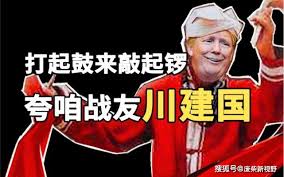 There are two culture wars raging – a partisan one in U.S. domestic politics and an international one between a suddenly tarnished U.S. model and a much-hyped “bright and shiny” new Chinese model. The same dynamics at play with the COVID-19 pandemic are at play in the technology sphere. Domestically, Trump works to energize his base with claims that China is the enemy and that his Administration’s COVID response and China de-coupling response are “the best” that any President could possibly do. Front-line health workers and tech experts know that, in both cases, the claim lies far afield from the truth.
In China, the popular view cuts to the bone of Trump Administration posturing. His new nickname is 建国 (Jiànguó), a popular name given by parents to their infants especially during the nationalistic years of the Cultural Revolution. It means “Build the Country.” In other words, Trump Administration policies are widely seen as accelerating the same nationalistically-driven Sputnik-type race to advanced semiconductors, artificial intelligence, robotics and the tech future which the policies ostensibly are meant to forestall. Trump’s impulsive “Only I Can Fix It” approach playing to a grandstand of partisan supporters has made the challenge which Xi Jinping’s China presents the U.S. more acute. An approach which takes measured and deliberate stock of that challenge and which aligns interests and works closely with the U.S. business community and international partners would be far more effective. Pumping up nationalist sentiment in both the U.S. and China serves only to narrow options and increase risks of conflict spiraling.
The View from History
 A pithy take on Trump’s approach to the U.S.-China technology challenge comes from a widely-respected former colleague who has decades of high-level experience with China from political, national security, economic and think-tank perspectives. He writes “(Trump is like) King Canute trying to fight, instead of the ocean tides, the tides of technology.”
I’ll conclude with another, somewhat longer historical reference which illuminates Trump’s campaign of China-bashing as a central element of his re-election strategy. It is drawn (almost) verbatim from Episode 66 of The History of Rome podcast series by Mike Duncan:
“Conscious that his standing with the people was taking a hit, the Emperor decided he needed to find someone to take the fall for the fire. Someone he could point to and say it was them, not me, I didn’t have anything to do with it. But he couldn’t just grab someone off the street because, with his popularity sinking like a stone, that would just engender the further charge that he was setting up some innocent to take all the blame. What Nero needed was someone, some group that the people disliked even more than him, someone that the people were ready, willing and able to believe had done this horrible thing if for no other reason than that the people were looking for an excuse to round up and punish them. Enter the Christians. In the thirty odd years since the death of Christ, nascent Christian communities had begun cropping up throughout the Empire. At first, they were primarily Jewish in character but through the missionary work of St Paul, known later as the Apostle to the Gentiles, this new religion began to spread into the Greco-Roman world. By the Emperor’s reign, a tiny community of believers, led according to tradition by St. Peter, had established a religious beachhead in Rome itself. The problem the early Christians faced in Rome, though, was not just that their religion, in comparison to the wider pagan world, struck the average Roman as downright weird, but also that at this point most Christian adherents were non-citizen resident aliens in the city who spoke primarily Greek or Hebrew. So the Christians in Rome looked different, spoke a different language, usually came from the lower rungs of the social ladder, and belonged to a strange monotheistic cult that seemed to have cannibalistic overtones. All in all, they were capital O Other in every sense of the word. And as has been proven over and over again by history, whenever terrible things happen to a community – economic problems, floods, plagues, fires – it is the capital O Others who usually get blamed. So desperate to shift responsibility for the great fire away from himself, the Emperor looked at these Others and decided to lay it all on them.”
The only change I have made to this podcast text, recorded in August 2009, was my substitution of the central character’s title instead of his name. Even with that switch, there’s little surprise who that Emperor was.
Nero.

Everything that I have ever done professionally has been approached and viewed through the lens of one of two disciplines. Eventually, I learned to combine the two.
The first was the discipline of cultural anthropology. A twelfth-grade class in 20th c. religious thought led me to major in Asian Comparative Religion at Princeton which led me (after a year of traveling overland from Europe to Taiwan via Turkey, Iran, Afghanistan, Pakistan, India and Nepal) to a joint MA/PhD program at the University of California at Berkeley. Two and a half years living at 10,500’ in the village of Tengyi in the Manang Valley north of Annapurna (pictured below), taught me how to see the world through the eyes of people with different circumstances and values.

The other was the discipline of diplomacy. I joined the U.S. Foreign Service in the spring of 1988, a little more than two years after getting my degree. (I should mention at this point that I made very good use of the intervening time by moving to New York to court Grace, by marrying Grace, and by renovating our first house in Brooklyn.) Having cleared the various assessment hurdles of the Foreign Service test and having been given an offer to join, it wasn’t a hard decision. My clearest career idea upon receiving my doctorate was that I did not want to stay in academics. And my only interview in the corporate world – with SmithKline (now Glaxo) – could have made for an amusing episode of The Office. So I took the offer. Having come in initially through the State Department, I asked for a lateral transfer into the U.S. Department of Commerce branch of the Foreign Service, because my sense was that — for the two places I really wanted to be posted, China and Japan – a lot of the Embassy action was on the business side. I wasn’t wrong. Anyway, the point I want to make here is that the anthropological viewpoint worked well with the diplomatic viewpoint to help me see issues in three dimensions and, with that better field of vision, helped me resolve some the issues at the heart of the U.S.-Japan Auto Talks and other knotty diplomatic challenges. I don’t think I ever told business clients, and rarely told Embassy colleagues, that I was trained as a cultural anthropologist. I definitely never contemplated for a moment putting PhD on my business cards. But I used the anthropological perspective every day during my time in the Foreign Service.

With this as personal introduction, I’ll share here the three roadmaps – ‘pathmaps,’ more accurately – which have been most helpful in guiding me through both the magnificent panoramas and the minefields of modern U.S.-China relations. In coming weeks, I will give each of these works its own dedicated post. Today will simply list the three with brief thumbnail intros and identify the common thread I have found most useful.
1
Wealth and Power: China’s Long March to the Twenty-First Century
By Orville Schell and John Delury
Random House (2013)

Given to me for Christmas in 2013 by James Gibney — former Foreign Service colleague in Tokyo, editor extraordinaire, and godfather to my younger son – Wealth and Power brings to life a simple but profound insight. Through the life stories of eleven completely different individuals — in some cases, mortal enemies – Schell and Delury show how all eleven hew to a single goal, China’s rejuvenation through the acquisition of wealth and power. The early 19th c. scholar Wei Yuan and the activist Feng Guifen proposed completely different courses of action; the Empress Dowager Cixi, the “new citizen” Liang Qichao and the reformer Sun Yaat-sen all saw radically different pathways to modernization, Chiang Kai-shek and Mao Zedong led opposing sides of a decades-long civil war, and Zhu Rongji (whom I met as Mayor of Shanghia on several occasions during my first posting there) and Nobel Prize winner Liu Xiabo had entirely different conceptions of the moral duty of a citizen in modern China. Nonetheless, despite differing in their ideas of the best means to reach the goal, they all shared an absolutely identical understanding of the most urgent goal in their lives – helping China acquire enough wealth and power to regain its traditional standing as a world colossus. (This goal, incidentally, continues to be inculcated in the education of every school child in China today).
2
Belt and Road: A Chinese World Order
By Bruno Maçães
Hurst Publishers (2019)
 This book is included not because it is one of the best books about China. Far from it. John Pomfret’s The Beautiful Country and the Middle Kingdom and countless other books would make that cut in front of Maçães. The reason for Belt and Road’s inclusion here is that Maçães does something few too scholars and commentators on China bother to do. He puts himself into the minds and mindset of the Chinese government planners who are charting China’s future. This is what an anthropologist does and the insight it provides helps minimize misunderstanding and creates more space for successful diplomatic outcomes.
Maçães is himself a former Portuguese diplomat with extensive experience in Hong Kong and China. To give just a sense of his approach, Maçães argues that Western theories of international relations entirely miss the basic conception at the heart of the Belt and Road Initiative (BRI). In Maçães’ view, that conception “follows Taoist logic: the single concept first divides in two — land and sea — then in several — the corridors and coutnries — then in many — the specific projects and privileged locations” in the BRI enterprise.
3
The U.S. and China in the 21st Century: Sub-National Sino-American Relations
Course Number IMPA 608 in the School of Liberal & Professional Studies (FY 2019 & 20)
International Masters of Public Administration, Fox Leadership International
Instructor: Terry Cooke Co-Instructor: Liyiran (Shelly) Xia
 This is the course I taught at Penn for two years before COVID-19 hit and the course was furloughed. I hasten to point out that I am adding it here because of the input from students, rather than because of my syllabus. The course is designed in two parts: the first seven weeks involves readings, lectures and classroom discussion structured on the basis of my syllabus; the second seven weeks, the most valuable part of the course, is a knowledge co-creation exercise based on original research, much of it in Chinese, which the students conduct and present. It is through this knowledge co-creation exercise and through insights provided by the students and Co-Instructor Shelly Xia that I have been able to articulate the framework which informs the Ambitions portion of the TEA Collaborative project (T = Technology, E = Energy/Environment, A = Ambitions). The Ambitions portion seeks to understand and systematically present the MacroDevelopment vision which Chinese government planners have been elaborating and adjusting since the birth of the People’s Republic of China in 1949 (and have been communicating clearly in their Five Year Plans). It is an effort to apply the joint lens of anthropology and diplomacy to better understand the motivation and to better delineate the opportunities and challenges associated with China’s MacroDev trajectory. We use three time periods (and, in the last time, period two different geographies) to organize this undertaking:
1949 – 1978: Version 1.0 of the PRC MacroDev Model
1982 – 2009: Version 2.0 of the PRC MacroDev Model
2012 – Current: Version 3.0 of the PRC MacroDev Model
A) Domestic Release
B) International Release (Belt & Road Initiative
Note: the years not covered above were years of opaque, internal deliberation
within the Chinese Communist Party leadership
The Common Thread

I hope the point is obvious. The common thread here is being able to understand the world as seen through the eyes of your counterpart. As in business, you don’t always know whether your counterpart will prove to be protagonist or antagonist, friend or foe. In order to negotiate the best possible deal, however, it is always vital to understand as well as possible that counterpart’s motivations, core values and thought processes. Whether the climate of U.S.-China relations is chilly or warm, I choose to stand firmly on that ground.


 ______Assessing China / The TEA Collaborative______
