As Bob Marley said, “If you know your history, then you would know where you’re coming from.”

Wednesday’s post — My Proprietary Chipset — included hyperlinks to specific publications and websites from the 2000s. Some of these are more easily accessed than others. For instance, the link to my testimony before the U.S. China Economic and Security Review Commission in the 109th Session of Congress (2005) takes you directly to that testimony. However, the links to my testimony at the 108th (2003) and 107th (2001) sessions takes you to the full text of the Commission’s work covering the full session and it takes some perseverance to find one’s way to my testimony. In the spirit of presenting my work on these issues from the 2000s in one, easily accessed location, I will add here to the blog a few archive posts to fill in behind Wednesday’s My Proprietary Chipset post providing readier access to those harder-to-navigate publications.

2003 Testimony, 108th Session of Congress

SUMMARY:

In the information technology sector, Taiwan semiconductor and electronics manufacturing firms are major global actors, and their
expansion into China continues, but without noticeable erosion of Taiwan equity control. In testimony before the Commission, Merritt Cooke, former senior commercial officer at the American Institute in Taiwan, attributed this to the relative stability of ‘‘highly differentiated, high-value supply chains’’ as opposed to the ‘‘instability of far simpler manufacturer-retailer networks characteristic of commodity products.’’ Cooke believes this distinction helps explain the historical pattern of Taiwan investment into the mainland. While many light industry sectors that Taiwan moved to the mainland in the 1980s and 1990s ‘‘have been swallowed up by mainland competitors,’’ highly differentiated, relatively high-value consumer products such as brand-name athletic shoes and high-performance bicycles have remained largely in Taiwan equity hands. ‘‘If these product sectors, with their relatively lower levels of technology and slower product cycles, could stay in Taiwan control for decades, there is every reason to believe that the various IT [information technology] hardware sectors will stay even more firmly in Taiwan’s grip in years ahead,’’ Cooke said. Despite the large and growing Taiwan business presence in the mainland and burgeoning indirect cross-Strait trade and investment, there is a sense in the Taipei business community that Taiwan itself—as a venue for investment, manufacturing, logistics, or finance—is in danger of becoming marginalized within Asia. Kaohsiung’s container port—once the fourth busiest in the world— now ranks sixth, with the Chinese ports of Shenzhen and Shanghai jumping ahead. The American Chamber of Commerce in Taiwan reports that a number of U.S. corporations’ regional headquarters in Taiwan have been eliminated or downgraded to local offices.

2001 Testimony, 107th Session of Congress

TESTIMONY:

STATEMENT OF MERRITT TODD COOKE, JR., CHIEF, COMMERCIAL SECTION, AMERICAN INSTITUTE IN TAIWAN

Mr. COOKE. Mr. Chairman, thank you. I hope the Commission will feel free to overlook the confusion that my parents introduced
with my legal name and call me by the name that I most often respond to, Terry. [Laughter.]
I will also request that, with the consent of the Commission, some paragraphs that I delete in the interest of brevity do be entered into the record. I will spare the Commission a recap of Taiwan’s ten-year structural transformation in the 1990s.
It is an honor to be asked to testify in front of this distinguished panel of Commissioners. In the following brief statement, I will bring to bear my perspective as current Chief of the Commercial Section at the American Institute in Taiwan to address the issues
identified by the Commission in its July 24 invitation letter, specifically the growing interdependence of the U.S., Taiwan, and Chinese high-tech economies.
The strategic interdependence of the U.S. and Taiwan economies has grown steadily throughout the 1990s as Taiwan’s economy has shifted from its traditional structure as a labor-intensive export-oriented economy towards a more service-oriented investment and technology-intensive economy. While Taiwan’s industrial sector has shrunk in relative terms over this period, capital and technology-intensive industries have expanded dramatically. These industries accounted for approximately 75 percent of total manufacturing in 2000, compared to 48 percent in 1986.
Taiwan now supplies 60 percent of the world’s motherboards and is the world’s leading supplier of notebook computers, monitors,
mice, keyboards, video cards, sound cards, on/off switches, LAN cards, graphic cards, scanners, and laser disk drives. Through the
strength of its foundry model, Taiwan has emerged as a preeminent semiconductor supplier to the world.
This transition from the production of labor-intensive goods to high-tech goods has to date proceeded relatively smoothly, even
against the background turbulence of the Asian financial crisis in 1997–98 and a major earthquake occurring on September 21, 1999.
Against the broad backdrop of its structural transformation, two major dynamics have emerged: First, the growing regional partnership and global interdependence of the U.S. and Taiwan high-tech industries, and secondly, the accelerating shift of the lower end of Taiwan’s high-tech production offshore, particularly to mainland China.
One clear indicator of the degree of evolving interdependence with the U.S. was the fact that following the 9/21 earthquake in
Taiwan, the tech markets in New York dropped more in percentage terms than in Taipei.
The scale of this interdependence is likewise highlighted in other ways. For example, four of the top U.S. suppliers of PCs alone procured $20 billion of components from Taiwan to support their 1999 global sales. Additionally, Taiwan will soon have more state-of-the-art 300-millimeter chip wafer fabs in operation than the U.S., Germany, Japan, or any other world market.
The accelerating shift of high-tech production from Taiwan to mainland China has been equally pronounced over this period. The
Taiwan government’s Office of Budget, Accounting, and Statistics reported in February that government approved Taiwan investments in China for 2000 more than doubled from the 1999 levels.
The Taipei Computer Association reported in the same month that 30 percent of Taiwan’s 411 high-technology companies had established major investments in mainland China and that fully 90 percent of those 411 companies planned to be invested in China by the end of 2001.
Lastly, China edged out Taiwan in 2000 for the first time for the number three slot in world IT production value. China came in behind the U.S. and Japan, with $25.5 billion of production value, against Taiwan in fourth place with $23 billion. The key point to
note, however, is that Taiwanese companies generated fully 70 percent of that $25.5 production value in mainland China.
The impending accessions of China and Taiwan to the WTO will likely further accelerate this process of growing cross-straits commercial interdependence in high-tech, with consequent implications for the already highly interdependent U.S. and Taiwan high-tech economies. Although Taiwan’s relatively late liberalization and privatization of its fixed-line monopoly regime will limit somewhat the impact of this development in the telecom sector, the likely effect will be continued fast accelerating cross-straits interdependence in sectors such as PC and notebook assembly, motherboard and other PC component manufacture, production of chip sets for mobile telephony and other applications, scanner and computer peripheral production, and lower end IC production.
A number of important trends will reinforce WTO financial linkages and commercial disciplines and tend to produce this outcome.
First, the network of business relationships which Taiwan firms have established in China represents largely an extension into
China of preexisting product and service supply chain relationships originally established in Taiwan. This greater Taiwan phenomenon in China, localized in growth centers such as Donguan in Guangdong, Xianen in Fujian, and increasingly in the greater Shanghai area, has now reached a critical mass sufficient for greater efficiency in the global supply chain.
Second, the commoditization of IT production worldwide is increasingly pressuring production costs, forcing manufacturers to
distribute a growing number of lower end steps in their production processes to the world’s lowest-cost production centers. Under more than a decade of the KMT or Guangdong’s ‘‘Go South’’ policy, Taiwan manufacturers have quite fully exploited the advantages of relatively low-cost production centers in the Philippines, Thailand, and elsewhere in Southeast Asia, the one exception to that probably being an expected spurt of Taiwan investment in Vietnam following the ratification and implementation of the U.S.-Vietnam bilateral trade agreement.
At the same time, the KMTs, and now the new administration, the DPP’s ‘‘go slow’’ policy vis-a-vis investment in the mainland has tended to limit the degree to which Taiwan firms could take advantage of the even lower costs of production in China. However, since cost pressure started mounting sharply in March 2000, Taiwan high-tech firms have found themselves no longer able to maintain global competitiveness without relocating a greater share of their production to China, the lowest cost major production center in the Asian production platform.
A third trend really represents a number of technology trends that underlie an emerging division of labor in high-tech production
between Taiwan and the PRC. Without trying to go into any of these, I would just note the increasing specialization of national
economies in the globalized IT industry segments. For instance, fully half of Finland’s GDP is dedicated to wireless telephony.
Secondly, the migration of value away from hardware assembly and towards embedded software technologies in scanners, in peripherals, in Internet appliances, and so on.
And a third technology trend being the steep rise in investment costs and shorter product cycles in the IC semiconductor sector.
A fourth and final trend, the Taiwan and China markets are
largely complementary, creating unique opportunities for commercial cooperation between these political rivals. For instance, Taiwan firms have generally failed to establish global brand and to capture the higher valuations that accrue to brand-name products. However, the large size of the China market, the skill and cultural familiarity of Taiwan business managers, and the high regard which China’s consumers have for Taiwan’s products are now giving Taiwan firms a chance to establish brand names on a large-scale regional basis as opposed to global basis.
Each one of these trends holds important implications for U.S. interests. The establishment of Taiwan regional brands might, for
instance, tend to weaken the existing cooperative bonds between U.S. and Taiwan alliance partners and foster more direct competition in the region. Conversely, the combination of U.S. innovation, Taiwan regional management skill, and the largely untapped potential of the developing China market is already creating a set of
opportunities for enhanced commercial cooperation among traditional U.S. and Taiwan partners.
The rapid proliferation of commercial ties between Taiwan and China is of major importance to U.S. interests. There are the narrower set of commercial implications for the U.S. competitive posture in regional and global markets, to which I have just alluded. Also, as Rupert Hammond Chambers, President of the U.S. ROC Business Council suggested in his June 14 testimony to this Commission, there are equally important implications which fast-growing commercial interdependence between Taiwan and China have for traditional U.S. military and security interests in the Straits of Taiwan.
I commend the Commission for focusing attention on the extent to which commercial dynamics in the computer electronics and telecommunications sectors are affecting these interests. It is my personal observation that these market and technology-driven dynamics are not always fully captured in the dialogue regarding our key
interests in this potential flash point region of the world. Thank you very much.

[The statement follows:]
PREPARED STATEMENT OF MERRITT TODD COOKE, JR.
It is an honor to be asked to testify in front of this distinguished panel of Commissioners. It is also, personally, a distinct pleasure to see again a number of former Departmental and Embassy colleagues as well as others with whom I have had the
past pleasure of working on various overseas and stateside activities. In the following brief statement, I will bring to bear my perspective as current Chief of the Commercial Section at the American Institute in Taiwan to address the issues identified by the Commission in its July 24th invitation letter.
The strategic interdependence of the U.S. and Taiwan economies has grown steadily throughout the 1990s as Taiwan’s economy has shifted from its traditional structure as a labor-intensive, export-oriented economy towards a more services-oriented,
investment- and technology-intensive economy. While Taiwan’s industrial sector has
shrunk in relative terms over this period, capital- and technology-intensive industries have expanded dramatically. These industries accounted for approximately 75 percent of total manufacturing in 2000, compared to 48 percent in 1986. During this
structural transition, labor-intensive industries, such as toys, footwear, umbrellas,
and garments, relocated offshore. Their place was taken by petrochemicals, metal products, machinery, and ‘‘most dramatically during the 1990s’’ by technology-oriented industries, such as electronic, electric, and information products.
By 2000, more than half of the top ten manufacturing firms in Taiwan were electronic and computer manufacturing firms, compared with only two in 1993. More than half of the top ten manufactured products were in the areas of integrated circuits (ICs), personal computers, and computer peripherals, whereas in 1993, only ICs had been among the top ten. Taiwan now supplies 60% of the world’s motherboards and is the world’s leading supplier of notebook computers, monitors, mice, keyboards, video cards, sound cards, on-off switches, LAN cards, graphics cards, scanners, and laser disk drives. Through the strength of its foundry model, Taiwan has emerged as a preeminent semiconductor supplier to the world. This transition from the production of labor-intensive goods to high-tech goods has, to date, proceeded relatively smoothly, even against the background turbulence of the Asian Financial Crisis in 1997–98 and a major earthquake occurring on September 21, 1999.
Against the broad backdrop of this structural transformation, two major dynamics have emerged: (1) the growing regional partnership and global interdependence of the U.S. and Taiwan high-tech industries and (2) the accelerating shift of the lowerend of Taiwan’s high-tech production offshore, particularly to mainland China. One clear indicator of the degree of evolving interdependence with the U.S. was the fact that, following the 9–21(–99) earthquake in Taiwan, the tech markets in New York
dropped more in percentage terms than in Taipei. The scale of this interdependence is likewise highlighted in other ways. For example, four of the top U.S. suppliers of PCs alone procured $20 billion (USD) of components from Taiwan to support their
1999 global sales. Additionally, Taiwan will soon have more state-of-the-art 300mm chip-wafer fabs in operation than the U.S., Germany, Japan or any other world market.
The accelerating shift of high-tech production from Taiwan to mainland China has been equally pronounced over this period. The Taiwan Government’s Office of Budget, Accounting, and Statistics reported in February that government-approved Taiwan investments in China for 2000 more than doubled from the 1999 levels. The Taipei Computer Association reported in the same month that 30 percent of Taiwan’s 411 high technology companies had established major investments in mainland China and that fully 90 percent of those 411 companies planned to be invested in China by the end of 2001. Lastly, China edged out Taiwan in 2000 for the first time for the number three slot in world IT production value. China came in behindthe U.S. and Japan with $25.5 billion of production value against Taiwan in fourth place with $23 billion. The key point to note, however, is that Taiwanese companies generated fully 70% of that $25.5 production value in Mainland China.
The impending accessions of China and Taiwan to the WTO will likely further accelerate this process of growing cross-straits commercial interdependence in hightech, with consequent implications for the already highly interdependent U.S. and Taiwan high-tech economies. Although Taiwan’s relatively late liberalization and privatization of its fixed-line monopoly regime will limit somewhat the impact of this development in the telecoms sector, the likely effect will be continued fast-accelerating cross-straits interdependence in sectors such as PC and notebook assembly, motherboard and other PC component manufacture, production of chipsets for mobile telephony and other applications, scanner and computer peripheral production, and lower-end IC production. A number of important trends will reinforce WTO financial linkages and commercial disciplines and tend to produce this outcome:
—First, the network of business relationships which Taiwan firms have established in China represents largely an extension into China of pre-existing product and service supply-chain relationships originally established in Taiwan. This ‘‘Greater Taiwan’’ phenomenon in China, localized in growth centers such as Dongguan (Guangdong), Xiamen (Fujian) and, increasingly, the Greater
Shanghai area, has now reached a critical mass sufficient for greater efficiency in the global supply chain;
—Second, the commoditization of IT production worldwide is increasingly pressuring production costs, forcing manufacturers to distribute a growing number of lower-end steps in their production processes to the world’s lowest-cost production centers. Under more than a decade of the KMT’s ‘‘Go South’’ policy, Taiwan manufacturers have quite fully exploited the advantages of relatively low-cost production centers in the Philippines, Thailand and elsewhere in Southeast Asia. (The exception to this being an expected spurt of Taiwan investment in Vietnam following the ratification and implementation of the U.S.-Vietnam Bilateral Trade Agreement). At the same time, the KMT’s (and now the DPP’s) ‘‘Go Slow’’ policy vis-a`-vis investment in the mainland tended to limit the degree to which Taiwan firms could take advantage of the even lower costs-of-production in China. However, since cost pressures started mounting sharply in March 2000, Taiwan high-tech firms have found themselves no longer able to maintain
global competitiveness without relocating a greater share of their production to China, the lowest-cost major production center in the Asian production platform;
—Third, a number of technology trends underlie an emerging division of labor in high-tech production between Taiwan and the PRC. Among these, are (a) the increasing specialization of national economies in globalized IT industry-segments (e.g., fully half of Finland’s GDP is now generated from wireless related technologies); (b) the migration of value away from hardware assembly and towards imbedded software (e.g., scanners and other peripherals, Internet Appliances, etc.); and (c) the steep rise in investment cost and shorter product cycles in the IC/semiconductor sector; and
—Fourth, the Taiwan and China markets are largely complementary, creating
unique opportunities for commercial cooperation between these political rivals. For instance, Taiwan firms have generally failed to establish global brands and to capture the higher market valuations that accrue to brand-name products. However, the large size of the China market, the skill and cultural familiarity of Taiwan business managers with that market, and the high regard which Chinese consumers have for Taiwan products, are now giving Taiwan firms the chance to establish brand-names on a large-scale regional basis. Further, Taiwan’s proven skills in development and service-oriented management of global IT technologies, coupled with the breadth and potential of China’s basic research capabilities, create distinct opportunities for partnership in regional innovation.
Each one of these trends holds important implications for U.S. interests. The establishment of Taiwan regional brands might, for instance, tend to weaken the existing cooperative bonds between U.S. and Taiwan alliance partners and foster more direct competition in the region. Conversely, the combination of U.S. innovation, Taiwan regional management skill, and the largely-untapped potential of the developing China market is already creating a set of opportunities for enhanced commercial cooperation among traditional U.S. and Taiwan partners.
The rapid proliferation of commercial ties between Taiwan and China is of major importance to U.S. interests. There are the narrower set of commercial implications for the U.S. competitive posture in regional and global markets, to which I have just
alluded. Also, as Rupert Hammond-Chambers, President of the U.S.-R.O.C. (Taiwan) Business Council, suggested in his June 14 testimony to this Commission, there are equally important implications which fast-growing commercial interdependence between Taiwan and China have for traditional U.S. military and security interests in the Straits of Taiwan. I commend the Commission for focusing attention on the extent to which commercial dynamics in the computer electronics and telecommunications sectors are affecting these interests. It is my personal observation that these market- and technology-driven dynamics are not always fully captured in the dialogue regarding our key interests in this potential flashpoint region of the world.


Since leaving the Foreign Service in 2002, my work with Greater China is most often associated with U.S.-China clean energy cooperation. That makes sense — that was the focus of the non-profit I founded in 2011, the book I published through the Wilson Center in 2012 and the BE Better program for low-carbon industrial park built environments which the China Partnership of Greater Philadelphia (CPGP) team and I developed through 2021.

However, the prior decade of work which I had done previously through the GC3 Strategy consultancy had a very different focus –on Taiwan as the world’s leader in advanced chip manufacturing and on the vulnerability of global supply chains due to Taiwan’s proximity to China. That earlier work became less active and visible as CPGP’s U.S.-China clean energy cooperation work earned support from Mayor Nutter (2012) and was subsequently competitively selected by the U.S. Departments of State and Energy for one of a very limited number of official U.S.-China EcoPartner awards (2014-21) in partnership with the TEDA EcoCenter in Philadelphia’s Sister City, Tianjin. But my Wikipedia profile gives equal prominence to both sets of work and noted “Cooke is known for his work on U.S.-China-Taiwan commercial interactions. As early as 2002, he was drawing attention to the issue of advanced semiconductor manufacturing in Taiwan and the vulnerability of global information and communication technology (ICT) supply chains.”

Cooke Testimony, 108th Congress (see below)

In 2022, my old chip chops have acquired some new relevance in light of China’s no-holds-barred bid for technology supremacy and the passage of the Biden Administration’s CHIPS Act. Here is a dusting off of some of the accomplishments from that earlier set of work:

  • Three-time Invited Congressional Commission Expert Witness at the U.S.-China Economic and Security Review Commission’s Public Hearings on Global Supply Chains and Cross-Straits Security Issues (109th108th, and 107th Sessions of the U.S. Congress)
  • Director and Head of Partnership Development, Asia at the World Economic Forum  (with strategic focus on ICT, Energy, Transportation, Finance industries)
  • Author of The Politics of Greater China’s Integration into the Global Info Tech Supply Chain in The Journal of Contemporary China, Vol. 13, No. 40; and of Taiwan’s FTA Prospects from the Global IT Supply Chain Perspective in Economic Integration, Democratization and National Security in East Asia, edited by Peter C.Y. Chow
  • Green Team Leader on Cross-Straits Economics, U.S. Dept. of Defense/Defense Intelligence Agency Strategic Coercion Wargame convened by Science Applications International Corporation (SAIC)
  • Invited Non-Governmental Expert Participant, Asian Scenario Seminar Game at the Army War College, Carlisle, PA
  • Co-organizer of The Role of Taiwan in the Post-WTO Global Supply Chain Workshop at the 19th Modern Engineering & Technology Seminar
  • Official Host (“Ambassador”) for the Taiwan Delegation at World Congress on Information Technology XV in Austin TX
  • Featured Speaker & Seminar Consultant – RAND Corporation, MITRE Corporation
  • Keynote/Plenary Speaker at large scale media (Forbes, BusinessWeek, Reuters, The Economist Conference Group) and investor (Berkshire-Hathaway-themed 3rd Annual Global Investment Conference, China’s Financial Markets Conference, New York Cleantech Investors Forum, National Association of Business Economists/NABE) conferences
  • Moderator at Fabless Semiconductor Association and Wharton China Business Forum annual conference events
  • Advisor on Global Business Outreach, The Lauder Institute, University of Pennsylvania
  • Invited Think-tank Speaker: CSIS, AEI, Heritage, Brookings, etc

Since the termination of the U.S-China EcoPartnership program in 2021 and, in particular, since China’s unilateral breaking off of all bi-national coooperation for climate change mitigation following Nancy Pelosi’s visit to Taiwan, I have returned exclusively to the issues of Taiwan, microchips and vulnerable ICT supply chains in my commercial work with Greater China. Currently, I am pursuing that primarily through consultancy engagements with private companies and through introductions provided by GLG, CapVision and other expert networks.

I hope that this retrospective review will help readers keep pace with the sharp break I am taking from the past decade-plus of China-centric work supporting U.S.-China clean energy programs at the bi-national level and stepping back to Taiwan-centric advanced technology markets. This change in my personal focus entails a change in posture towards China — from cooperation to reduce green house gas emissions through a bi-national program to stark competition to help the U.S. and its allies maintain leadership in 21st c. technologies vital to national security. (More prosaically, this change also entails a change in business platforms — from the CPGP non-profit to the GC3 Strategy consultancy S-corp.). This change in focus will become increasingly apparent here in the Assessing China/TEA Collaboration blog over the months and years ahead.

A shift in gears but I hope you’ll continue to enjoy the ride.

It has been a long journey to reach this moment …

  • In 1972, Nixon traveled to China
  • In 1973, the Philadelphia Orchestra became the first international orchestra to perform in China
  • In 1974, I began to study Mandarin at college
  • In 1976, Mao died (and the Cultural Revolution with him)
  • In 1978, Deng and the CCP began experimenting with economic reforms
  • In 1979, Carter normalized relations
  • In 1980, I traveled to the mainland for the first time
  • 1n 1982, at its 12th National Party Congress, China adopted economic reforms as its priority policy

Just this past week — forty years later at its 20th Party Congress — China under Xi has formally abandoned economic growth as its top priority for national development (along with the international partnerships on which that growth depended for trade, investment, access to capital markets and innovation) and prioritized instead “security” (with all the ideological baggage which that entails in Xi’s worldview).

Put simply, Xi has just crossed the Rubicon …

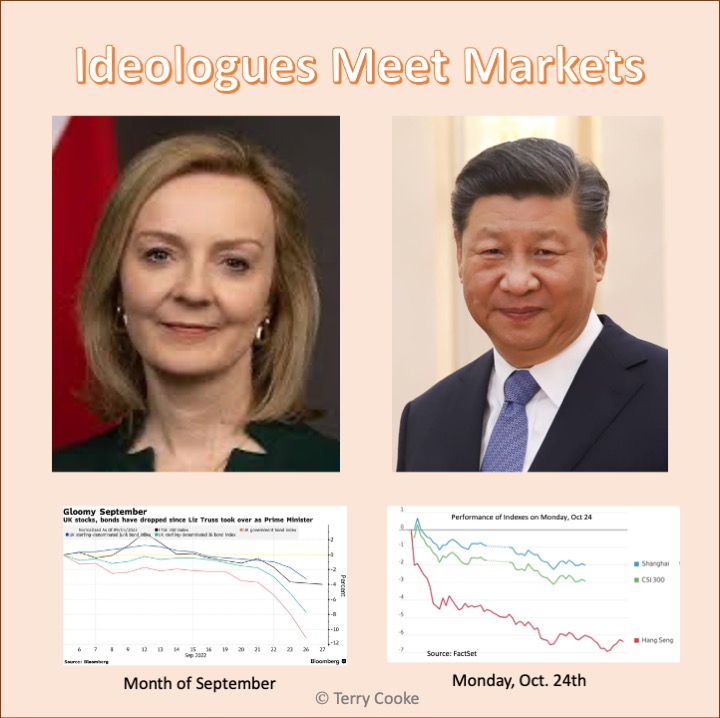
I wrote on Monday in Ideologues Meet Markets that I would share my considered view on the implications of the just concluded 20th National Party Congress after a few days of rumination and reflection. I am doing so now. Xi has just crossed the Rubicon. His move not only upends a forty-year trajectory of the most dynamic economic growth ever witnessed in the world, it threatens — more ominously — the foundations of the post-WWII international order and the unprecedented seventy-year run of (relative) peace the world has enjoyed at the global level.

An extremely well observed account of what this moment means is contained in the political economist Yuen Yuen Ang’s opinion piece in today’s New York Times. I reproduce below that piece in its entirety:

China’s Era of Reform Has Officially Ended

By Yuen Yuen Ang

Forty-four years ago, Deng Xiaoping kicked off the period of “reform and opening up” that transformed China from a poor, autarkic nation into an emerging global power.

President Xi Jinping officially ended that era last week. He emerged from the Chinese Communist Party’s congress in Beijing with unchallenged authority and plans for China that revolve around his obsession with control and security — even if that means harming the economy.

It’s a momentous change in outlook.

Deng Xiaoping’s strategy for China’s spectacular economic achievements had two main components. The first was a collective leadership arrangement within the Communist Party. Deng rejected Western-style democracy, but China’s tumultuous decades under Mao Zedong had taught him that one-man rule is dangerous. He and the party introduced partial checks and balances into politics at the highest level, including term limits. The second component was a single-minded pursuit of economic growth that, Deng famously declared, would be China’s “hard principle.” Officials throughout China dove headlong into promoting growth at all costs — bringing prosperity but also corruption, inequality and heavy industrial pollution.

Last week in Beijing, Mr. Xi dismantled those foundations. He ensured that he would remain paramount leader of China for a third term — if not for life — and packed the party’s leadership with loyalists while heavily prioritizing national security over the pursuit of economic growth.

In his speech to the party congress at the Great Hall of the People on Oct. 16, he mentioned “security” significantly more often than “economy,” a major break with precedent. He went further, declaring unambiguously, “National security is the bedrock of national rejuvenation, and social stability is a prerequisite for building a strong and prosperous China.”

In Chinese politics, small changes in wording can herald big shifts in ideology and policy. If there were any remaining doubts about Mr. Xi’s intentions, he dispelled them by vowing that China would stick to its zero-Covid policy, “without wavering.” His government’s approach to the pandemic, a public health policy in name, is in reality the most powerful security tool devised by the Communist Party, restricting access to the country and controlling who can go where, underpinned by tracking apps that citizens and visitors must have on their smartphones.

For observers long accustomed to Deng’s growth-first ethos, Mr. Xi’s policy choice is mind-boggling. The Covid controls are angering citizens, crippling China’s economy, decimating domestic consumption, disrupting manufacturing and logistics, and repelling foreign and local investors alike.

Why is the most powerful Chinese leader in decades so obsessed with security and domestic control that he would sacrifice the economy? The answer lies in an array of domestic and foreign challenges, some worsened by Mr. Xi’s own policy choices.

Politically, he probably fears the proverbial knife in the back after making enemies through a decade-long anti-corruption campaign in which thousands of officials — possibly including potential political rivals — were punished and is doubling down on repression out of his instinct for self-preservation.

On the economic front, he faces smoldering crises, including an economy that is slowing sharply, a property sector meltdown and record-breaking youth unemployment. These problems have been exacerbated by the Covid controls and by Mr. Xi’s “common prosperity” campaign — a strategy for narrowing inequality and addressing monopolistic behavior by big tech firms and other private companies, which was punctuated by an abrupt and sweeping regulatory crackdown last year that has alarmed investors. The market backlash was intense: Within months, more than a trillion dollars in value at many of China’s most innovative companies evaporated.

On foreign policy, Mr. Xi has projected an ambition to challenge American primacy. The Trump administration’s chaotic handling of the pandemic prompted Mr. Xi to boast that “the East is rising and the West is declining.” But his triumphalism was premature. China is far from an even match with the United States in economic, military or technological power. And while American democracy is in crisis, the United States remains strong, a true superpower and a free country able to criticize and renew itself. Mr. Xi criticizes the West for seeking to contain China, but his hubris and aggressive approach helped bring about this threat.

To be sure, Mr. Xi does not intend to completely abandon the capitalist success that rejuvenated China and brought global respect and influence. And to his credit, he has confronted serious problems that his predecessors swept under the rug, particularly corruption and economic inequality. His vision of a powerful China, respected on the global stage, is warranted given his country’s size and economic clout.

But addressing China’s myriad problems will require measured steps that Mr. Xi seems disinclined to take. Putting out fires in China’s economy must begin with relaxing Covid restrictions and importing more effective vaccines, something that his government has prevented. These won’t be miracle cures, but they are necessary first steps that will go a long way toward alleviating stress on China’s people and reassuring investors that his leadership team has not lost all sense.

Mr. Xi has plunged China into a vicious cycle: A hubristic and authoritarian leader, unaccountable to society and unchallenged even by his own advisers, makes poor policy choices, which add to his problems, exacerbating his fears of a revolt and leading to more repression.

The consequences of his decision to emphasize security over economic vibrancy will be global. China is the world’s second-largest economy and the biggest trading partner of dozens of countries. A prolonged economic slowdown in China will increase the risk of a global recession, with many countries sharing the pain. In the long run, there may be winners as China’s waning competitiveness hastens a shift in global supply chains to other emerging economies. But if China turns inward, it will lose. Chinese tech companies are already expanding overseas to compensate for a restrictive home environment.

China’s great capitalist revolution under Deng and his successors is now history. So is Mr. Xi’s first 10 years in office, when there was at least a minimal layer of checks on his power from moderate, non-loyalist officials. China under Mao and the former Soviet Union proved that absolute dictatorships fail miserably at making nations prosperous and strong. They bring only impoverishment and false security. Mr. Xi is likely to relearn those lessons in the coming years.

Yuen Yuen Ang (@yuenyuenang) is a political economist and the author of “Chinaʼs Gilded Age” and “How China Escaped the Poverty Trap.”

Two items from today’s Wall Street Journal highlight the increasingly belligerent turn in Xi’s foreign policy toward the United States.

China’s Wolf Warrior Diplomacy

The first is an excellent analysis of promotions (and putting out to pasture) during the 20th Party Congress through the lens of China’s Wolf Warrior diplomacy. Some key takeaways:

  • China’s acerbic foreign minister, Wang Yi, has replaced the relatively urbane Yang Jiechi as China Communist Party’s (CCP) top foreign affairs official. (It was Yang Jiechi together with John Kerry who awarded China Partnership of Greater Philadelphia our U.S.-China EcoPartnership award in 2014). Yang is retiring.
  • China’s envoy to the U.S., Qin Gang, who has earned a reputation for brusqueness since his appointment in 2021, is considered a leading contender for the position of foreign minister (to be decided this spring). His elevation to the CCP’s 205-member Central Committee makes him the first incumbent ambassador to be promoted directly to full membership.
  • As Chun Han Wong and Keith Zhai report, “Messrs. Qin and Wang are leading exponents of the muscular diplomacy that Mr. Xi demands, driven by the leader’s vision of an ascendant and uncompromising China that challenges the U.S. for global preeminence. The personnel shuffle suggests … that Beijing remains committed to an adversarial stance toward Washington, undeterred by rising tensions.

China’s Covid Coercion

The second, today’s main editorial, summarizes the confinements and coercive measures that U.S. diplomats were forced to endure in China despite the State Department’s stated policy that it would not allow authoritarian governments to use Covid as an excuse to mistreat or monitor diplomats. I rarely find myself in agreement with WSJ editorials but, in this instance, investigation is warranted because the Chinese government demonstrably leveraged its Covid measures to increase its control and technological surveillance over its population as a whole. It’s important to better understand how this intrusive and abusive treatment may also have been targeted to U.S. and other diplomats who are supposed, by internationally recognized law, to have special protections.

After a run of nine years and ten months, the Assessing China blog was blacklisted last weekend in China.

How did it last that long given that my view of the Chinese Communist Party (not the Chinese people) is highly critical? By exercising some diplomatic judiciousness in my posts and by hitching my star to a Presidential-level, bi-national program of U.S.-China clean energy cooperation aimed at mitigating the global effects of climate change at scale and speed. It was in the U.S. interest to cooperate with China on climate change mitigation as long as China was willing to cooperate.

What led to Sunday’s change? Three things …

1. China officially ended all high-level bilateral programs of cooperation with the U.S. — not only on climate change but also, among others, on defense coordination to forestall risks of military miscalculation — in the wake of Nancy Pelosi’s mid-August visit to Taiwan.

2. Last month’s CHIPS Act and last week’s National Security Strategy released by the Biden Administration have raised the salience of work, publications and Congressional Commission testimony I previously did in the 2000s, advocating strengthened trade ties with Taiwan and pointing out vulnerabilities in global semiconductor supply chains

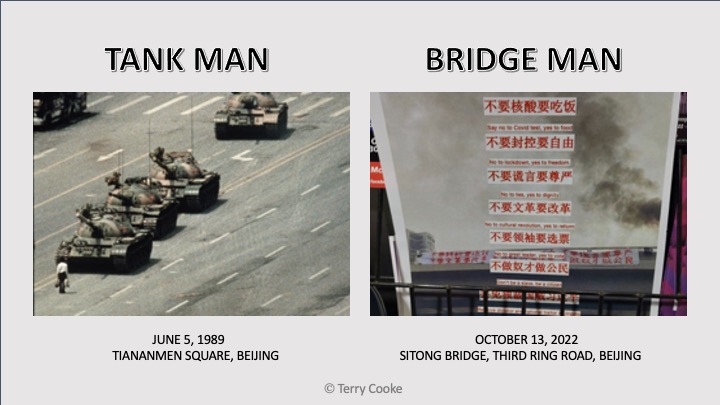
3. In light of 1 and 2, I intentionally courted blacklisting over the weekend by including a link to BBC’s coverage of The Bridge Man protest against Xi Jinping’s and the CCP’s rule in Saturday’s post (which contains the link to the BBC report). The censors didn’t miss a beat in catching this. But, given my shift in focus to Taiwan and microchips, it’s better for me that the blog is now blocked in China and can’t become the focus of netizen ire. I’m just sorry for the subscribers in the mainland who find themselves suddenly cut off.

My wife and I were stationed with the U.S. Consulate in Shanghai at the time of The Tank Man’s protest. That act of defiance as well as this month’s ‘cri du coeur’ by The Bridge Man are extraordinarily courageous acts by individuals against a system dedicated to silencing any voices other than those who choose to be fully obedient or, more frequently, are cowed into full obedience.

I’ll give my wrap on the conclusion of the 20th Party Congress in Beijing later in the week after some further digestion and rumination.

Meanwhile, here’s a graphic putting today’s market reaction to Xi’s consolidation of power into some context. Entirely different timelines and denouements but same implacable forces at work …

As we await Sunday’s introduction of the official lineup for the 25-person Politburo, the 7-person Standing Committee, and the putative Premier and the President for the next five years, what has already become clear is that the Chinese Communist Party (CCP) has gone all in on Xi Jinping. While the field might possibly look somewhat different at the next Party Congress, the broad contours for the global picture for the coming five years are becoming clear. The bold brushstrokes were drawn by Xi during his nearly two-hour speech delivered last Sunday. Since then, there have been ample signs of what’s to come. The team being assembled around Xi will be made up of apprentices filling in with finer brush strokes for Xi, not near-peers willing to argue for painting a different landscape.

“Dystopia with Chinese Characteristics” (my title). Original print artwork by Yang Yongliang

So what are the big takeaways from the Congress so far for the global community to consider?

  • The great rejuvenation of the Chinese nation” is the goal for the CCP and Xi alike. There’s no daylight between Xi Jinping and the Party on this point. China wants back at the center of the world.
  • Zero-COVID policy can only change marginally. It bears the weight of Xi’s claim that “Chinese-style democracy” is superior to traditional Western-style democracy. Look, fewer people died, right?
  • Whatever the economic headwinds, the ship of state will stay “secure” and on-course as long as Xi is at the helm. (Translation: state security and ideology to be prioritized over Deng’s economic reforms)
  • Taiwan’s incorporation into China — which, post-Hong Kong, is now only feasible by outright coercion or military force — is the sine qua non of the full achievement of China’s great rejuvenation

And what are some key things that we’ll be watching in this this space in the weeks and months ahead to gauge Xi’s and the CCP’s success in making progress toward this vision:

  • Fall-out from Russia’s invasion of Ukraine (neither of which were mentioned once in Xi’s speech)
  • Performance of China’s economy in light of Covid lockdowns, real estate sector implosion, regulatory crackdown on tech firms, and the drag of Belt & Road Initiative debt burdens
  • Push-back from the U.S. and Europe, from non-aligned nations and the developing world, and from China’s own citizens as Xi pushes dictatorship with Chinese characteristics as his “new choice for humanity.”
  • And, most crucially from my individual perspective, the “tech-tonic” shocks upending global economies as competition over microchip innovation, production and supply continues to ramp up

The Fat Lady won’t be singing in Beijing until Sunday but we know who’s in the lead after three innings. In the deciding game of this once-every-five year series, the Emperor For Life team currently holds a three-to-nothing lead over the Court of Rivals team.

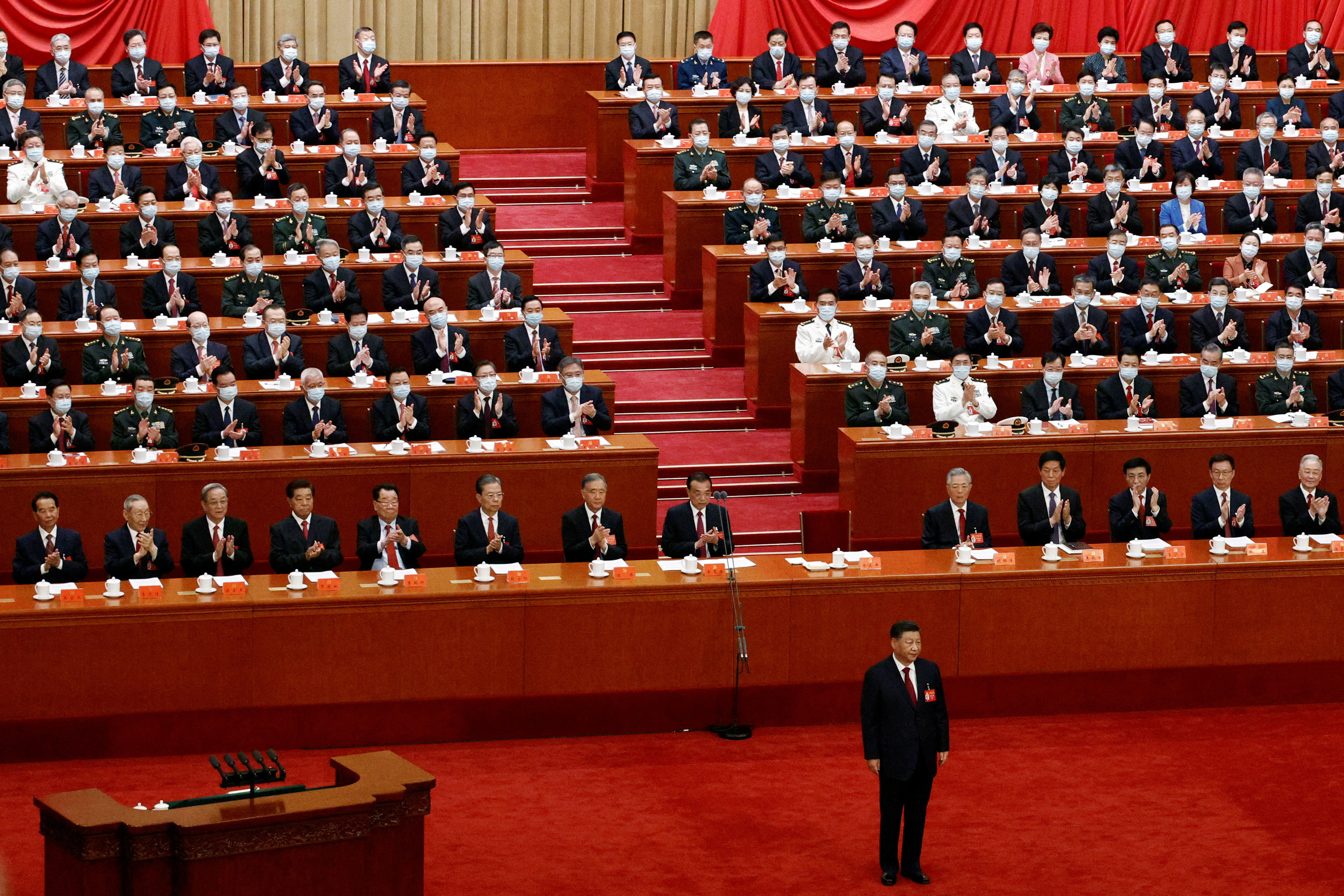
Chinese President Xi Jinping attends the opening ceremony of the 20th National Congress of the Communist Party of China, at the Great Hall of the People in Beijing, China October 16, 2022. REUTERS/Thomas Peter

Who scored? As reported by Josh Chin in today’s Wall Street Journal (see below), Ding Xuexiang, Xi’s Chief of Staff, and Li Qiang, party boss in Shanghai, are both being widely mooted in Beijing as favorites to land Standing Committee appointments. Both are “Xi’s men.” Given the nature of the National Congress process, a candidate whose name is being touted loudly at this stage of the process is almost guaranteed to be formally anointed come Sunday. Additionally, the fact that Li Qiang’s name is being advanced as the likely Premier to replace Li Keqiang means another run based on the scoring system set up in my Chutes and Ladders post last Friday. So, after three innings, score three for the Emperor For LIfe team.

The third name being picked in today’s reporting by Josh Chin is Li Xi, the top party official in Guangdong Province. This player is harder to score in the sense that Guangdong is the province most committed to international trade and investment and Xi has been actively narrowing that space. For instance, during his nearly two hour speech during the opening of the Congress on Sunday, Xi mentioned “security” (read, “surveillance”, “lack of consumer data protection” and “insecurity for private investors”) more than sixty time while giving lip-service to market forces only three ties. Of course, Xi may be bringing Li Xi on board precisely to keep Guangdong on a tight leash but there’s at least some possibility that Li Xi could represent a balancing perspective representing power blocs more committed to maintenance of international trade linkages, if not economic liberalization. We’ll score Li Xi as a Court of Rivals batter who was stranded on second without scoring. After three innings, no runs in for Court of Rivals team.

Final comment: The score may only be 3-0, but the game is shaping up as a total rout by Team Emperor For Life.

Stay tuned for further updates as we get to the later innings. For now, take a look at Josh Chin’s fine reporting below from today’s Wall Street Journal.

China’s Xi Jinping Likely to Pack Party Leadership With Allies in Show of Strength

Shanghai party chief is a front-runner for premier, people close to party leaders say, despite outrage over Covid-19 lockdown

Chinese leader Xi Jinping is preparing to name loyalists to top positions in the Communist Party hierarchy, according to people close to party leaders, in a move that would strengthen his hand as he confronts mounting challenges at home and abroad—from a sluggish domestic economy to Western resistance to Beijing’s ambitions on the world stage.

One of the allies Mr. Xi aims to promote is Li Qiang, currently the top party official in Shanghai, the people said. Earlier this year, Mr. Li shouldered blame for a weekslong Covid-19 lockdown during which tens of millions of residents in the country’s financial center struggled to access food and medical care.

Mr. Li is likely to be elevated to the Politburo Standing Committee, the party’s top decision-making body, according to the people, who say the 63-year-old is also considered a leading contender to be named premier at China’s annual legislative gathering next spring.

China’s premier has traditionally assumed responsibility for the country’s economy, which has been battered in recent months by Mr. Xi’s zero-tolerance approach to Covid-19, a dramatic downturn in the property market and a regulatory crackdown that has created uncertainty for business.

China’s National Bureau of Statistics postponed the release of third-quarter gross-domestic-product data on Monday, a day before it was set to be published. An official at the statistics bureau cited unspecified work arrangements as the reason for the delay.

Others likely to join the Standing Committee include Mr. Xi’s chief of staff, Ding Xuexiang, and the top party official in Guangdong province, Li Xi, who once worked as a secretary to a veteran of the Communist revolution with close ties to Mr. Xi’s family.

The people close to party leaders cautioned that final deliberations on the makeup of the Standing Committee won’t be revealed until Sunday when the party elite is due to complete the membership of its top decision-making bodies for the next term.

China’s State Council Information Office didn’t respond to requests for comment.

The makeup of the next Standing Committee and the identity of the next premier have been the subject of intense speculation among Chinese politics watchers ahead of this week’s twice-a-decade party congress in Beijing, where Mr. Xi is poised to break with recent precedent and claim a third term as party leader.

While Mr. Xi seems assured of securing another five years in power, growing public frustration over his management of Covid-19 and the economy has provided ammunition to potential rivals trying to check his power by ensuring his allies don’t monopolize senior appointments.

If Mr. Xi gets his way, despite the pushback, he would surround himself with like-minded officials and upend succession norms that the party had honed over recent decades to prevent a return to Mao-style dictatorship. This might make it easier for Mr. Xi to pursue his priorities, but it also raises the stakes should that agenda fail, political analysts said.

“The risk of things going wrong and him getting the blame is much greater,” said Ryan Manuel, managing director of Bilby, a Hong Kong-based artificial intelligence firm that analyzes Chinese government documents.

With more allies holding key positions, Mr. Xi, who turns 70 next year, may start to delegate some of his authority to his trusted lieutenants as he gets more advanced in age, some of the people said. He has fewer political opponents to worry about, having neutralized many of them with anticorruption purges and cut off retired party elders from meddling in politics, they said.

A promotion for Li Qiang would mark a surprising political comeback. He appeared to be given extra leeway in handling a local Covid-19 outbreak in Shanghai in February, but infections spread out of control. A wave of online anger over the ensuing lockdown spilled over into physical clashes with officials, prompting several analysts to predict Mr. Li had lost his chance at making the Standing Committee.

China’s current premier, Li Keqiang, is due to step down next spring after completing two five-year terms—the maximum allowed under China’s constitution. He has occasionally contradicted Mr. Xi and pressured the Chinese leader to dial back policies seen as hurting growth. Political analysts nevertheless consider him one of China’s least influential premiers, whose sway over the economy dissipated as Mr. Xi centralized decision-making in his own hands.

Li Qiang, Li Xi and Li Keqiang aren’t related.

Analysts say other candidates to succeed Li Keqiang include Wang Yang, the head of China’s top government advisory body, the Chinese People’s Political Consultative Conference, and Hu Chunhua, currently the youngest among the country’s four vice premiers. In recent decades, Chinese premiers had prior experience as vice premier, a criterion that both Messrs. Wang and Hu satisfy.

Some foreign officials and academics have regarded Messrs. Wang and Hu as standard bearers for liberal-minded overhauls that favor market principles. Both are seen as being outside Mr. Xi’s orbit, having been brought along by other political patrons, though both have publicly backed the Chinese leader’s policies. The people close to party leaders said Mr. Hu may fall short of making the Standing Committee.

Among likely new members of the Standing Committee, Li Xi, Guangdong’s party chief since 2017, could step up as the next chief of the party’s top anticorruption watchdog, the Central Commission for Discipline Inspection, the people said.

Mr. Ding, the 60-year-old aide to Mr. Xi, is positioned to be named executive vice premier early next year, according to the people.

Top party theorist Wang Huning and anticorruption czar Zhao Leji are likely to join Mr. Xi as the only members of the current Standing Committee to get another term, though both are likely to be given new responsibilities, the people said.

He Lifeng, the top official at China’s state economic-planning agency and a friend of Mr. Xi since the 1980s, is likely to assume control over economic and financial policy, The Wall Street Journal previously reported. In this role, Mr. He would succeed Vice Premier Liu He, who has been Mr. Xi’s top economic adviser and his point man in trade talks with Washington.

The people close to party leaders and political analysts say Mr. Xi isn’t expected to elevate any potential successors to the Standing Committee, as doing so would undermine his own authority as paramount leader.

Both Li Qiang and Li Xi are too close to Mr. Xi in age to be considered viable successors. While Mr. Ding is younger, he has never served as a regional party boss—an experience long considered an unwritten prerequisite for candidates seeking China’s top political office.

Many in the business community see Li Qiang as a relatively liberal party leader who prefers discussing commercial deals to politics. In the early 2000s, he served as the top commerce official in the coastal province of Zhejiang, home to what would become major private companies including Alibaba Group Holding Ltd. He was later promoted to party secretary of Wenzhou, a city in Zhejiang that became a thriving entrepreneurial hub after China opened up its economy in the late 1970s.

After Mr. Xi became party leader in 2012, Mr. Li took top jobs in the relatively affluent regions of Zhejiang and Jiangsu, before he was elevated to Shanghai party boss in 2017.

If Mr. Xi can make Li Qiang premier, he would be able to consolidate control over the formulation of economic and social policy, said Chen Gang, a senior research fellow at the National University of Singapore’s East Asian Institute. “China’s reform and opening will continue, but the pace will slow down. Zero-Covid policy will continue, and Li may rely on stimulus policies to boost the economy,” he predicted.

Write to Josh Chin at Josh.Chin@wsj.com

Please accept my apology for the mysteriously truncated version of yesterday’s post you received and please click here to access to the corrected and full version of that post. Thanks to several of you for pointing this issue out to me promptly and thanks to all of you for your patience with this goof.

Kevin Rudd, global president of the Asia Society and former Prime Minister of Australia, knows China well. He wrote in yesterday’s Wall Street Journal that:”The 20th Congress, which gets under way Oct. 16th will be different (from other Congresses since the opening of the 1982 reform era). There’s only one appointment that matters now: Xi Jinping, China’s Chairman of Everything. The delegates will reappoint Mr. Xi to a third five-year term as general secretary by a vote of 2,296 to 0.”

I don’t disagree with the main point that Kevin Rudd is making here but there is also a more nuanced view that is important to bring to bear. Wednesday’s post set the table for this more nuanced view. That perspective involves understanding the seven appointments which will be announced on Sunday to the Standing Committee under Xi. The crux of the issue is whether those seven appointments represents a line-up of Xi loyalists — in which case Rudd’s take is spot on — or whether there are appointments enfranchising power-bases at odds with Xi’s direction and indicating that the Party wants some checks on Xi’s untrammeled authority.

Here’s my cheat-sheet to reading next week’s Standing Committee appointments in light of this question:

Chutes & Ladders: 20th CPP National Congress Edition

So what to watch for?

(Scenario 1) Signs that the CCP is totally bought into Xi being Chairman of Everything

Premier Li Keqiang (aged 67 and therefore normatively eligible for another term) is gone

— No one in their early 50s joins the Standing Committee (showing Xi doesn’t want heir apparent)

Chen Min’er, a Xi loyalist and champion of Xi’s war on poverty, is appointed

Ding Xuexiang, a Xi loyalist and Xi policy enforcer, is appointed

(Scenario 2) Signs that the CCP wants some checks on Xi’s untrammeled exercise of power

He Lifeng, an internationally-friendly protégé of retiring economic czar Liu He, is appointed

Hu Chunhua, who like Xi had a stellar early career but hasn’t been close with him since, is appointed

Li Hongzhong, party boss of Tianjin and not “a dyed-in-the-wool” Xi man, is appointed

Li Xi, party boss of independently minded Guangdong province, is appointed

Finally, keep an eye on Chen Quanguo, party boss of Xinjiang in charge of Uyghur “reeducation,” and Liu Jieyi, head of the Taiwan Affairs Office and the political dimension of the Taiwan reunification project. Whether their stars shine brightly or dim will also give an indication of the degree of CCP support for Xi’s hardline policies on these two fronts.

So that’s the scorecard I recommend you follow. We’ll circle back next week and tally up the score after the Standing Committee line-up has been brought out, in rank order, onto the main stage of the 20th National Party Congress.

Enter your email address to subscribe to this blog and receive notifications of new posts by email.

Join 43.2K other subscribers

Unknown's avatar
For more information about
Assessing China /The TEA Collaborative blog, please visit us at www.teacollab.org